

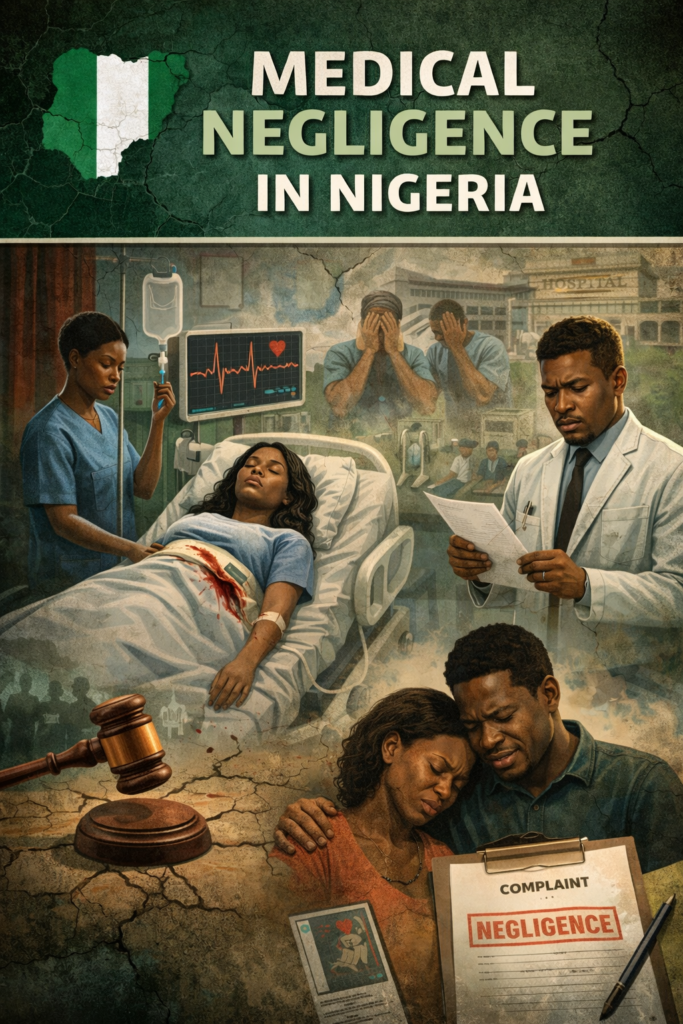
Medical Negligence in nigeria Medical Negligence in Nigeria
Adaeze had always been a careful woman. At forty-three, she worked as a secondary school teacher in Enugu and made sure to visit the hospital at the slightest sign of illness. So when she began experiencing persistent headaches and blurred vision, she promptly visited St. Raphael Hospital, where Dr. Emeka Okonkwo examined her briefly and assured her she was suffering from ‘stress and high blood pressure.’ He prescribed pain relievers and sent her home. Adaeze trusted him he was a doctor, after all.
Three months later, Adaeze collapsed in her classroom. A second opinion at the University of Nigeria Teaching Hospital revealed what Dr. Okonkwo had missed: a brain tumour that had now grown significantly. Her family her husband Chukwuemeka and their children were devastated. The tumour was operable at first presentation; now, the odds had changed dramatically. Adaeze’s sister, Ngozi, a paralegal in Lagos, asked a question that set everything in motion: ‘Can we sue?’
The answer was yes. And Nigerian law had more tools than the family imagined.
A wrong diagnosis is not merely a medical error it is a potential death sentence handed down in a consulting room. When a doctor fails to correctly identify a patient’s condition, the consequences can range from unnecessary suffering to irreversible harm or death. In Nigeria, this problem is compounded by systemic issues: inadequate diagnostic equipment, overworked physicians, and a culture that has historically discouraged patients from questioning medical authority.
Yet the law is not silent. Nigerian patients have a growing arsenal of legal frameworks that allow them to seek accountability when a wrong diagnosis causes harm. From the National Health Act 2014 to the Federal Competition and Consumer Protection Act (FCCPA) 2018, and supported by a body of case law that has progressively clarified the standard of care, Nigerian courts have demonstrated both the willingness and the capacity to hold negligent medical professionals liable. This article examines those legal tools and explains how they can be deployed in the fight against wrong diagnosis.
The Legal Frameworks for Medical Negligence in Nigeria
1. The Patient’s Bill of Rights (PBoR) 2018 and the FCCPA
The Patient’s Bill of Rights (PBoR), launched by the Federal Competition and Consumer Protection Commission (FCCPC), is the primary document redefining the relationship between Nigerian patients and healthcare providers. Crucially, it reframes that relationship as a consumer transaction one governed by the Federal Competition and Consumer Protection Act (FCCPA) 2018. This framing is powerful because it gives patients rights they already possess as consumers, now explicitly applied to healthcare.
For a case of wrong diagnosis, three clauses are particularly relevant.
Clause 1 (Right to Information): requires that patients receive full disclosure about their diagnosis, treatment, and prognosis. Where a hospital conceals a diagnostic error or provides deliberately vague information that leads a patient down the wrong treatment path, this clause is breached.
Clause 3 (Right to Quality Care): holds that patients are entitled to care meeting professional standards meaning a diagnosis arrived at without basic necessary tests (such as an MRI, biopsy, or blood panel that any competent physician would have ordered) constitutes a breach.
Clause 12 (Right to Complain): further provides an explicit procedural right to investigate grievances and receive formal responses, making internal hospital accountability legally enforceable.
The FCCPA 2018 gives these rights their teeth. Section 130 implies that medical services must be rendered with ‘reasonable care and skill,’ while Section 131 entitles a patient-consumer to demand that the hospital correct any defective service — or offer compensation. In Adaeze’s case, the failure to conduct basic neurological tests before diagnosing ‘stress’ would directly engage both provisions.
2. The National Health Act 2014 and Medical and Dental Practitioners Act
The National Health Act 2014 serves as the constitutional backbone of the Nigerian health sector. Section 23 imposes a duty on health providers to inform patients of their health status and the range of diagnostic services available to them —a provision that directly addresses the kind of diagnostic omission that wrong diagnoses often involve.
If a patient is never told that more comprehensive testing exists, they cannot make an informed decision about their own care. Sections 26 to 29 deal with the confidentiality and proper keeping of medical records, which are indispensable in any wrong diagnosis litigation. These records can be subpoenaed to establish what tests were or were not run, what findings were documented, and what information was communicated to the patient.
Equally important is the Medical and Dental Practitioners Act and the Code of Medical Ethics in Nigeria (2008) issued under it. Rule 28 of the Code addresses professional negligence directly, defining it as a failure to exercise reasonable skill and care. Crucially, it includes within this definition the failure to refer a patient to a specialist when a diagnosis is beyond the attending doctor’s competence. In cases like Adaeze’s where a general practitioner attempts to diagnose what is in fact a neurological condition without referral — Rule 28 is arguably violated. A plaintiff can present expert testimony establishing that the applicable standard of care required referral, thereby converting an ethical breach into legal liability.
What the Courts Say about Medical Negligence in Nigeria
Understanding the legal framework is only half the battle. A plaintiff must also know the evidentiary and legal standards required to succeed in court. Nigerian jurisprudence has provided clear guidance through a line of decided cases.
The foundational test for what a plaintiff must prove was authoritatively stated by the Court of Appeal in Unilorin Teaching Hospital v. Abegunde (2015) 3 NWLR (Pt. 1447) 421. The court held that the three ingredients of negligence which a plaintiff must establish are: (a) that the defendant owed him a duty of care; (b) that there was a breach of that duty; and (c) that the breach caused the plaintiff injury or damage. In a wrong diagnosis claim, the duty of care is easily established by the doctor-patient relationship.
The breach lies in the failure to meet the standard of a reasonably competent medical professional. The causation element, arguably the most contested requires showing that but for the wrong diagnosis, the patient would not have suffered the harm that followed. In Adaeze’s scenario, medical evidence that the tumour was treatable at first presentation but had progressed by the time of correct diagnosis would go directly to causation.
However, not every diagnostic error will found a successful claim. The Supreme Court’s decision in Kim v. State (1992) 4 NWLR (Pt. 233) 17 establishes a critical threshold: the degree of negligence required, both in the medical and legal professions, to render a practitioner liable is that it should be gross and not mere negligence. This distinction is significant. A doctor who makes a genuinely difficult diagnostic call, one where competent colleagues might reasonably disagree, may escape liability.
But a doctor who ignores obvious symptoms, fails to order tests that any reasonable physician would consider standard, or misreads clear diagnostic results will likely cross the threshold into gross negligence. In Adaeze’s case, dismissing persistent headaches and blurred vision as ‘stress’ without neurological investigation would, with proper expert evidence, arguably constitute gross negligence.
Medical Negligence in Nigeria
On the question of who bears the burden of proof, the Court of Appeal in Abi v. C.B.N. (2012) 3 NWLR (Pt. 1286) 1 confirmed that in a medical negligence claim, the onus is on the plaintiff to establish the negligence. This means Adaeze’s family cannot simply assert that Dr. Okonkwo was wrong — they must prove it. This is typically done through expert medical testimony, documentary evidence from medical records, and evidence of the standard of care applicable at the time of treatment. The lesson for any prospective plaintiff is practical: secure your medical records immediately, seek an independent medical expert opinion, and document everything.
Conclusion
Adaeze’s story is not unique. Across Nigeria, patients like her are harmed every day by diagnostic failures that are dismissed as unavoidable mistakes in an imperfect health system. The law says otherwise. The Patient’s Bill of Rights, the FCCPA, the National Health Act, and the Code of Medical Ethics collectively construct a framework of accountability that Nigerian patients can and should use. The courts, through decisions like Unilorin Teaching Hospital v. Abegunde, Kim v. State, and Abi v. C.B.N., have provided a clear roadmap: establish the duty, prove the breach, demonstrate the harm, and meet the evidentiary burden.
Suing a hospital or doctor is not an act of ingratitude toward the health profession — it is an act of accountability in service of a better system. When negligent practitioners face legal and financial consequences for their failures, the entire system is incentivised to improve. Medical professionals are compelled to order necessary tests, to refer patients when cases exceed their expertise, and to communicate honestly about diagnoses and limitations. Every successful negligence claim does not just compensate one patient; it protects the next one.
For Adaeze, Chukwuemeka, and Ngozi — and for every Nigerian patient who has been handed a wrong diagnosis and told to simply accept it — the message of the law is clear: you have rights, you have recourse, and the courts are open.
Contributors

Lead Partner, EKO SOLICITORS AND ADVOCATES

Counsel, EKO SOLICITORS AND ADVOCATES

Counsel, EKO SOLICITORS AND ADVOCATES
Medical Negligence in Nigeria Medical Negligence in Nigeria Medical Negligence in Nigeria Medical Negligence in Nigeria