

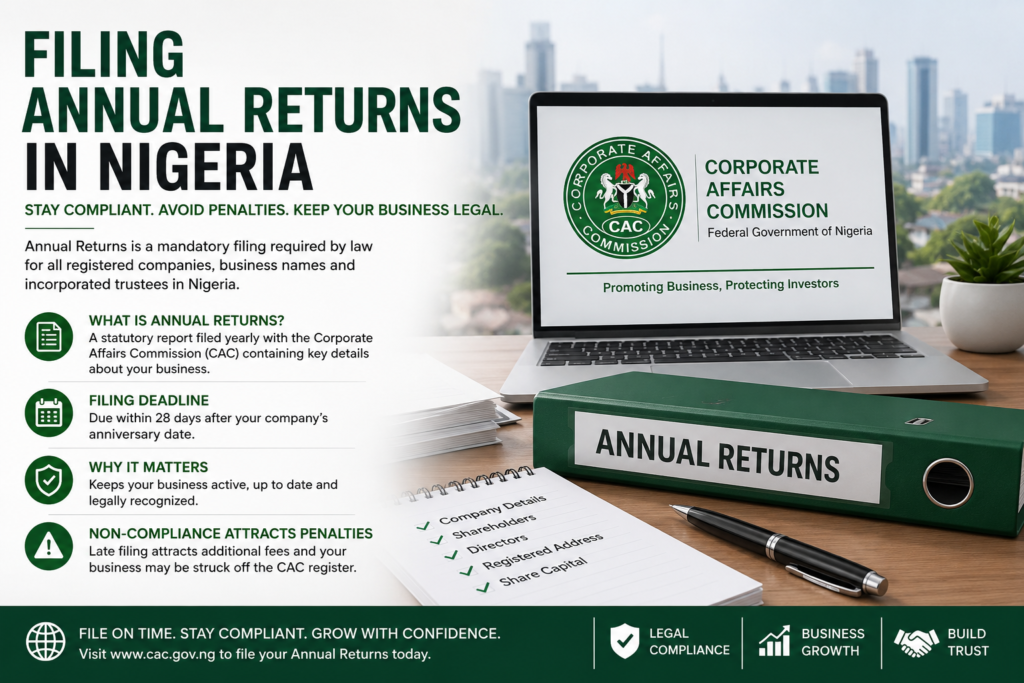
INTRODUCTION to filing annual returns
A business owner registered a company with the Corporate Affairs Commission (CAC) five years ago. Since registration, the business has grown steadily, secured several clients, and built a reputable brand. One day, an investor expresses interest in investing in the company. Excited about the opportunity, the owner begins the due diligence process only to discover that the company has not filed annual returns since incorporation. Before the investment can proceed, the company must first settle accumulated penalties and regularise its compliance status with the CAC. In another instance, a business owner wishes to update the company’s records or apply for a government contract but discovers that the CAC will not process the application until outstanding annual returns have been filed.
These situations are more common than many people realise. One of the biggest misconceptions among business owners in Nigeria is that once a company, business name, or non-profit organisation is registered, there are no further obligations to fulfill. However, registration is only the beginning of a continuing compliance journey. One of the most important post-registration obligations is the filing of annual returns.
Every year, thousands of registered entities incur penalties because they fail to comply with this statutory requirement. Annual returns are not mere administrative formalities; they are legal obligations that demonstrate that a registered entity remains active, compliant, and recognised by law.
This article explains what annual returns are, who must file them, when they should be filed, and why compliance is essential for every registered entity in Nigeria.
WHAT EXACTLY ARE ANNUAL RETURNS?
Annual returns are statutory filings made to the Corporate Affairs Commission to provide updated information about a registered entity. In simple terms, they serve as a yearly confirmation that a company, business name, or organisation still exists and continues to operate or pursue its registered objectives.
Many people mistakenly believe that annual returns are taxes or financial statements. They are not. Rather, they are compliance documents filed with the CAC to keep the Commission informed about the current status of a registered entity. The filing helps the CAC maintain an accurate and reliable register of businesses and organisations operating in Nigeria.
WHY DOES THE LAW REQUIRE ANNUAL RETURNS?
The requirement to file annual returns is contained in the Companies and Allied Matters Act (CAMA) 2020.
The purpose of annual returns is to ensure that the records maintained by the CAC remain current and accurate. Through these filings, the Commission is able to determine whether a registered entity is still active and whether its information remains up to date. The law applies to companies, business names, incorporated trustees, limited liability partnerships, and limited partnerships, irrespective of whether they are actively conducting business or generating profits.
I REGISTERED MY BUSINESS YEARS AGO; DO I STILL NEED TO FILE ANNUAL RETURNS? filing annual returns
Yes.
Registration alone does not exempt a business from future compliance obligations. Once an entity is registered with the CAC, it is generally required to file annual returns throughout its existence. This obligation applies regardless of whether the business is making profits, has employees, or is actively trading.
DOES THE REQUIREMENT APPLY ONLY TO COMPANIES?
No.
The obligation to file annual returns extends to almost every entity registered with the CAC. Private companies, public companies, and companies limited by guarantee are required to file annual returns. Similarly, owners of registered business names, including sole proprietorship and partnership, must also comply with this requirement. Organisations registered as incorporated trustees, such as churches, mosques, charities, foundations, NGOs, community associations, and professional bodies, are equally required to file annual returns.
Limited Liability Partnerships and Limited Partnerships are also subject to the same obligation.
WHEN SHOULD ANNUAL RETURNS BE FILED?
For companies, the first annual return is generally due within eighteen months after incorporation. Thereafter, annual returns must be filed once every year. Other registered entities are also required to file annual returns in accordance with the timelines prescribed by the Corporate Affairs Commission. To avoid penalties, business owners should ensure they monitor their filing deadlines and comply promptly.
WHAT INFORMATION DO CAC REQUIRE IN AN ANNUAL RETURN? filing annual returns
The information required varies depending on the type of entity involved. However, annual returns generally contain details relating to the registered office address, business activities, directors, shareholders, trustees, ownership structure, and any significant changes that may have occurred during the year. It is important that the information supplied is accurate and current because false information may attract legal consequences.
WHAT HAPPENS IF I FAIL TO FILE ANNUAL RETURNS?
Failure to file annual returns can have serious consequences.
First, the defaulting entity may become liable to penalties that accumulate over time. The longer the delay, the greater the financial burden. Second, the CAC may refuse to process certain post-incorporation applications until outstanding annual returns have been regularised. Third, investors, lenders, and business partners conducting due diligence may view non-compliance as a sign of poor corporate governance. Most importantly, persistent failure to file annual returns may expose a company to the risk of being struck off the register by the Corporate Affairs Commission.
In addition, businesses may lose valuable opportunities, including government contracts, grants, and investment opportunities that require evidence of regulatory compliance.
MY BUSINESS IS DORMANT; DO I STILL NEED TO FILE?
Yes.
One of the most common misconceptions is that dormant businesses are exempt from annual return obligations. In reality, a company or business name does not cease to exist simply because it is inactive. Unless otherwise exempted by law, annual returns must still be filed even where business operations have slowed down or ceased entirely.
IF I PAY TAXES, IS THAT NOT ENOUGH? Filing annual returns
No.
Tax compliance and CAC compliance are separate legal obligations. A business may be fully compliant with its tax obligations and yet be in default of its obligations to the Corporate Affairs Commission if annual returns have not been filed. Business owners should therefore ensure compliance with both requirements.
CONCLUSION filing annual returns
The filing of annual returns is not merely a requirement; it is a legal obligation that helps maintain the credibility, legal status, and operational flexibility of every registered entity. Whether you operate a company, a business name, an NGO, a church, a foundation, an LLP, or any other registered organisation, filing annual returns should form part of your annual compliance routine. A simple annual filing today can save your business from penalties, lost opportunities, and regulatory complications tomorrow.
Note: To file annual returns and ensure compliance with CAC requirements, it is advisable to engage the services of a legal practitioner or other authorized professional familiar with corporate compliance procedures.
CONTRIBUTORS

Ojienoh Segun Justice, ESQ
LEAD PARTNER, EKO SOLICTORS AND ADVOCATES

Counsel EKO SOLICITORS AND ADVOCATES

FAITH OGUNLEYE
GRADUATE TRAINEE, EKO SOLICITORS AND ADVOCATES