

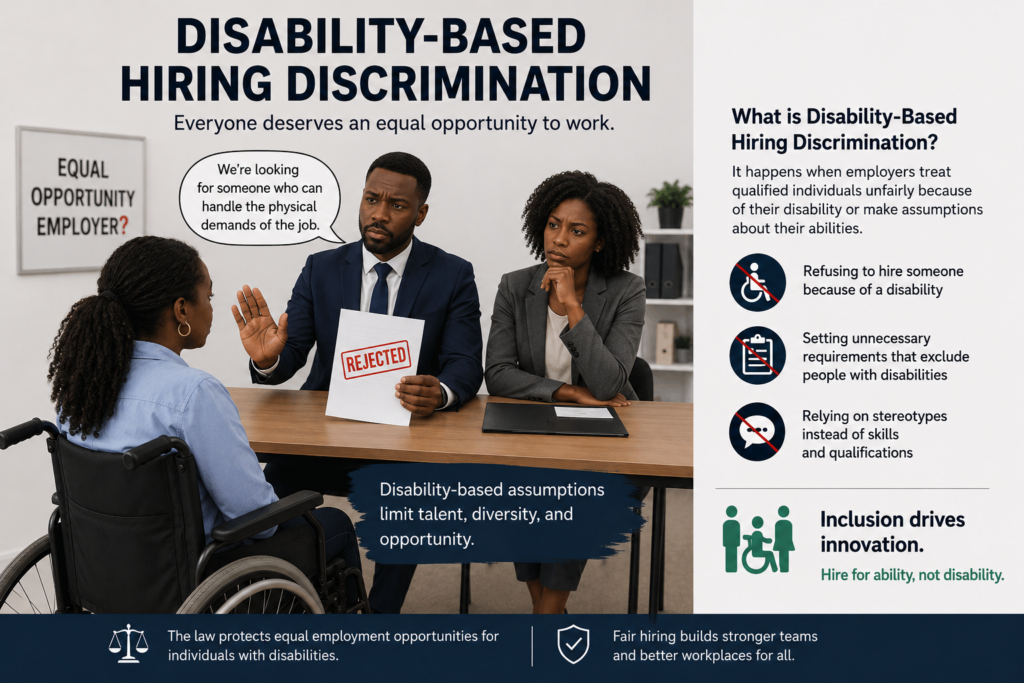
Introduction to disability-based hiring discrimination
Imagine preparing rigorously for a job interview, submitting an outstanding application, and performing excellently during the selection process, only to be turned away not because of your qualifications or competence, but because of a physical disability. This scenario, unfortunately, remains a lived reality for a significant number of Nigerians with disabilities. According to a widely cited 2011 World Health Organisation estimate, around 15 percent of Nigeria’s population, or at least 25 million people, live with some form of disability[1] and more recent academic estimates put the figure closer to 29 million[2]. The question then arises: is such a refusal lawful? The short answer is no. Nigerian law expressly prohibits discrimination against persons with disabilities in the workplace, and any employer who refuses to hire a qualified candidate solely on the basis of a physical disability does so in clear violation of the law.
This article examines the legal framework that protects persons with disabilities (PWDs) from discriminatory hiring practices in Nigeria. It covers the primary statutory authority, what the law treats as a discriminatory refusal to hire, the constitutional foundation, employment quotas and incentives, regional legislation with particular attention to Lagos State, a recent judicial decision illustrating how the courts apply these protections in practice, and the procedural avenues available to anyone who has suffered such discrimination.
The Primary Legal Authority: The 2018 Disability Act
The Discrimination Against Persons with Disabilities (Prohibition) Act, 2018 (“the 2018 Act” or “the Act”) is the cornerstone of disability rights in Nigeria. Signed into law on 23 January 2019 after nearly a decade of advocacy[3], it is the first comprehensive federal statute dedicated to the rights of persons with disabilities, and it provides the clearest and most direct legal protection against discriminatory hiring.
The Act defines a person with a disability as someone with a long term physical, mental, intellectual or sensory impairment that, in interaction with various barriers, may hinder full and effective participation in society on an equal basis with others[4]. This definition, drawn substantially from the United Nations Convention on the Rights of Persons with Disabilities (CRPD), to which Nigeria is a state party[5], is broad enough to capture most forms of physical disability relevant to employment.
Section 28(1) of the Act, found in Part VI (“Opportunity for Employment and Participation in Politics and Public Life”), explicitly states that a person with a disability has the right to work on an equal basis with others. This includes the right to gain a living by work freely chosen or accepted in a labour market and work environment that is open, inclusive, and accessible. This provision is unambiguous: a disability cannot, in law, be a basis for denying a person access to employment as the case may be.
Section 1(1) reinforces this by providing a general prohibition on discrimination. It states that a person with a disability shall not be discriminated against on the ground of his disability by any person or institution in any manner or circumstance. The breadth of this provision is notable: it covers every person and every institution, including private employers.
The Act in fact provides for two distinct layers of penalty for discrimination, a level of detail often missed in general commentary. Under Section 1(2), general discrimination against a person on the ground of disability attracts a fine of ₦1,000,000 for a corporate body, or a fine of ₦100,000, a term of six months’ imprisonment, or both, for an individual[6]. Separately, and more specifically, Section 28(2) and (3) impose dedicated penalties for discrimination in employment: a person or company found to have breached the equal right to work is liable to nominal damages of not less than ₦250,000 (where an individual commits the offence) or ₦500,000 (where a company commits the offence), payable to the person discriminated against, with principal officers of an offending company separately liable to pay ₦50,000 in damages to the victim[7]. Crucially, the Act preserves the right of the victim to pursue a civil action for damages independent of any criminal prosecution. This means a victim can seek financial compensation in court even where no criminal charge has been filed.
What the Law Treats as a Discriminatory Refusal to Hire
A discriminatory refusal to hire is not limited to an employer who states outright that a candidate’s disability is the reason for rejection; few employers are that explicit. In practice, the prohibition extends to less direct forms of conduct that nonetheless deny a qualified candidate equal access to employment. These include job advertisements that exclude applicants with disabilities without genuine justification, interview processes conducted in physically inaccessible venues, withdrawal of a job offer after a medical examination reveals a disability unrelated to the actual requirements of the role, and reliance on generalised assumptions about a candidate’s capacity rather than an individualised assessment of their ability to perform the job.
Nigerian courts have also begun to articulate how the burden of proof operates in these disputes. Once a claimant establishes that they have a disability within the meaning of the law, the evidential burden shifts to the employer to show that its decision was based on a legitimate, non-discriminatory reason[8]. An employer who cannot point to objective evidence, such as a medical assessment specific to the role in question, a documented attempt at accommodation, or a fair hearing process, will struggle to rebut a claim of discrimination.
It is worth noting that the 2018 Act does not use the term “reasonable accommodation” in the way that some foreign disability statutes do. However, Nigeria’s obligations under Article 27 of the CRPD, which guarantees the right of persons with disabilities to work on an equal basis with others in an open, inclusive, and accessible labour market, and under Article 5 of the CRPD, which obliges states to prohibit all forms of disability based discrimination, inform how the 2018 Act and the Constitution are applied by the National Industrial Court[9]. In practice, an employer’s failure to consider reasonable adjustments before rejecting or dismissing a candidate or employee with a disability is treated as evidence of discriminatory intent rather than as a neutral business decision.
The Constitutional Foundation Disability-Based Hiring Discrimination
Beyond the 2018 Act, the Constitution of the Federal Republic of Nigeria 1999 (as amended) provides an overarching framework of protection. Section 42(1) guarantees the right to freedom from discrimination. Although “disability” is not explicitly listed alongside community, ethnic group, place of origin, sex, religion, or political opinion in that provision, human rights scholars and advocacy organisations argue that disability constitutes an analogous and protected ground, since discrimination on that basis causes systemic disadvantage, undermines human dignity, and adversely affects the equal enjoyment of rights in a manner comparable to the grounds expressly listed[10]. This reasoning draws further support from Nigeria’s obligations under the African Charter on Human and Peoples’ Rights (Ratification and Enforcement) Act, which the Fundamental Rights (Enforcement Procedure) Rules 2009 expressly recognise as a source of enforceable rights alongside Chapter IV of the Constitution[11].
Additionally, Section 17(3)(a) of the Constitution places a directive on the State to ensure that all citizens, without discrimination, have the opportunity for securing adequate means of livelihood and suitable employment. While these Directive Principles of State Policy are not directly justiciable, they provide important interpretive guidance to courts when assessing disability related employment disputes.
A further constitutional provision deserves particular emphasis. Section 254C(1)(g), introduced by the Constitution (Third Alteration) Act 2010, expressly vests the National Industrial Court with exclusive jurisdiction over “any dispute arising from discrimination… at workplace”[12]. This means that, unlike many other categories of constitutional rights disputes, which must generally proceed by way of the Fundamental Rights Enforcement Procedure, workplace disability discrimination claims have a dedicated, specialist constitutional forum, discussed further below.
Employment Quotas and Employer Incentives
Nigerian law does not merely prohibit discriminatory hiring; it also creates positive obligations on certain employers to actively include persons with disabilities in their workforce. Section 29 of the 2018 Act mandates that all public institutions reserve at least five percent of their employment opportunities for persons with disabilities[13]. This quota obligation means that, for public sector employers at least, failure to maintain inclusive hiring practices is not merely an ethical failing but a statutory violation.
In Lagos State, the obligation extends further into the private sector. The Lagos State Special People’s Law 2011 requires employers with up to one hundred employees to reserve a minimum of one percent of their workforce for qualified persons with disabilities, in addition to obligations to provide reserved parking spaces and accessible seating in employer provided vehicles[14].
Private sector employers nationally are also given some reason to embrace inclusive hiring through tax policy, though the picture here is more modest than is sometimes suggested. The Nigeria Tax Act 2025, which took effect on 1 January 2026 as part of a broader overhaul of Nigeria’s tax framework, introduces an additional deduction of fifty percent on certain employment related costs incurred by companies, including costs associated with wage increases and net new employment, subject to defined conditions[15]. This, however, is a general employment incentive rather than a disability specific one. As of this writing, there is no provision in the Nigeria Tax Act 2025 or its predecessor Finance Acts that grants a targeted tax credit or relief specifically tied to the employment of persons with disabilities. This remains a notable gap in Nigeria’s fiscal architecture for disability inclusion, and researchers in this field have specifically called for the introduction of such tax related benefits to strengthen employer incentives[16].
Regional Legislation: The Lagos State Context Disability-Based Hiring Discrimination
For persons living and working in Lagos State, there is an additional and highly active layer of legal protection. The Lagos State Special People’s Law 2011 (LSSPL), which established the Lagos State Office for Disability Affairs and was signed into law in June 2011[17], mirrors and in some respects extends the protections available at the federal level.
Section 21(1) of the LSSPL prohibits discrimination against a person living with a disability in any form, a broad provision that has been applied by the courts to hiring decisions, promotions, and fringe benefits[18]. Section 34 separately guarantees the right to work and employment for persons with disabilities, while Section 44(7) goes further still, providing that no employee shall be relieved of their employment on the ground of a disability sustained during the course of their employment, a protection that the National Industrial Court has interpreted to require either retention, retraining, or a substantial severance package where dismissal cannot be avoided[19].
A caveat is worth noting here. Some commentators have questioned whether the Lagos State House of Assembly possessed the legislative competence to enact provisions touching on labour, employment, and conditions of service, given that “labour, including trade unions [and] industrial relations” falls within Item 34 of the Exclusive Legislative List in the Second Schedule to the 1999 Constitution, an area reserved for the National Assembly alone[20]. This constitutional question has not yet been squarely tested before the courts, and the National Industrial Court has to date applied the LSSPL’s employment provisions without difficulty. It nonetheless remains a live issue that may eventually require appellate clarification, and it is a reason why claimants in Lagos are well advised to plead the federal 2018 Act and the Constitution alongside, rather than instead of, the LSSPL.
At the institutional level, the Lagos State Office for Disability Affairs (LASODA) provides a localised mechanism for reporting and mediating disability discrimination disputes. LASODA offers an accessible entry point for affected individuals, particularly those who may find formal litigation daunting or expensive as a first resort.
The Law in Practice: A Recent Judicial Precedent
The protections outlined above are not merely theoretical. In Olakunle Jagun v Airtel Networks Limited,[21] decided by the National Industrial Court in October 2025, the claimant, an employee who had lived with paraplegia and used a wheelchair since 2007, was terminated after seventeen years of meritorious service, ostensibly on account of “extended absence beyond ninety days” linked to a wellness report. The claimant had, throughout his tenure, received consistently positive performance appraisals and a formal letter of commendation from his employer.
The Court held that the termination amounted to unlawful discrimination on the basis of disability, in clear breach of Section 1 and Section 28 of the 2018 Act, and invoked Nigeria’s obligations under Articles 5 and 27 of the CRPD in support of its reasoning. It emphasised that once the claimant’s disability was established as a matter of fact, the evidential burden shifted to the employer to demonstrate compliance with its statutory duties of fairness, non-discrimination, and accommodation, a burden the employer failed to discharge, having tendered no medical report, granted no incapacity leave, and afforded no fair hearing before terminating the claimant’s employment. It awarded the claimant approximately ₦99.4 million in special damages, calculated as sixty months’ aggregate salary under the LSSPL’s severance formula, together with a further ₦50 million in general and exemplary damages[22].
While the facts of Jagun concerned termination rather than a refusal to hire, the Court’s reasoning on the burden of proof, the relevance of the CRPD, and its willingness to award substantial compensation are directly instructive for hiring discrimination claims, where the same statutory provisions and the same evidential principles apply with equal force.
How to Challenge a Discriminatory Refusal to Hire
If a company refuses to hire you on the basis of a physical disability, you are not without recourse. There are three principal legal pathways available.
The National Industrial Court (NIC)
Under Section 254C(1)(g) of the Constitution, the National Industrial Court has exclusive jurisdiction over civil causes and matters relating to or connected with any dispute arising from discrimination at the workplace, in addition to its broader exclusive jurisdiction over labour, employment, and industrial relations matters generally[23]. The NIC is generally the most appropriate forum for employment related disability discrimination claims, including discriminatory refusals to hire, and it has developed a body of jurisprudence, illustrated by cases such as Jagun v Airtel Networks discussed above, that is increasingly favourable to workers’ rights and willing to award substantial damages.
The National Commission for Persons with Disabilities (NCPWD)
Established under Part VII of the 2018 Act (Sections 31 to 39), the National Commission for Persons with Disabilities is empowered, among its functions under Section 38, to receive and investigate complaints from persons with disabilities regarding violations of their rights and to ensure compliance with the Act[24]. Filing a complaint with the NCPWD can be an efficient and less adversarial route to resolution, particularly where the goal is to secure an employment opportunity or an administrative remedy rather than monetary damages.
The Fundamental Rights Enforcement Procedure (FREP) Rules
Where the discriminatory refusal to hire amounts to a breach of the constitutionally guaranteed right to freedom from discrimination under Section 42, a claimant may invoke the Fundamental Rights (Enforcement Procedure) Rules 2009, made by the Chief Justice of Nigeria pursuant to Section 46(3) of the Constitution, and file an application before the High Court[25]. This route is particularly useful where the breach is flagrant and the claimant seeks swift judicial intervention, although claimants should be mindful that the National Industrial Court route is often more appropriate where the dispute is squarely an employment matter.
Practical Steps for Affected Job Seekers
Persons who suspect they have been denied employment because of a physical disability can take several concrete steps to protect their position. First, retain all documentation relating to the application and rejection, including job advertisements, correspondence, interview invitations, and any written or verbal explanation given for the rejection; courts and the NCPWD place significant weight on contemporaneous evidence. Second, where possible, obtain or retain a Certificate of Disability issued or recognised by the NCPWD under Section 22 of the 2018 Act, as this can simplify the process of establishing disability status before a court or the Commission[26]. Third, act promptly. While no single limitation period applies uniformly to every cause of action discussed in this article, unreasonable delay can weaken a claim and, in some contexts, expose it to challenge on the equitable ground of laches and acquiescence[27]. Finally, affected persons should consider seeking advice from a disability rights organisation, LASODA (where the conduct occurred in Lagos State), or a lawyer experienced in employment and human rights litigation, before deciding which of the pathways described above is most suitable to their circumstances.
Conclusion Disability-Based Hiring Discrimination
The law in Nigeria is unequivocal: a company cannot lawfully refuse to hire a person solely because of a physical disability. The Discrimination Against Persons with Disabilities (Prohibition) Act 2018, the 1999 Constitution, and complementary state legislation such as the Lagos State Special People’s Law 2011 collectively create a robust framework that protects persons with disabilities from discriminatory employment practices, and recent decisions of the National Industrial Court confirm that this framework has real practical teeth, with damages awards now running into tens of millions of naira.
Despite these protections, enforcement remains a challenge. Many persons with disabilities are unaware of their rights, many employers remain uninformed of or indifferent to their obligations, and gaps persist, particularly the absence of a targeted tax incentive for employers who hire persons with disabilities. Awareness is therefore just as important as legislation. If you or someone you know has been denied employment on account of a disability, the law provides clear remedies, whether through the National Industrial Court, the NCPWD, or the courts under the fundamental rights procedure.
Disability is not inability. It is time Nigerian workplaces reflected that truth, not just in policy statements, but in actual hiring decisions.
[1]Human Rights Watch, “Nigeria Passes Disability Rights Law,” 25 January 2019, citing the World Health Organisation’s 2011 World Report on Disability.
[2]Chumo, I., Kabaria, C., and Mberu, B., “Social Inclusion of Persons with Disability in Employment,” Frontiers in Rehabilitation Sciences, 2023.
[3]Human Rights Watch, “Nigeria Passes Disability Rights Law,” 25 January 2019.
[4]Discrimination Against Persons with Disabilities (Prohibition) Act 2018, section 1; see also Convention on the Rights of Persons with Disabilities, article 1.
[5]Nigeria ratified the CRPD in 2007 and its Optional Protocol in 2010. See Human Rights Watch, “Nigeria Passes Disability Rights Law,” 25 January 2019.
[6]Discrimination Against Persons with Disabilities (Prohibition) Act 2018, section 1(2); Policy and Legal Advocacy Centre, Factsheet, July 2020.
[7]Discrimination Against Persons with Disabilities (Prohibition) Act 2018, section 28(2) and (3); Policy and Legal Advocacy Centre, Factsheet, July 2020.
[8]Olakunle Jagun v Airtel Networks Limited, Unreported Suit No. NICN/LA/343/2023 (NICN, 2 October 2025).
[9]Convention on the Rights of Persons with Disabilities, articles 5 and 27; Olakunle Jagun v Airtel Networks Limited, Unreported Suit No. NICN/LA/343/2023 (NICN, 2 October 2025).
[10]Equal Rights Trust, Submission on the Lagos State Special Peoples Bill 2010, 27 March 2011.
[11]Fundamental Rights (Enforcement Procedure) Rules 2009, Order II, rule 1.
[12]Constitution of the Federal Republic of Nigeria 1999 (as amended), section 254C(1)(g).
[13]Discrimination Against Persons with Disabilities (Prohibition) Act 2018, section 29.
[14]Lagos State Special People’s Law 2011; Global Legal Insights, “Employment and Labour Laws and Regulations 2026, Nigeria.”
[15]Nigeria Tax Act 2025; PwC Nigeria, “Nigeria, Corporate, Tax Credits and Incentives,” PwC Worldwide Tax Summaries.
[16]Chumo, I., Kabaria, C., and Mberu, B., “Social Inclusion of Persons with Disability in Employment,” Frontiers in Rehabilitation Sciences, 2023, recommending tax related benefits for employers as an unmet need.
[17]Lagos State Office for Disability Affairs, lasoda.lagosstate.gov.ng.
[18]Lagos State Special People’s Law 2011, section 21(1).
[19]Lagos State Special People’s Law 2011, sections 34 and 44(7); Folabi Kuti SAN, “A Review of 2025 Significant Decisions in Labour and Employment Matters,” National Industrial Court of Nigeria, 6 January 2026, discussing Olakunle Jagun v Airtel Networks Limited.
[20]Folabi Kuti SAN, “A Review of 2025 Significant Decisions in Labour and Employment Matters,” National Industrial Court of Nigeria, 6 January 2026; Constitution of the Federal Republic of Nigeria 1999, Second Schedule, Part I, item 34.
[21]Olakunle Jagun v Airtel Networks Limited, Unreported Suit No. NICN/LA/343/2023 (NICN, judgment delivered 2 October 2025), as reported in Folabi Kuti SAN, “A Review of 2025 Significant Decisions in Labour and Employment Matters,” National Industrial Court of Nigeria, 6 January 2026.
[22]ibid.
[23]Constitution of the Federal Republic of Nigeria 1999 (as amended), section 254C(1)(g); National Industrial Court of Nigeria, “Jurisdiction and Power.”
[24]Discrimination Against Persons with Disabilities (Prohibition) Act 2018, Part VII and section 38; Policy and Legal Advocacy Centre, Factsheet, July 2020.
[25]Fundamental Rights (Enforcement Procedure) Rules 2009; Constitution of the Federal Republic of Nigeria 1999 (as amended), section 46(3).
[26]Discrimination Against Persons with Disabilities (Prohibition) Act 2018, section 22.
[27]Bishop Ewama Tuku & Anor v Nkrah Marine Ltd, Unreported Suit No. NICN/CA/04/2022 (NICN, judgment delivered 29 April 2025), as discussed in Folabi Kuti SAN, “A Review of 2025 Significant Decisions in Labour and Employment Matters,” National Industrial Court of Nigeria, 6 January 2026.
CONTRIBUTORS

OJIENOH SEGUN JUSTICE, ESQ.,
LEAD PARTNER, EKO SOLICTORS AND ADVOCATES

Idowu-Agida Nifemi
COUNSEL, EKO SOLICITORS AND ADVOCATES
Disability-Based Hirin
g Discrimination, Disability-Based Hiring Discrimination, Disability-Based Hiring Discrimination,Disability-Based Hiring Discrimination,Disability-Based Hiring Discrimination,Disability-Based Hiring Discrimination,Disability-Based Hiring Discrimination,Disability-Based Hiring Discrimination,Disability-Based Hiring Discrimination, Disability-Based Hiring Discrimination, Disability-Based Hiring Discrimination,Disability-Based Hiring Discrimination,Disability-Based Hiring Discrimination,Disability-Based Hiring Discrimination,Disability-Based Hiring Discrimination,Disability-Based Hiring Discrimination,