

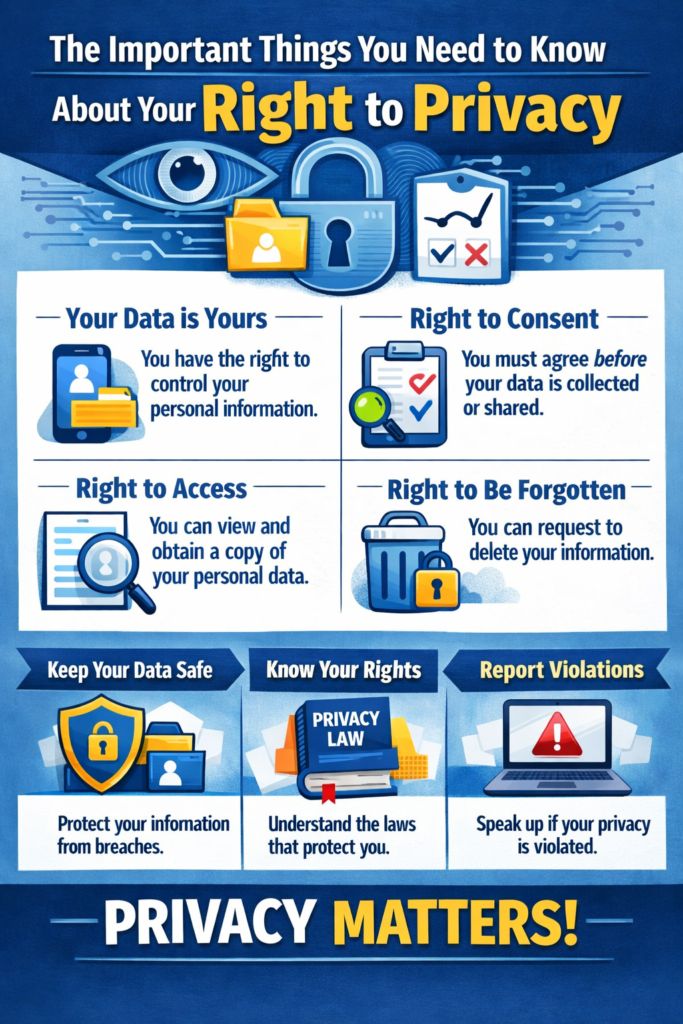
Introduction to Right to Privacy
It was a warm Tuesday afternoon in Lagos when Tunde Adeyemi stepped out of the bank on Broad Street, looking visibly distressed. He had just received difficult news about his account, a situation that had left him flustered and teary-eyed. Unknown to him, a popular content creator, Ngozi Okonkwo, was a few metres away, livestreaming a “public reactions” video for her fast-growing YouTube channel. Her camera captured Tunde’s emotional moment in full detail his face, his tears, and even the name on his ID card. Within hours, the clip had garnered over 200,000 views. Viewers commented, speculated, and mocked. Some even identified him by name.
Tunde had not consented to being filmed. He had not signed any waiver. He was simply a private citizen going about his day in a public space. Yet his most vulnerable moment had been broadcast to the world. When he reached out to Ngozi, she shrugged it off: “You were in public. Anyone could see you.” But was she right? Does stepping outside your front door mean surrendering your right to privacy?
This question sits at the heart of one of the most urgent legal debates in Nigeria today. And the answer, as you will see, is far more nuanced than Ngozi assumed.
International law and Nigerian jurisprudence recognise the right to privacy as one of the most fundamental human rights. This right protects individuals from unwarranted intrusion into their personal lives, correspondence, and identities. However, many people still hold a persistent misconception: they believe that once a person steps into a public space—such as a market, street, park, or banking hall—that person completely forfeits this right. This reasoning seems simple: if others can see you, they can record you.
This article challenges that assumption. Drawing from the 1999 Constitution of the Federal Republic of Nigeria (as amended), the Nigeria Data Protection Act (NDPA) 2023, and relevant case law. It can be argued that privacy in public spaces is not a contradiction in terms. Rather, it is a nuanced right that continues to evolve. Particularly in an era where smartphones, surveillance cameras, and social media have transformed what it means to be “seen” in public.
The Legal Framework on Right to Privacy: What Nigerian Law Says
The constitutional anchor for privacy in Nigeria is Section 37 of the 1999 Constitution. The Act is commonly referred to as the “Privacy Clause.” It guarantees and protects the privacy of citizens, their homes, correspondence, telephone conversations, and telegraphic communications. In the context of public spaces, courts and legal scholars have interpreted this to include the right to informational privacy the right to control how information about oneself, including one’s image and likeness, is collected, used, and distributed. This means that even in a public place, the unauthorised capture and viral distribution of your image or personal data may constitute a violation of your constitutional rights.
However, this right is not absolute. Section 45 of the Constitution provides a critical “claw-back” provision that allows the government to limit the right to privacy in the interest of national defence, public safety, public order, public morality, or public health. This is balanced by the Freedom of Information (FOI) Act, 2011, which, while promoting transparency, contains a key exemption under
Section 14 that protects individuals from the public disclosure of private facts by public institutions. Additionally, the Lawful Interception of Communications Regulations, 2019 governs how security agencies may monitor communications in both public and private spheres, requiring warrants in most cases which is a safeguard that underscores the state’s own obligation to respect privacy even in its law enforcement activities.
The Nigeria Data Protection Act 2023: Privacy Gets Teeth
The enactment of the Nigeria Data Protection Act (NDPA), 2023 represents a watershed moment in Nigerian privacy law. For the first time, individuals have a comprehensive statutory framework that gives concrete rights in relation to how their personal data including images, voice recordings, and location data captured in public is processed. Under Section 65, “personal data” is defined broadly enough to capture any information that can identify an individual, even if that information was gathered in a public space.
The NDPA’s Section 24 which lays out the six core principles of data processing is particularly instructive. Anyone collecting data in a public space, whether a private CCTV operator, a journalist, or a social media content creator, must ensure that data is:
(a) processed in a fair, lawful, and transparent manner;
(b) collected for specified, explicit, and legitimate purposes;
(c) adequate, relevant, and limited to what is necessary (the principle of data minimisation); and
(d) processed in a manner that ensures appropriate security against unauthorised access or data breaches.
Crucially, under Section 25, any such processing must have a lawful basis either the individual’s consent (S.25(1)(a)), a recognised public interest justification (S.25(1)(b)(iv)), or a legitimate interest (S.25(1)(b)(v)) that does not override the individual’s fundamental rights and freedoms. This means content creators like Ngozi, in our opening story, cannot simply rely on the fact that Tunde was in a public space. She must have a lawful basis for processing his image and likeness.
The Act further empowers individuals with specific rights over their data. Under Section 34, a person has the Right of Access for example, to request CCTV footage from a building owner in which they appear. Under Section 34(1)(d), they may invoke the Right to Erasure (Right to be Forgotten), demanding the deletion of their data if it was collected unlawfully or is no longer necessary for the purpose it was collected.
And under Section 36, they have the Right to Object to their data being processed for marketing or other specific purposes. Taken together, these provisions make clear that the NDPA treats public spaces not as zones of no legal protection, but as environments where the rules of data protection continue to apply.
Regulatory Action: The NDPC Warning of March 2026
The practical relevance of these laws was brought into sharp focus in March 2026 when the Nigeria Data Protection Commission (NDPC) issued a stern warning to content creators particularly TikTokers and YouTubers who film unsuspecting Nigerians in public spaces for “pranks” or “reality show” content. The Commission stated unequivocally that being in a public space does not waive an individual’s right to informational self-determination under Section 37 of the 1999 Constitution.
This warning grounded in the NDPA’s Section 1 (Objectives), which explicitly safeguards the fundamental rights, freedoms, and interests of data subjects as guaranteed under the Constitution signals a new era of regulatory enforcement in Nigeria’s digital content landscape. Importantly, Section 3 of the NDPA is also instructive here: while it exempts data processing for personal or household purposes, it makes clear that this exemption falls away where such processing violates the fundamental right to privacy. Personal filming in public, therefore, has a legal limit.
Case Law on Right to Privacy: The Courts Speak
Nigerian courts have begun to grapple with these tensions directly. In the landmark case of Portland Paints & Products Nig. Ltd. & Anor. v. Mr. Jimmy S. Olaghare & Anor. (2019) 2 NWLR (Pt. 1657) 541, the Court of Appeal held that the unauthorised use of a photograph of a person’s private residence even though the photograph was taken from a public road for commercial purposes (in this case, a calendar) constituted a breach of the right to privacy under Section 37 of the Constitution. This decision is significant for several reasons.
First, it establishes that the vantage point of the photographer whether standing on a public road or in a public space does not automatically legitimise the capture and commercial exploitation of another person’s private life. Second, it demonstrates that Nigerian courts are willing to extend privacy protections beyond the strict confines of the home into spaces that may technically be accessible to the public. The case reinforces a key principle: what matters is not merely where data is captured, but how it is subsequently used and whether such use respects the dignity and consent of the individual concerned.
Conclusion
The question posed in the title of this article “Can your right to privacy be protected in public spaces?” must be answered with a clear and qualified yes. Nigerian law, as reflected in the 1999 Constitution, the NDPA 2023, and the evolving regulatory posture of the NDPC, does not treat public presence as a blanket waiver of privacy rights. The right to informational privacy, the right to control how information about oneself is captured, stored, and disseminated survives in public spaces.
This does not mean that photography, journalism, CCTV surveillance, or public interest content creation are prohibited. They are not. The law recognises legitimate bases consent, public interest, and legitimate purpose upon which data may be lawfully collected in public. But these bases are not unlimited, and they do not excuse the gratuitous, exploitative, or commercially motivated capture and use of private citizens’ images without their knowledge or consent.
As Nigeria’s digital economy grows and the culture of online content creation expands, individuals, businesses, and regulators must grapple seriously with these boundaries. Tunde Adeyemi’s story is not unique it is the story of countless Nigerians who have been filmed, recorded, and broadcast without consent. The law, increasingly, is on their side.
By Idowu Agida Oluwanifemi
Keywords: Right to Privacy, Public Spaces, Nigeria Data Protection Act 2023 (NDPA), Section 37 Constitution, Informational Privacy, Data Subject Rights, NDPC, Content Creators, CCTV Surveillance, Right to Erasure, Consent, Lawful Basis, Data Minimisation, Portland Paints v. Olaghare, Privacy Law Nigeria, Digital Rights, Informational Self-Determination, Section 45 Constitution, FOI Act 2011, Lawful Interception
Contributors

Lead Partner, EKO SOLICITORS & ADVOCATES
Idowu-Agida Nifemi
Counsel, EKO SOLICITORS & ADVOCATES