

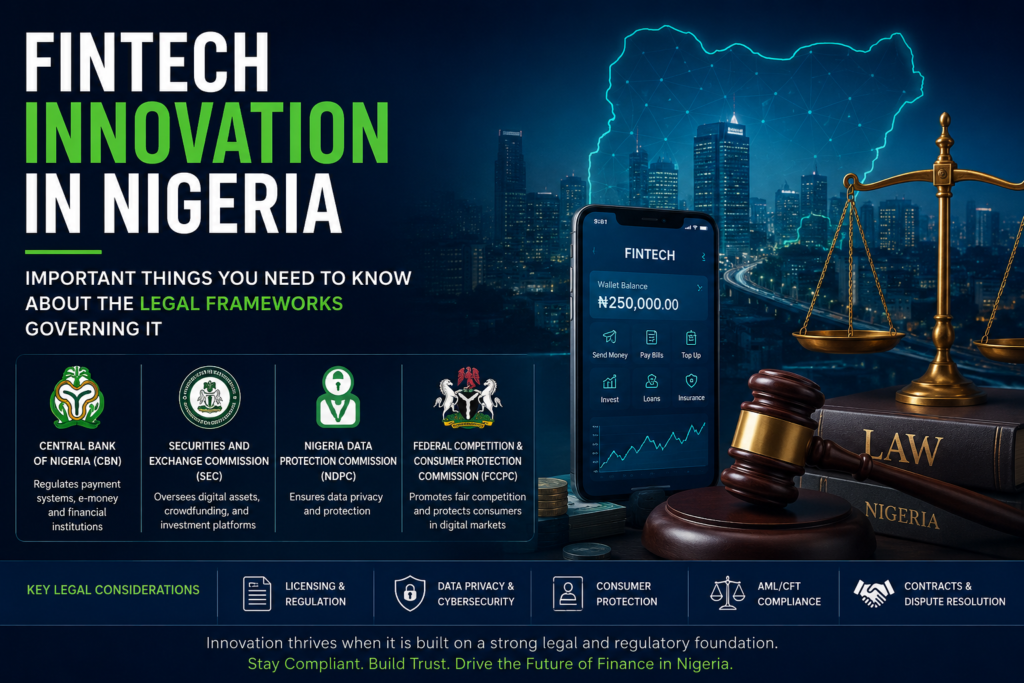
Introduction to Fintech Innovation in Nigeria
Nigeria has become one of Africa’s most vibrant fintech markets, but the legal frameworks meant to protect consumers have not fully kept pace with the speed and complexity of digital financial innovation. The Central Bank of Nigeria’s consumer protection rules, the Nigeria Data Protection Act 2023, and the Federal Competition and Consumer Protection Act together form a layered regime, yet they remain fragmented, overlapping, and sometimes uncertain in how they apply to rapidly evolving fintech products.
The fintech landscape on Fintech Innovation in Nigeria
Nigeria’s fintech ecosystem now spans mobile money, digital wallets, payment service banks, lendtech, insurtech, crypto‑adjacent platforms, buy‑now‑pay‑later schemes, and agency banking networks. Each of these models touches core consumer interests: the safety of funds, the clarity of charges, the fairness of terms, the security of data, and the availability of redress when things go wrong. That diversity is both a strength and a regulatory challenge. A single app may combine lending, payments, savings, and investment features, each of which could attract different regulatory expectations and consumer rights. The law therefore has to be not only technically sound, but also flexible enough to handle convergence.
The core legal architecture on Fintech Innovation in Nigeria
The primary pillars of consumer protection for fintech in Nigeria are:
- The Central Bank of Nigeria Consumer Protection Framework 2016 and the CBN Consumer Protection Regulations 2019 (and the 2023 exposure draft of revised regulations).
- The Nigeria Data Protection Act 2023, which establishes the Nigeria Data Protection Commission and sets out obligations for data controllers and processors, including fintechs.
- The Federal Competition and Consumer Protection Act 2018, which gives the Federal Competition and Consumer Protection Commission broad powers over unfair practices, misleading conduct, and consumer rights across sectors, including financial services.
- Sector-specific instruments such as the CBN Guidelines for Licensing and Regulation of Payment Service Banks, regulatory frameworks for mobile money operators, switching companies, and payment solution service providers.
Together, these instruments create a multi-regulator environment in which fintechs must navigate CBN prudential and conduct rules, NDPC data obligations, and FCCPC consumer protection mandates, often at the same time.
CBN’s consumer protection regime
The CBN’s 2016 Framework and 2019 Regulations set out nine core principles, including responsible business conduct, disclosure and transparency, fair treatment, protection of consumer assets and privacy, and complaints handling and redress. The Regulations apply to all institutions licensed or regulated by the CBN, which captures most mainstream fintechs that operate in payments, lending, deposits, or as agents of regulated entities. Fintechs are required to develop internal policies documenting processes and systems designed to ensure compliance, and contracts with consumers must not contain unfair terms that eliminate or limit liability for misrepresentation, negligence, or misleading information.
The CBN has also issued a Guide to Bank Charges and other circulars that seek to control fees, interest rates, and transparency in pricing. That is significant for consumer protection because many fintech complaints relate to hidden charges, unexpected deductions, and opaque fee structures. The limitation is that the CBN’s regime is primarily designed for traditional financial institutions, even if it formally applies to fintechs. It does not always address the unique risks of algorithmic credit scoring, automated decision-making, cross-border data flows, platform liability, and digital onboarding at scale.
Data protection and the NDPA 2023
The Nigeria Data Protection Act 2023 is the most important statutory development for consumer protection in the digital age. It replaces the earlier NDPR regime with a full statutory commission, the Nigeria Data Protection Commission, and grants it enforcement powers, including fines of up to 2% of annual gross revenue or ₦10 million, depending on the breach.
For fintechs, the NDPA is not a side issue. It goes to the heart of their business model: collection of identity data, transaction history, device information, location data, behavioural analytics, and credit-related information. The Act requires lawful processing, purpose limitation, data minimisation, security safeguards, breach notification within 72 hours, and, for major data controllers, registration, audit returns, and appointment of data protection officers.
Recent enforcement activity shows that the NDPC is moving from guidance to action. In 2025, the Commission launched a sector-wide probe into fintechs and financial firms, including well-known names such as Moniepoint, eTranzact, Abeg, Chams, FBN Mortgages, Coronation Insurance, Leadway Assurance, Zenith Pensions, and Merrybet, requiring them to produce compliance audit returns, appoint DPOs, and document security measures within 21 days or face fines and possible prosecution.
That is a clear signal that consumer data protection in fintech is no longer a box-ticking exercise. It is a live regulatory frontier with real sanctions.
The FCCPC’s expanding role
The Federal Competition and Consumer Protection Commission has increasingly asserted its role in the digital economy. The landmark Meta/WhatsApp case, in which the Competition and Consumer Protection Tribunal upheld a $220 million administrative penalty for discriminatory and exploitative practices against Nigerian consumers, confirmed that the FCCPC’s powers extend to data protection and privacy issues even in heavily regulated sectors. For fintech, that means the FCCPC is not limited to classic consumer complaints about defective goods or poor service. It can address unfair terms, misleading digital interfaces, opaque privacy policies, and exploitative data practices, especially where these affect large numbers of consumers.
The Federal High Court has also affirmed that banks fall under the FCCPC’s jurisdiction, reinforcing the idea that sectoral regulation does not exclude general consumer protection oversight. That is important for fintechs that partner with banks or operate in the payments space, because they may face scrutiny from both CBN and FCCPC.
Judicial trends and case law on Fintech Innovation in Nigeria
Nigerian case law on consumer protection in financial services is still developing, but key themes are emerging. In disputes over bank charges, courts have generally held that the relationship between a bank and its customer is contractual and governed by account opening documents and CBN guidelines. In Access Bank Plc v. Ugwuh and related authorities, the Court of Appeal emphasized that charges must be consistent with the contractual terms and regulatory guides.
In Mr. Junaid Sanusi v. Access Bank Plc, a customer challenged unauthorized deductions from his account, arguing that deductions must comply with CBN guidelines and the Finance Act. The suit sought substantial exemplary damages and restraint on further deductions, highlighting growing consumer willingness to litigate over charges and transparency.
At the same time, in some consumer protection cases, courts have held that consumers are bound by the terms and conditions they accepted at account opening, especially where the bank can show compliance with CBN’s Guide to Bank Charges. That underscores the importance of clear disclosures and fair contracting as part of consumer protection, not just regulatory compliance.
These cases show that Nigerian courts are prepared to engage with consumer protection in financial services, but they tend to rely heavily on contract and regulatory interpretation rather than broad consumer rights doctrines.
Gaps and weaknesses on Fintech Innovation in Nigeria
Despite this architecture, significant gaps remain. First, the regulatory landscape is fragmented. A fintech may face CBN prudential rules, NDPC data obligations, and FCCPC consumer protection mandates, with limited harmonization among the regulators. That can create uncertainty, duplication, and compliance fatigue.
Second, the existing frameworks are not fully tailored to digital-specific risks such as algorithmic bias in credit scoring, automated denial of services, profiling, dark patterns in user interfaces, and cross-border data transfers. The NDPA is a major step forward, but its detailed fintech-specific guidance is still evolving.
Third, enforcement capacity and consumer awareness are uneven. While the NDPC and FCCPC have shown increasing assertiveness, many consumers still lack the knowledge or resources to assert their rights, and many smaller fintechs operate with minimal compliance infrastructure.
Finally, redress mechanisms are often slow or inaccessible. The CBN’s complaints framework, the NDPC’s complaint process, and the FCCPC’s tribunal route are all important, but they do not yet provide the fast, low-cost, digital-native dispute resolution that consumers expect in a fintech environment.
Comparative perspective
Compared to jurisdictions like the United States, South Africa, and Canada, Nigeria has made significant progress in setting up fintech-friendly regulation, including regulatory sandboxes and innovation hubs. However, there is still a need for further alignment with global best practices in areas such as open banking, data portability, explicit digital consumer rights, and coordinated cross-border supervision.
Those jurisdictions show that effective consumer protection in fintech requires not only strong statutes, but also adaptive regulation, active stakeholder engagement, and a willingness to update rules as technology evolves. Nigeria’s challenge is to move from having frameworks on paper to having frameworks that are living, dynamic, and enforcement-ready.
What should be done about Fintech Innovation in Nigeria
A more adequate legal framework for fintech consumer protection in Nigeria should:
- Harmonize the roles of CBN, NDPC, and FCCPC to reduce overlap and confusion, while preserving each regulator’s core mandate.
- Introduce fintech-specific consumer protection rules that address algorithmic decision-making, automated credit scoring, digital disclosures, and unfair digital design.
- Strengthen digital dispute resolution, including online complaint portals, fast-track small claims procedures, and clearer timelines for redress.
- Enhance consumer education through coordinated campaigns on digital rights, data protection, and complaint channels.
- Encourage regulatory sandboxes that test consumer protection safeguards alongside innovation, rather than treating conduct rules as an afterthought.
Conclusion
Nigeria’s existing legal frameworks for fintech consumer protection are substantial but not yet fully adequate. The CBN’s consumer protection regime, the NDPA 2023, and the FCCP Act provide a solid foundation, but they operate in a fragmented, sometimes overlapping manner that does not fully reflect the realities of digital finance.
The law is moving in the right direction, especially with the NDPC’s assertive enforcement and the FCCPC’s willingness to tackle digital platforms. But to truly protect consumers while sustaining innovation, Nigeria will need more harmonized, fintech-specific, and enforcement-ready rules that match the sophistication of the market it regulates.
References
Central Bank of Nigeria. (2016). Consumer Protection Framework.[sterling]
Central Bank of Nigeria. (2019). Consumer Protection Regulations.[sterling]
Central Bank of Nigeria. (2023). Exposure Draft: Revised Consumer Protection Regulations.[cbn.gov]
Federal Competition and Consumer Protection Commission. (2018). Federal Competition and Consumer Protection Act.[fccpc.gov]
Nigeria Data Protection Commission. (2023). Nigeria Data Protection Act, 2023.[mondaq]
Competition and Consumer Protection Tribunal. (2025). Judgment in Meta/WhatsApp appeal.[fccpc.gov]
Sanusi v. Access Bank Plc. (2024).[businesspost]
Access Bank Plc v. Ugwuh. (2013).[edojudiciary.gov]
Aluko & Oyebode. (2024, February 1). Consumer protection in the fintech industry.[aluko-oyebode]
Simpa Labs. (2026, April 22). NDPR privacy checklist for fintechs.[simpalabs]
Startup Researcher. (2025, August 28). NDPC probes fintechs, insurers over data compliance.[linkedin]
CONTRIBUTORS

Ojienoh Segun Justice, ESQ
LEAD PARTNER, EKO SOLICITORS AND ADVOCATES

ITSEDE EMOSHIOKE VICTORY
GRADUATE TRAINEE, EKO SOLICITORS AND ADVOCATES
fintech innovation in nigeria, fintech innovation in nigeria, fintech innovation in nigeria,
fintech innovation in nigeria, fintech innovation in nigeria, fintech innovation in nigeria, fintech innovation in nigeria,