

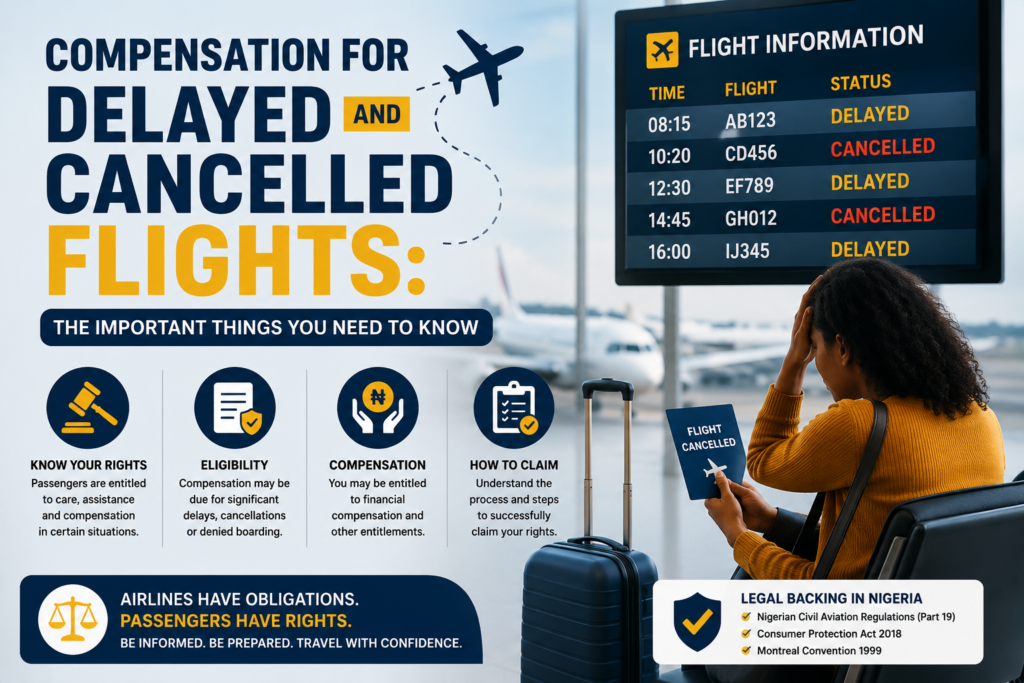
Introduction to delayed and cancelled flights
Air travel in Nigeria is indispensable to commerce, education, diplomacy, and personal mobility, yet it is also a sector where regulatory promises and operational realities often diverge sharply. Flight delays and cancellations are a recurring feature of the Nigerian aviation experience, and for many passengers, the question is not whether disruptions will occur, but whether the law will deliver meaningful redress when they do.
This article examines the legal framework governing compensation for delayed and cancelled flights in Nigeria, with particular focus on the Nigerian Civil Aviation Regulations (NCARs) Part 19, the Civil Aviation Act, the Montreal Convention, and the role of the Nigerian Civil Aviation Authority (NCAA) and consumer protection agencies. It argues that while the regulatory framework is robust on paper, enforcement gaps and awareness deficits continue to undermine its effectiveness.
Legal framework for delayed and cancelled flights
The primary source of passenger rights in Nigeria is the Nigerian Civil Aviation Regulations (NCARs) Part 19 on Consumer Protection, issued by the NCAA. Part 19 sets out minimum rights and obligations for passengers and airlines regarding consumer protection, including assistance for persons with reduced mobility, accident victim assistance, and compensation for denied boarding, delayed or lost baggage, delays, and cancellations of flights.
Part 19 is supported by the Civil Aviation Act, which establishes the NCAA and empowers it to regulate civil aviation in Nigeria, including consumer protection matters. For international flights, the Montreal Convention 1999, domesticated through the Civil Aviation Act, provides an additional layer of protection, particularly on liability for delay, damage, and loss.
Together, these instruments create a layered regime: NCAR Part 19 governs domestic and international operations from a consumer protection perspective, while the Montreal Convention governs international carriage by air on liability and compensation issues.
Rights to compensation for delays and cancellations
Domestic flights delayed and cancelled flights
Under NCAR Part 19, passengers on domestic flights have specific rights in the event of cancellation. Section 19.10 provides that passengers have the right to compensation by the operating air carrier unless they are informed of the cancellation at least twenty-four hours before the scheduled time of departure.
Where compensation is payable, Section 19.8 prescribes minimum amounts:
- 25% of the fare or passenger ticket price for all flights within Nigeria.
In addition, where flights are delayed, airlines are required to provide assistance, which may include food, refreshments, communication facilities, and accommodation where necessary, depending on the length of the delay and time of day. In some cases, particularly where domestic flights are delayed beyond three hours, passengers may have a right to rerouting or alternative flights.
International flights delayed and cancelled flights
For international flights, the thresholds are higher. Passengers must be informed of the cancellation at least seven days before the scheduled time of departure to avoid compensation liability. Where compensation is payable, Section 19.8 provides:
- 30% of the passenger ticket price for all international flights.
International passengers are also protected under the Montreal Convention, which imposes liability on carriers for damage occasioned by delay in the carriage of passengers, baggage, or cargo, subject to certain defences and limits. The Convention does not prescribe fixed percentages like the NCARs, but it provides a cause of action for proven loss or damage resulting from delay, including additional expenses, missed connections, and consequential losses, within the applicable limits.
Extraordinary circumstances defence for delayed and cancelled flights
A critical limitation on compensation is the “extraordinary circumstances” defence. Both the NCARs and the Montreal Convention recognise that carriers should not be liable where the delay or cancellation is caused by circumstances beyond their control, such as severe weather, political instability, security risks, air traffic control strikes, or hidden manufacturing defects.
In Emirates Airline v. Aforka, the court affirmed that where cancellation or delay is caused by extraordinary circumstances beyond the control of the carrier, the carrier need not pay compensation. This principle aligns with international practice and prevents airlines from being held strictly liable for events they could not reasonably foresee or avoid.
However, the defence is not unlimited. Circumstances that are within the airline’s operational control—such as routine technical faults, crew scheduling issues, or overbooking are generally not considered extraordinary. The burden is on the airline to prove that the disruption was due to an extraordinary cause and that it took all reasonable measures to avoid or mitigate the delay or cancellation.
Denied boarding and overbooking
Part 19 also addresses denied boarding due to overbooking. Where a flight is oversold, airlines must first seek volunteers willing to give up their seats in exchange for benefits before resorting to involuntary denial of boarding.
Where passengers are involuntarily denied boarding, they are entitled to compensation:
- 25% of the ticket price for domestic flights.
- 30% of the ticket price for international flights.
In addition, they are entitled to immediate cash reimbursement or rerouting, depending on the circumstances. This regime is designed to discourage overbooking and ensure that passengers are not treated as mere numbers in a revenue optimisation exercise.
Payment methods and timeframes
The NCARs prescribe how compensation and refunds must be paid. Payment may be made in cash, electronic bank transfer, bank orders, or bank cheques. With the passenger’s agreement, travel vouchers or other services may be offered, but cash or electronic transfer remains the default.
Refund timeframes are also specified:
- Cash payments: immediate refund.
- Electronic payments: within 14 days.
These provisions are important because delayed or vague reimbursement processes have historically been a major source of passenger dissatisfaction.
Enforcement and claims process
Role of the NCAA
The NCAA is the primary regulator responsible for enforcing Part 19. It operates a Consumer Protection Directorate that receives complaints, investigates violations, and can sanction non-compliant airlines.
Passengers can claim compensation by:
- Documenting the disruption (ticket, booking number, flight details, reason given).
- Contacting the airline directly with a written complaint.
- If rejected, escalating to the NCAA’s Consumer Protection Directorate.
- Filing complaints using forms available at all airports.
The NCAA has reported a 70% case resolution rate, with 75% of cases resolved within 10 days in recent years, indicating a relatively efficient administrative process for straightforward complaints. The Authority has also taken enforcement action against multiple airlines, including Kenya Airways, Ethiopian Airlines, Air Peace, Arik Air, and others, demonstrating increased commitment to passenger protection.
Role of the FCCPC delayed and cancelled flights
Although the Federal Competition and Consumer Protection Commission (FCCPC) does not have general oversight over aviation operators, it retains a general mandate to protect consumers in Nigeria and can assist with flight cancellation and delay compensation claims, particularly where broader consumer rights issues are implicated.
In practice, the NCAA remains the primary forum for aviation-specific complaints, but the FCCPC can be a complementary avenue, especially where deceptive practices, unfair terms, or systemic consumer harm are alleged.
Judicial enforcement for delayed and cancelled flights
Where administrative remedies fail, passengers may resort to litigation. The Civil Aviation Act and the Montreal Convention provide bases for court action, particularly for international flights where damages for delay may exceed the fixed percentages under the NCARs.
However, litigation remains underutilised due to cost, delay, and limited awareness. Most disputes are resolved through the NCAA’s complaint mechanism or direct negotiation with airlines.
Emerging issues and recent developments
The 2023 NCARs introduced several improvements to passenger protection, including:
- Enhanced protection for passengers with reduced mobility.
- Tarmac delay provisions for the first time, addressing prolonged confinement on aircraft without adequate assistance.
- Airport authority obligations for passenger protection, recognising that disruptions are not solely the airline’s responsibility.
- Right to rerouting for domestic flights delayed beyond three hours.
- Clearer definitions and procedures for compensation and assistance.
These developments reflect a more sophisticated understanding of the passenger experience and the multiple points at which rights can be infringed. They also signal a shift from a purely airline-centric model to a broader ecosystem approach that includes airports, ground handlers, and regulators.
Challenges and gaps
Despite the robust framework, several challenges persist. First, awareness remains low. Many passengers are unaware of their rights under Part 19, the Montreal Convention, or the claims process. This informational asymmetry allows some airlines to avoid liability simply by relying on passenger ignorance.
Second, enforcement is uneven. While the NCAA has improved its complaint resolution rate, sanctions are not always publicised, and compliance monitoring is not always rigorous. Some airlines continue to delay or deny compensation, betting that most passengers will not pursue their claims.
Third, the “extraordinary circumstances” defence is sometimes overused or mischaracterised. Technical issues that should be within the airline’s operational control are occasionally labelled as extraordinary to avoid liability. Greater clarity and stricter scrutiny of such claims are needed.
Fourth, the interaction between the NCARs and the Montreal Convention is not always well understood by practitioners or passengers. In international cases, passengers may have stronger claims under the Convention than under the NCARs, but this is not always leveraged.
Conclusion
Nigeria’s legal framework for compensation of delayed and cancelled flights is comprehensive and, in many respects, aligned with international best practices. The NCARs Part 19 establish clear rights to compensation, assistance, and rerouting for both domestic and international passengers, while the Montreal Convention provides an additional layer of protection for international carriage.
The real challenge is not the absence of law, but the gap between law and experience. Many passengers still face delays and cancellations without timely information, adequate assistance, or prompt compensation. Enforcement has improved, but awareness, consistency, and transparency must catch up.
For the regime to deliver its full promise, three things are necessary: sustained public education on passenger rights, rigorous and visible enforcement by the NCAA, and a willingness by courts to interpret the regulations and the Montreal Convention in a manner that gives real value to the rights they confer. Only then will the promise of Part 19 move from regulatory text to lived reality for Nigerian air travellers.
References
Civil Aviation Act (Nigeria).[templars-law]
Nigerian Civil Aviation Regulations (NCARs) Part 19: Consumer Protection.[ncaa.gov]
Montreal Convention 1999.[templars-law]
Nigerian Civil Aviation Authority. (n.d.). Nigeria Civil Aviation Regulations Part 19: Consumer Protection.[ncaa.gov]
Templars. (2025, October). A guide to passenger rights and airline obligations.[templars-law]
Law Clinic Pro. (2026, February 13). Compensations for flight delay & flight cancellation in Nigeria.[lawclinicpro]
Ekanem, V. O., & Thomas, E. (n.d.). Consumer protection and carrier’s liability for flight cancellations and delays in Nigeria.[journals.ezenwaohaetorc]
Nigerian Civil Aviation Authority. (n.d.). Aviation Part 19.[ncaa.gov]
CONTRIBUTORS

LEAD PARTNER, EKO SOLICITORS AND ADVOCATES

ITSEDE EMOSHIOKE VICTORY
GRADUATE TRAINEE, EKO SOLICITORS AND ADVOCATES