

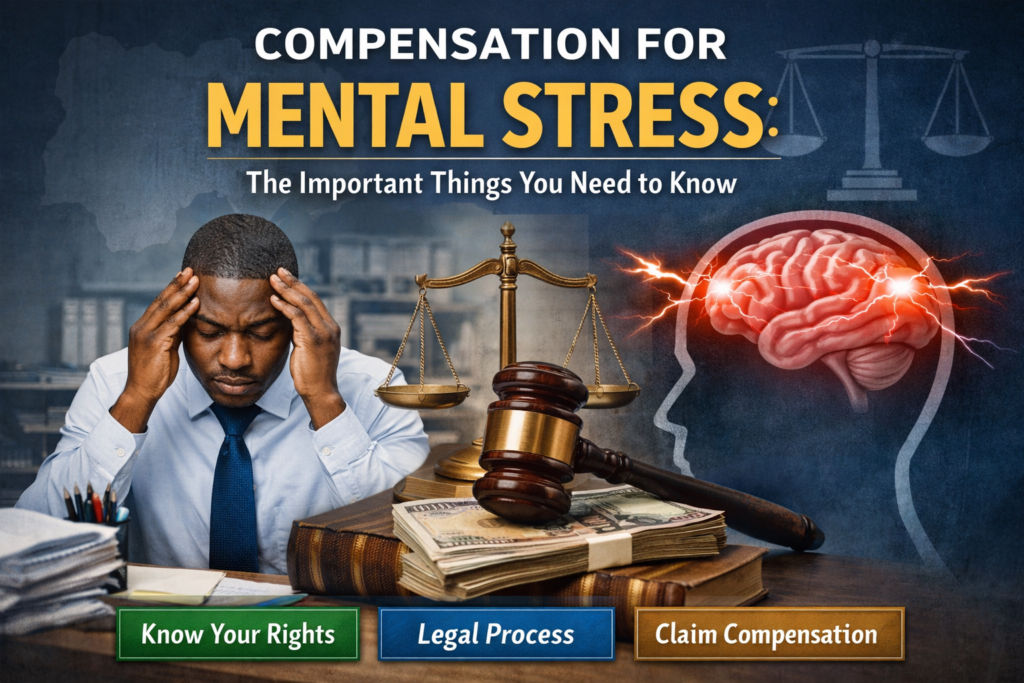
INTRODUCTION TO COMPENSATION FOR MENTAL STRESS
The Employee’s Compensation Act was enacted by the National Assembly and signed into law by the President of Nigeria and on the 17th December, 2010. The Act makes comprehensive provisions for compensation provisions for compensation for death, injury, mental stress, occupational diseases and other hazards in the course of employment. This article examines compensation for mental stress and how to prevent it, including a guide to making a successful claim for mental stress.
COMPENSATION FOR MENTAL STRESS :MENTAL HEALTH AT THE WORKPLACE
The International Labour Organisation (ILO)
defines mental health as a state of health and well being in which workers realise their own abilities, work productively and contribute to their community. More than half the global workforce works in the informal economy [1], where there is no regulatory protection for health and safety. These workers often operate in unsafe working environments, work long hours, have little or no access to social or financial protections, and face discrimination, all of which can undermine mental health.
Although psychosocial risks can be found in all sectors, some workers are more likely to be exposed to them than others, because of what they do or where and how they work. Health, humanitarian, or emergency workers often have jobs that carry an elevated risk of exposure to adverse events, which can negatively impact mental health. Mental health disorders, particularly depression and anxiety, are on the rise. There have also been cases of suicide and attempted suicide by employees, especially in Lagos State. Declining mental health among employees is not only a cost to the organisation, but a threat to national growth and economic developmemt.
COMPENSATION FOR MENTAL STRESS UNDER THE EMPLOYEE COMPENSATION ACT
Section 8(1)(a-b) of the Act provides that an employee shall be entitled to compensation for mental stress if it is due to an acute reaction to a traumatic event in the course of employment. Also, Section 8(2) of the Act further provides for mental stress that may arise when working conditions are unreasonably strenuous or the work schedule exceeds the employee’s work ability. Section 8(3) further provides that for the purpose of ascertaining the veracity of compensation claims, the NSTIF Board may appoint a Medical Board of Inquiry consisting of relevant specialists to review the claim.
The compensable scenarios provided under section 8(1) and (2) of the Act are not uncommon in workplace settings in Nigeria.
ILLUSTRATIVE SCENARIOS
Ada is a customer service officer working with a commercial bank in Lagos. One afternoon, while attending to customers, a group of armed robbers stormed the banking hall. During the robbery, Ada is held at gunpoint, physically assaulted, and forced to open cash vault systems. The incident lasted for over 30 minutes and left several staff and customers traumatised.
Although Ada sustains no visible physical injuries, she begins to experience severe psychological symptoms in the weeks following the incident. She suffers from nightmares, panic attacks, anxiety, and an inability to return to work. A medical evaluation later confirms that she is suffering from Post-Traumatic Stress Disorder (PTSD) as a direct result of the robbery incident.
Under Section 8(1)(a) of the Employee’s Compensation Act, Ada’s condition qualifies as mental stress arising from an acute reaction to a traumatic event in the course of her employment. Consequently, she is entitled to compensation, provided she satisfies the procedural requirements, including medical assessment and verification by the appropriate authority.
Similarly, consider Tunde, a junior associate in a high-pressure law firm. He is consistently required to work 16–18 hours daily without adequate rest, often handling multiple complex cases under tight deadlines. Despite repeatedly complaining to his employer, no adjustments are made.
Over time, Tunde develops severe anxiety, insomnia, and depression, rendering him medically unfit to continue his duties. A psychiatric evaluation confirms that his condition was caused by unreasonably strenuous working conditions. Under Section 8(2) of the Act, Tunde may also be entitled to compensation, as his mental stress arose from a work schedule that exceeded his capacity.
ACTION PLAN ESPECIALLY FOR HR MANAGERS.
- It is important to organize occasional health trainings and periodic counselling for everyone. Relevant professionals should be invited to talk to employees on how to manage stress, common symptoms of mental stress, and how to seek help.
- Where work-related mental stress leads to disability or loss of income, the HR managers should help such employees to seek compensation from the NSTIF under the scheme.
- The HR department has a duty to help organisations provide a work environment that promotes the physical and mental well-being of their employees.
- The need for employee awareness on mental health should be overemphasised.
FINAL THOUGHTS ON COMPENSATION FOR MENTAL STRESS
The Employee’s Compensation Act recognises mental stress as a legitimate workplace injury and provides a legal pathway for affected employees to seek compensation. This underscores the importance of protecting not just physical health, but also the mental well-being of workers.
Employers must take proactive steps to prevent workplace stress, while employees should remain aware of their rights. Ultimately, a healthy workforce is essential for organisational efficiency and national development.
[1] Women and men in the informal economy: a statistical picture. Geneva: International Labour Organization; 2018 (https://www.ilo.org/global/publications/books/WCMS_626831/lang–en/index.htm, accessed 26 August 2022).
Contributors

OJIENOH SEGUN JUSTICE, ESQ.,
Lead Partner, EKO SOLICITORS AND ADVOCATES

Counsel EKO SOLICITORS AND ADVOCATES

Faith Ogunleye
Graduate Trainee, EKO SOLICITORS AND ADVOCATES