

Introduction to What Happens When Someone Dies Without a Will
A successful businessman in Lagos passes away unexpectedly. No Will. No written instructions. Just houses, bank accounts, and investments.
At first, the family mourns. But soon, tension begins to rise. The wife assumes she should take control of everything. The children disagree among themselves. Extended relatives suddenly appear, claiming rights over the estate. Confusion turns into conflict. Everyone is asking the same question: who inherits property when there is no Will in Nigeria?
This situation, legally known as intestacy is very common in Nigeria. Yet, many people do not realise that inheritance in such cases is not determined by family opinion, culture alone, or emotional claims. Instead, it is governed by a structured legal framework, particularly under the Administration of Estates Law of Lagos State.
WHAT DOES IT MEAN TO DIE WITHOUT A WILL?
When a person dies without a Will, they are said to have died intestate. In such circumstances, the law steps in to determine who inherits property when there is no Will in Nigeria. Unlike situations where a valid Will exists, the deceased has no direct control over how their assets are distributed. Instead, the estate is administered and distributed strictly in accordance with the law.
Under the Administration of Estates Law of Lagos State, the estate of a person who dies intestate does not automatically pass to family members. Rather, it is first vested in the court until proper administrators are appointed through Letters of Administration. This legal requirement is fundamental in resolving the question of who inherits property when there is no Will in Nigeria, because no one has authority to deal with the estate without court approval.
THE FIRST STEP: OBTAINING LETTERS OF ADMINISTRATION
Before determining who inherits property when there is no Will in Nigeria, the law requires that someone be legally appointed to manage the estate. This is done through Letters of Administration, issued by the Probate Registry of the High Court.
Under Section 49 of the Administration of Estates Law of Lagos State, the law provides an order of priority for persons entitled to apply:
1. The surviving spouse
2. The children of the deceased
3. The parents
4. The siblings
5. Other relatives
6. Creditors (in limited situations)
The persons appointed as administrators are responsible for:
- Identifying the assets of the deceased.
- Paying debts and liabilities
- Distributing the estate to beneficiaries
In Omonuwa v. Edegbe & Ors (2022) LPELR-57135 (CA), the Court of Appeal emphasised that properties not properly disposed of must fall into intestacy and be distributed according to law. Similarly, in Adebayo v. Adebayo (2023) LPELR (CA), the Court of Appeal reiterated that only duly appointed administrators have the legal authority to deal with the estate of a deceased person. Any transaction carried out without such authority is invalid.
This structured process ensures that the issue of who inherits property when there is no Will in Nigeria is handled lawfully and transparently.
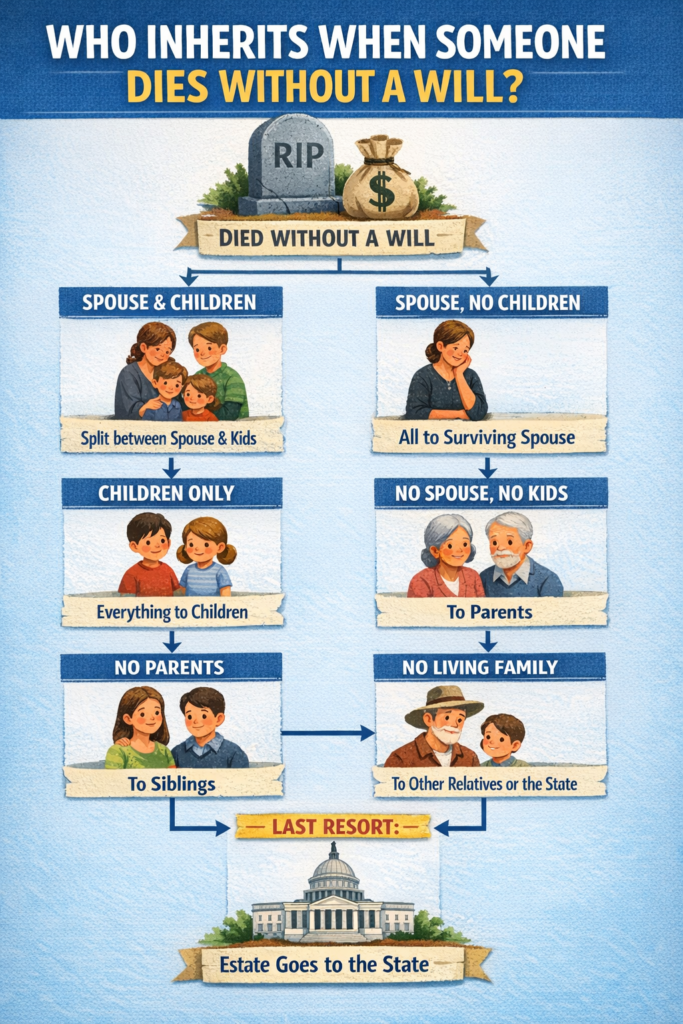
WHERE THE DECEASED IS SURVIVED BY A SPOUSE AND CHILDREN BUT DIES WITHOUT A WILL
- The spouse and children are the primary beneficiaries.
- The estate is shared among them in defined proportions.
- Children inherit equally, regardless of gender
This means that in determining who inherits property when there is no Will in Nigeria, no child is given preference based on being male or firstborn.
Where There Is a Spouse but No Children
In this situation, the spouse takes a significant portion of the estate. The remaining part may go to the deceased’s parents or relatives. Thus, even without children, the law still provides a structured answer to who inherits property when there is no Will in Nigeria
Where There Are Children but No Spouse
Where the deceased leaves behind children but no surviving spouse:
- The children inherit the estate equally
Where There Is No Spouse or Children
If the deceased has no spouse or children:
- The estate passes to the parents
- If no parents, then to siblings
- If none, then to extended family members
This hierarchy ensures that the estate remains within the family line.
THE ROLE OF CUSTOMARY LAW IN INTESTATE SUCCESSION (DIES WITHOUT A WILL)
A major complexity in determining who inherits property when there is no Will in Nigeria is the interaction between statutory law and customary law.
In many parts of Nigeria, customary law governs inheritance, especially where the deceased lived under customary practices. However, customary law is not absolute. It must comply with constitutional principles.
This was firmly established in Ukeje v. Ukeje (2014) LPELR-22724 (SC), where the Supreme Court upheld the decision of the Court of Appeal and declared that any customary law which excludes female children from inheriting property is unconstitutional.
Conclusion
Where there is no Will, the estate is distributed according to law, with priority given to spouses and children, and subject to fairness and equality. Ultimately, determining who inherits property when there is no Will in Nigeria is not a matter of family preference, but a matter of law and the courts will always ensure that justice prevails.
Contributors

Lead Partner, EKO SOLICITORS & ADVOCATES

Counsel EKO SOLICITORS AND ADVOCATES

Salawa Abike Sule-Azeez
Associate, EKO SOLICITORS & ADVOCATES