

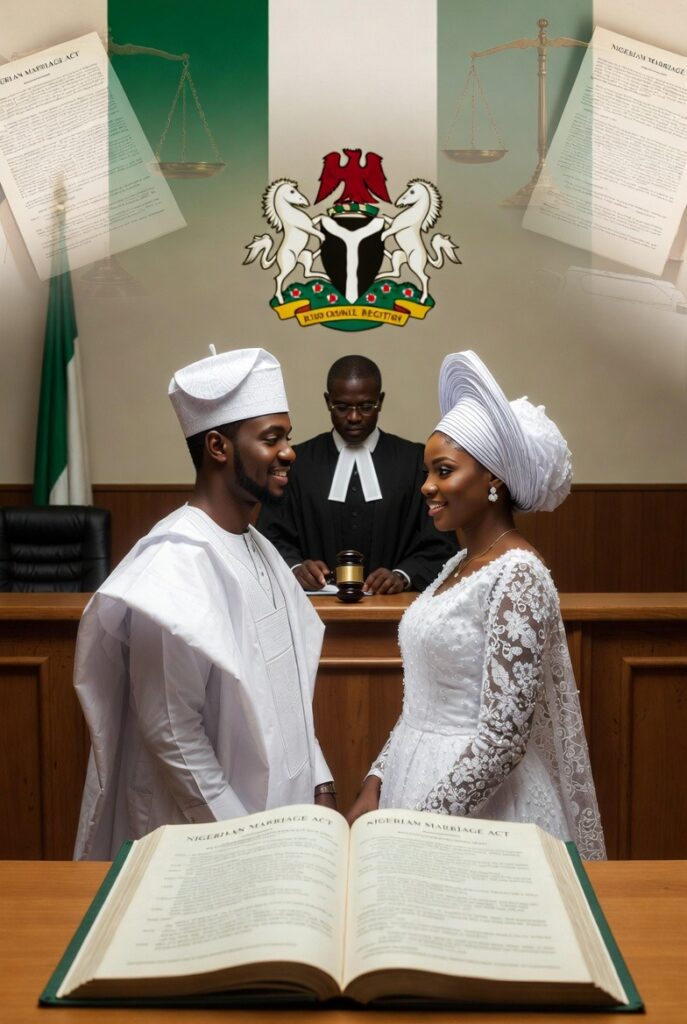
Introduction To Court Marriage in Nigeria
Court marriage (statutory marriage) in Nigeria is the most legally recognised form of marriage under the Marriage Act. It creates a monogamous union with far-reaching legal consequences affecting property rights, inheritance, legitimacy of children, maintenance obligations, and dissolution procedures. Unlike customary marriages, statutory marriage is uniform, enforceable, and governed strictly by statute and judicial interpretation.
This article examines the legal framework governing court marriages in Nigeria and critically analyses its legal implications using statutory provisions and Nigerian case law. It demonstrates that court marriage is not merely ceremonial but a binding legal institution that significantly alters the rights and obligations of spouses under Nigerian law.
Marriage in Nigeria is governed by three principal systems: customary law, Islamic law, and statutory law (court marriage). Among these, statutory marriage occupies the highest legal position due to its formal legal structure and nationwide recognition under the Marriage Act. The courts have consistently emphasized that statutory marriage creates a legally binding union that cannot be modified by custom or informal arrangements.
In Olowu v. Olowu (1985) 3 NWLR (Pt. 13) 372, the Supreme Court held that where a marriage is contracted under the Marriage Act, it is governed exclusively by statute and not by customary law. This principle forms the foundation of court marriage jurisprudence in Nigeria.
Legal Framework Governing Court Marriage In Nigeria
Court marriage is governed by:
- Marriage Act, Cap M6 LFN 2004
- Matrimonial Causes Act, Cap M7 LFN 2004
The courts have affirmed that these statutes form a complete code for statutory marriage. In Ayoade v. Ayoade (2014) LPELR-22115(CA), the Court of Appeal reiterated that statutory marriage must comply strictly with the provisions of the Marriage Act, and any deviation may render the marriage void.
Validity Requirements of Court Marriage: Court Marriage in Nigeria
- Legal Formalities
In Awojugbabe Light Industries Ltd v. Chinukwe (1995) 4 NWLR (Pt. 390) 379, the court emphasized the importance of strict compliance with statutory procedures where legal rights are created. By analogy, failure to comply with the Marriage Act requirements may invalidate a statutory marriage.
- Capacity and Consent
In Osamwonyi v. Osamwonyi (1972) 1 All NLR (Pt. 1) 105, the court held that consent is fundamental to the validity of marriage. A marriage contracted under coercion or fraud is voidable. This principle applies directly to court marriage under Nigerian law. One of the strongest legal consequences of court marriage is monogamy. In Obiekwe v. Obiekwe (1963) 1 All NLR 196, the court held that a statutory marriage cannot coexist with another valid marriage under customary law.
Similarly, in R v. Princewill (1963) WNLR 56, the court affirmed that contracting another marriage while still legally married under the Marriage Act constitutes bigamy. Once a statutory marriage exists, no other valid marriage can be contracted without dissolution. If a man marries under the Marriage Act and later marries another woman under customary law, the second marriage is void, and he may be criminally liable for bigamy under Nigerian law.
- Inheritance Rights
Court marriage strengthens spousal inheritance rights. In Lewis v. Bankole (1908) 1 NLR 81, the court recognized the validity of statutory marriage over customary inheritance rules, holding that English-type statutory marriage confers superior legal rights. Also, in Suberu v. Sumonu (1957) 2 FSC 33, the court held that customary inheritance rules cannot override statutory marital rights. Also, Statutory spouses cannot be excluded from inheritance based on customary law.
- Legitimacy of Children
The presumption of legitimacy is strongly protected under Nigerian law. In Eyo v. Eyo (1973) 1 All NLR (Pt. 2) 263, the court held that children born during a valid marriage are presumed legitimate unless proven otherwise. This principle ensures legal protection for children of statutory marriages
- Property Rights in Marriage
Nigerian courts have consistently applied equitable principles in matrimonial property disputes. In Nzekwu v. Nzekwu (1989) 2 NWLR (Pt. 104) 373, the Supreme Court recognized that contributions (financial or otherwise) must be considered in determining ownership of property within marriage. Similarly, in Ukeje v. Ukeje (2014) 11 NWLR (Pt. 1418) 384, the Supreme Court struck down discriminatory customary practices, affirming equality in inheritance and property rights. Courts recognize both financial and non-financial contributions in matrimonial property disputes.
- Dissolution of Marriage
Court marriage can only be dissolved by court order under the Matrimonial Causes Act. In Williams v. Williams (1962) 1 All NLR 162, the court emphasized that statutory marriage cannot be dissolved except by judicial decree. In Kodilinye v. Odunuga (1959) WRNLR 50, the court held that irretrievable breakdown is sufficient ground for dissolution. For instance, a spouse who abandons the marriage may be subject to divorce proceedings, as courts recognize desertion as a valid ground for dissolution.
- Maintenance and Custody
In custody disputes, Nigerian courts prioritize the welfare of children. In Olowu v. Olowu (1985) 3 NWLR (Pt. 13) 372, the Supreme Court emphasized that child welfare is the paramount consideration in custody decisions. Similarly, in Williams v. Williams (1962), the court affirmed the importance of fairness in maintenance obligations.
Legal Status of Court Marriage In Nigeria Compared to Customary Marriage
In Cole v. Cole (1898) 1 NLR 15, the court distinguished between statutory and customary marriages, holding that statutory marriage overrides customary arrangements where conflict arises. This remains a foundational authority in Nigerian family law.
Jurisprudential Analysis
Court marriage is best understood as a status-transforming legal institution rather than a mere contract. Once entered, it alters the legal identity of individuals, affecting:
- Property rights
- Succession rights
- Parental rights
- Criminal liability (bigamy)
The Nigerian courts consistently reinforce statutory supremacy over customary practices in marital matters, as seen in Lewis v. Bankole and Cole v. Cole. This demonstrates a strong legal policy preference for certainty, uniformity, and enforceability in matrimonial relations.
Conclusion
Court marriage in Nigeria is a legally binding institution with profound legal implications. Judicial authorities have consistently affirmed their superiority over customary marriage in matters of legal status, inheritance, property rights, and dissolution. Through cases such as Olowu v. Olowu, Cole v. Cole, Nzekwu v. Nzekwu, and Ukeje v. Ukeje, Nigerian courts have developed a robust jurisprudence reinforcing statutory marriage as the most legally secure form of marital union. Court marriage is therefore not merely ceremonial but a transformative legal contract that imposes enforceable rights and obligations on spouses, backed by statutory and judicial authority.
Contribute

Lead Partner, EKO SOLICITORS AND ADVOCATES

Counsel EKO SOLICITORS AND ADVOCATES

MISS, ITSEDE VICTORIA
Graduate Intern, EKO SOLICITORS AND ADVOCATES
Court Marriage in Nigeria, Court Marriage in Nigeria, Court Marriage in Nigeria, Court Marriage in Nigeria, Court Marriage in Nigeria, Court Marriage in Nigeria, Court Marriage in Nigeria, Court Marriage in Nigeria.