

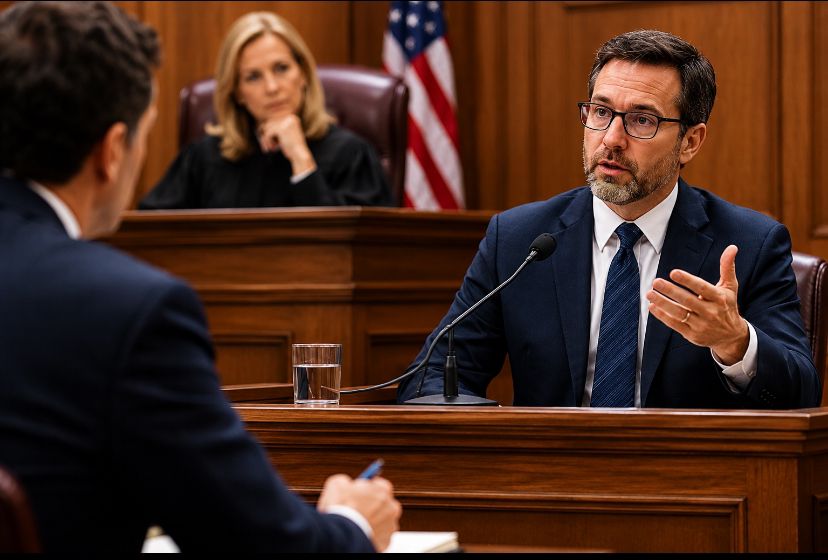
Introduction to Role of Expert Witnesses
The courtroom was silent. The accused sat nervously biting his nails as his future hung in the balance. The prosecution had presented its case so convincingly . The fingerprints, CCTV footage, and witness testimonies all seemed to point in one direction: the defendant’s guilt.
Then in a shocking twist of events, the defense called an expert witness – a forensic analyst.
With calm confidence, the expert explained that the fingerprint analysis was flawed and that the CCTV footage had been misinterpreted due to poor image quality. Within minutes, the entire case began to unravel.
This moment highlights the true power of an expert witness as an individual who can make or break a case through logical and specialised knowledge.
In today’s legal sphere, the administration of justice is increasingly dependent on specialised knowledge beyond that of ordinary judges and lawyers. The courts requires people of specialised and professional knowledge or experience in certain fields to aid the court in making informed decisions on technical, scientific or complex issues beyond the understanding of judges. This is where the role of expert witnesses come into play.
As the world advances, modern litigation often involves forensic analysis, medical negligence, digital evidence and financial disputes. These are areas where legal practitioners lack technical expertise or know how. Therefore the role of an expert witness in Nigerian courts is therefore indispensable in ensuring justice is fair and accurate.
Who is An Expert Witness?
An expert witness is a person with specialised knowledge, skill, experience or training in a particular field on whom the court may call upon to provide an opinion in court.
This differs from a regular witness who only testifies to facts he witnessed. An expert witness gives an opinion based on their specialised knowledge and skill. For example
- a medical doctor or coroner explaining cause of death
- A forensic scientist analysing DNA evidence
Legal Framework for Expert Witnesses in Nigeria
The legal basis for use of expert witnesses in Nigerian Courts is governed by the Evidence Act 2011.
Section 68 of the Evidence Act defines an expert and primarily governs the admissibility of expert opinions of persons skilled in areas such as foreign law, science, art, handwriting or fingerprints.
However, the court must be satisfied that:
- The person is truly an expert
- Their testimony is relevant to the case
- Their opinion is based on proper knowledge and analysis
Ultimately, it’s up to the judge to decide on whether to accept or reject the expert evidence.
Role of Expert Witnesses In Nigerian Courts
- Clarifying Technical Issues
Courts have to deal with cases filled with complicated matters such as forensic reports, medical diagnoses or financial audits. Expert witnesses simplify these issues in a way judges and lawyers can understand. This helps to save the time and stress trying to decipher or understand technical or specialised knowledge.
- Providing Independent and Professional Opinions
A credible expert witness is expected to be impartial and objective. They are expected to owe their duty to the court to state the truth rather than to speak in favour of the party that hired them.
- Assist the Court in Decision-Making
Judges have legal expertise in Law and legal precepts not medicine, science, engineering, language. The role of experts is to provide testimony to help bridge that gap.
- Strengthen or Weaken a Case
Strong expert evidence can significantly boost or support a party’s case. Similarly if a weak or inconsistent expert testimony can damage it.
- Helping in Fact Finding
Expert witnesses assist in uncovering the truth by analysing evidence beyond that of ordinary people’s perceptions.
Types of Expert Witnesses Common in Nigerian Courts
Some of the most frequently used expert witnesses used in Nigerian courts:
- Medical Experts – in murder, assault, and negligence cases
- Forensic Experts – in criminal investigations involving DNA, ballistics or fingerprints
- Financial Experts – in embezzlement, fraud, tax disputes
- Engineering Experts – in construction disputes and accident cases
- Digital Experts – in cybercrime and data evidence cases
Admissibility of Expert Evidence
For expert testimony to be admitted in Nigerian courts, certain conditions must be met:
- Qualification: The expert giving the testimony must have recognised training or experience.
- Objectivity: The expert must not appear biased.
- Relevance: Their evidence must be directly related to the issues in dispute.
- Cross-Examination: The opposing party has the right to challenge the expert’s findings.
If an expert fails to meet these standards, their testimony may be disregarded. In the case of Dr. Udugbai Ilebare v Medical and Dental Council of Nigeria1, the counsel of claimant stated the DW4 tendered a forensic report does not meet the criteria to be met to testify as an expert. He submitted that Section 68 of the Evidence Act, 2011 regulates the admissibility of expert evidence and which is to the effect that such person must first prove his knowledge and skill in that particular field.
The claimants counsel relied on the case of Omisore & Anor v. Aregbesola & Ors2
Challenges with Expert Witnesses in Nigeria
Expert witnesses are important but despite this, their use is not without problems:
- Bias or ‘Hired Gun’ Syndrome: Some Experts may favour the party that pays them.
- Conflicting Opinions: Different Experts may reach different conclusions or opinions.
- High Cost: Hiring or engaging top experts comes with high costs.
- Questionable Qualifications: There is no one standard that can determine the qualifications or competence of the expert. As seen in Lawrence Fasugba v The Inspector of police3, Onyeama, Ag. C.J. of Lagos held “I do not think there was enough material before the Magistrate, judging from the record, to warrant treatment of the witness as an expert and the reception of his opinion as relevant evidence, and as the opinion was the crucial evidence on which the Magistrate relied the appeal ought to be allowed.”
Conclusion
The role of an expert witness in the Nigerian judicial system is a crucial element for the fair and informed decision-making of judges. An expert witness bridges the knowledge gap between technical know-how and legal reasoning. This enables a fair judgement based on sound expertise and law.
Understanding how expert witness and evidence works–the legal frameworks, roles, its admissibility and challenges– is essential for the making or breaking of a case.
Contributors

OJIENOH SEGUN JUSTICE, ESQ.
Lead Partner, EKO SOLICITORS & ADVOCATES

RINDAP NANJUL DANJUMA
Counsel, EKO SOLICITORS & ADVOCATES