

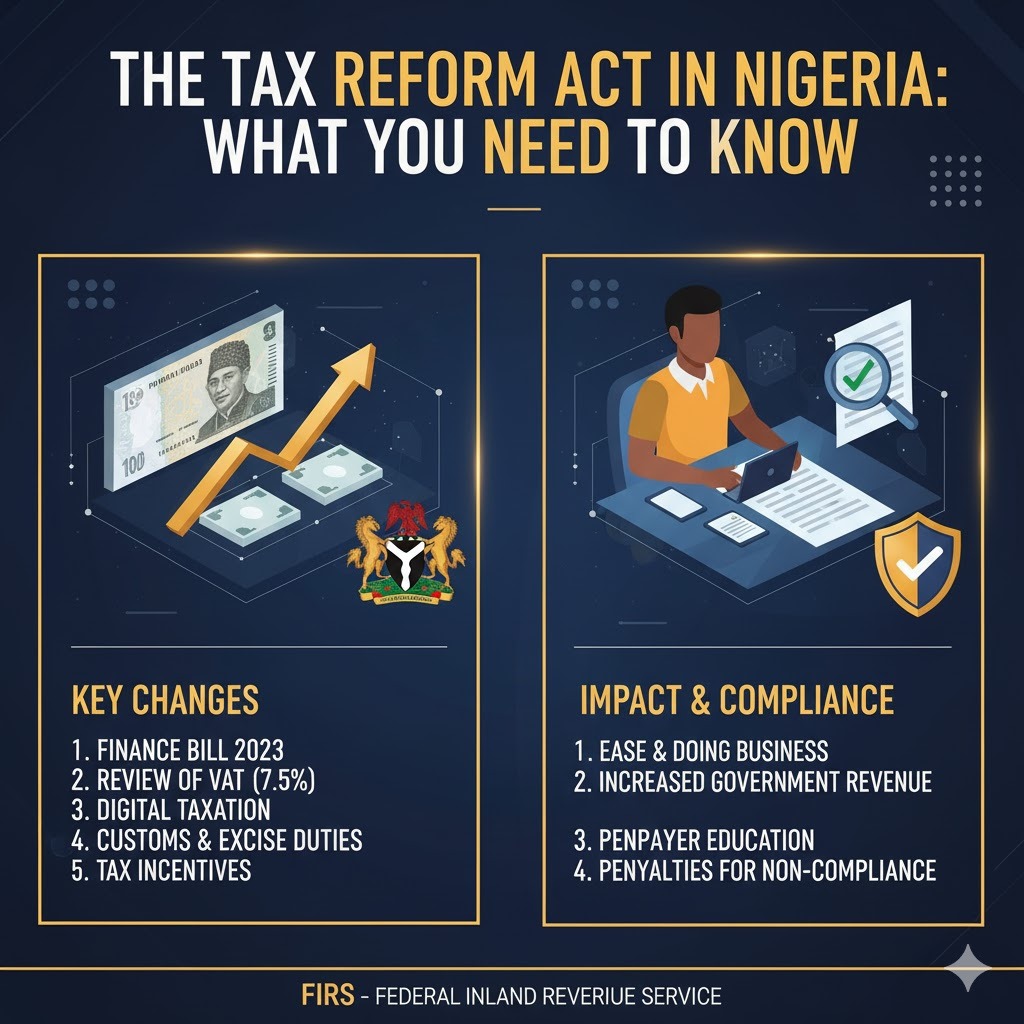
The Tax Reform Act
There’s been a growing buzz across social media and everyday conversations about Nigeria’s new tax laws. From WhatsApp broadcasts to market gossip, many are saying that starting January 1, 2025 every credit alert will be taxed as personal income tax and that every Nigerian must now get a Tax Identification Number (TIN) or risk having their account frozen. But how true are these claims?
This article takes a closer look at the Nigeria Tax Act 2025 and its companion laws, unpacking what’s fact, what’s fiction, and what Nigerians should genuinely prepare for. Beyond the viral headlines, clickbaits, and the online panic, it’s important to understand what the law actually says and how these reforms aim to reshape tax compliance, not just how citizens use their bank accounts.
What does the law actually say?
The Nigeria Tax Act 2025 (NTA 2025) is has repealed several old tax statutes, including the Personal Income Tax Act, Companies Income Tax Act, and Value Added Tax Act. Basically, it consolidates Nigeria’s major tax laws into a single, comprehensive framework. [here for reference- https://ekosolicitors.com/the-new-tax-reform-act-in-nigeria-what-you-need-to-know-about-the-new-dawn-of-fiscal-policy/ ].
Section 3 of the NTA 2025 says that income tax shall be imposed on the income, profits, or gains of any company, individual, family, trustee, or estate. In simple terms, if you earn money whether from a business, salary, rent, or digital assets, you’re expected to pay tax on that income. But note the key phrase is “income, profits, or gains.” The law does not say “every deposit into your bank account.” Money transfers, gifts, or your mum sending you ₦1000 for data don’t suddenly qualify as taxable income.
The Act also clarifies what counts as taxable income under Section 4, under the heading income, profits or gains chargeable to tax, to include profits from business or trade, salaries and allowances, dividends, rents, and royalties, and income from digital or virtual assets. So, if your income falls under those categories, then yes, it is taxable. But if the money in your account isn’t income per se, the law doesn’t automatically touch it.
Who then needs the TIN?
The Nigeria Tax Administration Act 2025 (NTAA 2025), in Sections 4 to 8, makes it mandatory for every taxable person to register with the relevant tax authority and obtain a Tax Identification Number (TIN) now referred to as a Tax ID.
Who Is a Taxable Person?
The law defines it broadly to include anyone required to comply with the tax laws, whether in their personal capacity or on behalf of another person. In simpler terms, if you run a business, are self-employed, earn an income from a profession or trade, or receive employment income, then you’re a taxable person and are expected to have a Tax ID.
The law goes further in Section 8(1) to say that a Tax ID must appear on documents used for tax compliance and even on contracts or transactions involving government agencies, banks, insurance companies, and similar institutions.
What the Act doesn’t say is that you can’t have a bank account without a Tax ID. It does say however, that financial institutions should ensure that taxable persons (that is, people or entities engaged in taxable activities) have a Tax ID for compliance purposes. So students receiving allowances, or someone whose only inflows are gifts or personal transfers need not be fettered with unnecessary thoughts or even go as far as taking out all their money from their banks. The conclusion then is that your bank will not suddenly start deducting “personal income tax” from every transfer you receive.
What Then Is the Importance?
By requiring taxable persons to have a Tax ID, the government can create a unified database linking individuals, businesses, and their financial activities. The Joint Revenue Board (Establishment) Act 2025 even mandates the integration of taxpayer information across federal, state, and local tax authorities, which is a move aimed at ending double taxation, fraud, and lost revenue.
But beyond policy, it also matters for you and me; and here’s why:
- Transparency and accountability: With everyone properly registered, tax evasion becomes harder, and government revenue can be more accurately tracked.
- Ease of compliance: Having a Tax ID means your records are streamlined; you won’t need to fill multiple forms or prove your identity repeatedly.
- Future-proofing your finances: For professionals, business owners, or freelancers, having a Tax ID is becoming as important as having a BVN as it is how you show you’re compliant and eligible for certain contracts, grants, or opportunities.
There also exist certain challenges with the Acts. For one, public misunderstanding remains a major hurdle. Many Nigerians first heard about the reforms through viral voice notes and tweets, not official communication, which is why the misinformation spread faster than the actual text of the law. There is also the issue of digital and infrastructural readiness.
The NTAA 2025 empowers tax authorities to deploy technology for compliance and verification (see Section 71), but the systems linking banks, tax offices, and identity databases aren’t yet seamless. Without proper coordination, people could face delays, double registrations, or even wrongful classification as non-compliant. Then there’s the problem with the fact that many small business owners in the informal sector do not keep financial records or even know what counts as taxable income.
Expecting them to suddenly register for a Tax ID and file returns without massive sensitisation could lead to confusion and eventually, non-compliance. Lastly, trust remains a big challenge. Nigerians are more willing to pay tax when they believe they’ll see results good roads, working hospitals, uninterrupted power. Until governance catches up with taxation, public sc
skepticism will remain a stumbling block.
Conclusively
The Nigeria Tax Act 2025 and its companion laws, the Tax Administration Act 2025 and the Joint Revenue Board (Establishment) Act 2025, represent one of the boldest mechanisms of Nigeria’s tax system in recent history. But they do not mean that every inflow into your account will be taxed, nor that every Nigerian must rush to get a Tax ID tomorrow.
As the reforms take effect in January 2026, the best thing Nigerians can do is stay informed, understand who the law actually targets, confirm their tax status, and follow verified channels and not viral chats for updates. In the end, the real issue isn’t whether every credit alert will be taxed; it’s whether we can build a system where everyone contributes fairly and sees the value in doing so.
CONTRIBUTORS

Managing Partner, EKO SOLICITORS AND ADVOCATES

Counsel, EKO SOLICITORS AND ADVOCATES

CHINWENDU MBANU
Graduate Trainee, EKO SOLICITORS AND ADVOCATES
(The Tax Reform Act, The Tax Reform Act, The Tax Reform Act, The Tax Reform Act, The Tax Reform Act)