

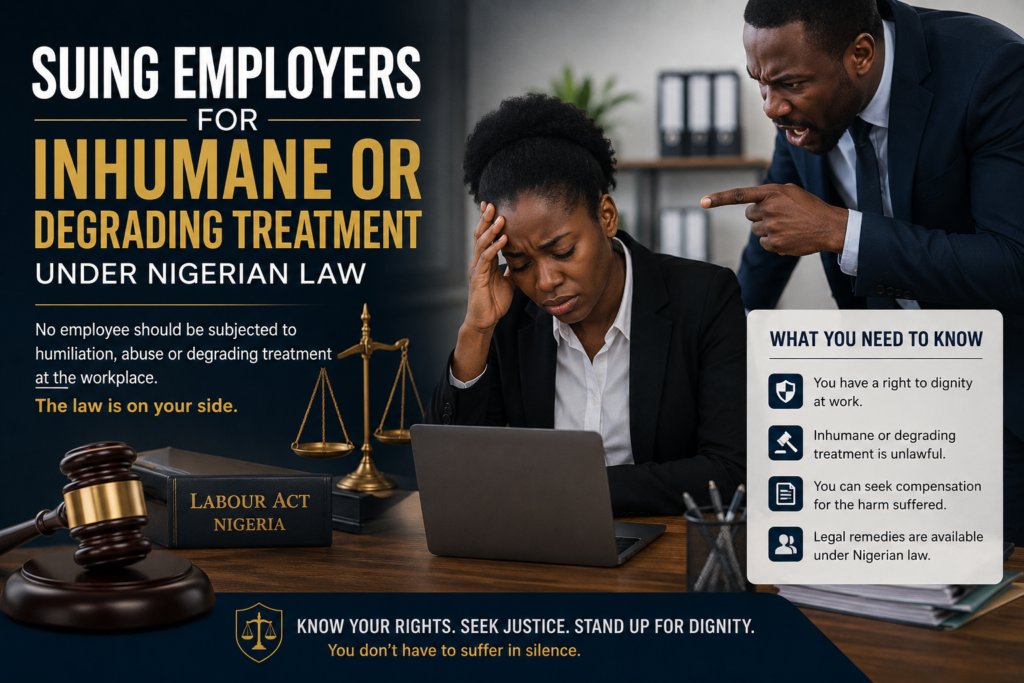
Introduction to inhumane or degrading treatment
In boardrooms, open offices, factory floors, and digital workspaces across Nigeria, a silent epidemic persists. Employees are shouted at, belittled, isolated, humiliated, and subjected to conditions that erode their dignity on a daily basis. Victims are routinely told to endure the abuse, to remain professional, or to be grateful they have a job at all. The law, however, says something entirely different.
Workplace bullying and harassment, when sufficiently severe, are not merely managerial misconduct or interpersonal disputes. They constitute violations of a worker’s fundamental human rights. Nigerian law, anchored in the Constitution and reinforced by a growing body of international labour standards and judicial decisions, provides robust remedies for employees who have been subjected to inhuman or degrading treatment in the course of their employment.
This article examines the constitutional and statutory framework governing workplace harassment in Nigeria, the international obligations Nigeria has assumed, the specific forum in which claims must be pursued, the legal basis for employer liability, what claimants must prove, and the remedies available to them. It is intended as both a legal reference for practitioners and an accessible guide for employees who are confronting abuse in their workplaces and considering their legal options.
The Constitutional Bedrock: Section 34(1)Inhumane or Degrading Treatment
The most powerful tool in an employee’s arsenal is the Constitution of the Federal Republic of Nigeria 1999 (as amended). Section 34(1) provides the primary constitutional protection for human dignity. It states unambiguously: [1]
“Every individual is entitled to respect for the dignity of his person, and accordingly (a) no person shall be subjected to torture or to inhuman or degrading treatment…”
The constitutional guarantee of dignity is not confined to the realm of criminal law or state action. It extends horizontally to private relationships, including the employer-employee relationship. When bullying becomes so severe that it materially affects an employee’s mental health, self-worth, or physical well-being, the conduct transcends a mere workplace dispute and becomes a justiciable fundamental rights issue. The National Industrial Court of Nigeria (NICN) has increasingly relied on this constitutional provision as the primary basis for awarding substantial damages against employers who permit or perpetuate cultures of workplace abuse.
It is essential to appreciate that Section 34(1) is not merely a civil wrong actionable in the abstract. It is a constitutionally guaranteed right enforceable directly before a court of competent jurisdiction. Employers who allow their managers, supervisors, or colleagues to degrade workers are not only incurring civil liability. They are facilitating a breach of Nigeria’s supreme legal instrument.
The significance of grounding a harassment claim in constitutional terms cannot be overstated. Unlike ordinary civil claims, constitutional rights violations carry a presumption of gravity, attract a broader range of remedies, and can result in awards of general, aggravated, and in exceptional cases exemplary damages. They also enable the court to make declaratory orders of lasting significance to the parties and to the broader workplace environment.
The International Standard: ILO Convention No. 190
Nigeria made a landmark commitment to the protection of workers from workplace violence and harassment by ratifying the International Labour Organization (ILO) Violence and Harassment Convention, 2019 (No. 190). This instrument, one of the most progressive in the history of international labour law, entered into force globally on 25 June 2021 and has since become central to how workplace harassment claims are framed before the NICN.[2]
The significance of Nigeria’s ratification goes well beyond diplomatic symbolism. Under Section 254C(1)(f) and (h) of the 1999 Constitution, as introduced by the Third Alteration Act 2010, the National Industrial Court is expressly mandated to apply international best practices and treaties ratified by Nigeria in the determination of labour disputes.[3] Convention No. 190 is therefore not merely persuasive authority before the NICN. It is a binding normative standard that shapes how the court interprets and applies domestic law.
Convention No. 190 defines violence and harassment broadly as behaviours that aim at, result in, or are likely to result in physical, psychological, sexual, or economic harm. Several features of this definition are of particular practical relevance to Nigerian litigants. First, the Convention’s reach is not limited to conduct occurring within the physical premises of the employer. It explicitly covers work-related conduct that occurs during commutes, at work-related events and social functions, through work-related communications, and via digital platforms.
This breadth is transformative. An employee who is harassed via WhatsApp by a supervisor at midnight, or who is publicly humiliated in a virtual meeting on a digital platform, is equally protected as one who is abused face to face in the office.[4] The workplace, under this Convention, is wherever work happens. Employers are required to adopt and implement a workplace policy on violence and harassment, to take measures to prevent and address such conduct, and to provide victims with access to remedies.[5]
The Jurisdiction: The National Industrial Court of Nigeria
For any employee seeking to litigate a workplace harassment claim in Nigeria, the National Industrial Court of Nigeria is the mandatory and exclusive forum. The NICN was established as a superior court of record by the National Industrial Court Act 2006 and its jurisdiction was constitutionally entrenched by the Third Alteration Act 2010.[6]
The NICN has exclusive jurisdiction over all civil causes and matters relating to labour, employment, trade unions, and industrial relations in Nigeria. More specifically, and directly relevant to workplace harassment claims, the court exercises jurisdiction over matters involving discrimination at the workplace, sexual harassment, and cruel, inhuman, or degrading treatment at the workplace.
Order 14 of the NICN Civil Procedure Rules 2017 makes specific provision for the enforcement of fundamental rights within the court’s jurisdiction.[7] This is an important procedural mechanism that enables claimants to invoke their constitutional rights to dignity and fair treatment directly before the court without the procedural hurdles that ordinarily accompany applications to the High Courts for fundamental rights enforcement. The NICN also applies a more flexible approach to rules of evidence in labour matters, which is of significant practical advantage in harassment cases where direct documentary evidence may be limited.[8]
Beyond procedural advantages, the NICN offers a forum staffed by judges who specialise in labour and employment law. Unlike High Court judges who deal with the full spectrum of civil litigation, NICN judges develop institutional familiarity with the dynamics of workplace relationships, power structures, and the psychological dimensions of employment disputes. This specialisation is a genuine advantage in harassment cases, which often turn on nuanced assessments of workplace culture, managerial authority, and the cumulative impact of conduct that might appear innocuous in isolation.
Vicarious Liability: Can You Sue the Company?
One of the questions most frequently posed by employees who have experienced workplace harassment is whether the company itself can be held liable for the actions of individual perpetrators. The answer, under Nigerian law, is generally yes, by virtue of the doctrine of vicarious liability, supplemented by the emerging doctrine of direct employer liability for failure to maintain a safe workplace.
Vicarious liability operates on the principle that an employer is held responsible for torts committed by an employee in the course of their employment.[9] Where harassment occurs in the course of the employment relationship, either through the exercise of managerial authority or in circumstances sufficiently connected to the performance of the employee’s duties, the employer is liable regardless of whether it authorised the specific conduct. The rationale is firmly grounded in policy: an employer who derives the economic benefits of its workforce should equally bear the risks associated with the conduct of that workforce.
The NICN authoritatively addressed employer liability for workplace harassment in Ejieke Maduka v. Microsoft Nigeria Ltd & Others (2014),[10] a foundational decision in Nigerian workplace harassment jurisprudence. In that case, the court held both Microsoft Nigeria Limited and the senior executive personally responsible for sexual harassment perpetrated in the workplace. The court established that an employer owes a non-delegable duty of care to provide all employees with a safe working environment, free from harassment, bullying, and conduct that violates their dignity.
Critically, the court in Maduka rejected the argument that the employer could insulate itself from liability on the basis that it was not the direct perpetrator of the harassment.[11]
Elements of Proof Inhumane or Degrading Treatment
To successfully establish a claim for inhuman or degrading treatment in the workplace before the NICN, the employee as claimant generally bears the burden of establishing the following elements. While the NICN has demonstrated welcome flexibility in how evidence is assessed in harassment matters, the stronger and more comprehensive the evidentiary foundation, the greater the likelihood of a successful outcome.
1. Repetitive or Sufficiently Severe Conduct
Workplace bullying is typically characterised by a pattern of repeated conduct rather than isolated incidents.[12] Courts have recognised that the cumulative effect of individually minor incidents can, over time, constitute severe and degrading treatment. This pattern may include repeated verbal abuse or threats, consistent exclusion from team communications, ongoing public humiliation in meetings, deliberate withholding of information or resources necessary for the performance of one’s duties, or the systematic sabotage of an employee’s professional reputation.
While a pattern is the norm, a single incident of extreme severity may in certain circumstances suffice. The deliberate and public humiliation of an employee in front of colleagues, a serious physical threat, or conduct that causes immediate and severe psychological injury may independently constitute degrading treatment without the need to demonstrate repetition.
Claimants are strongly advised to document every incident contemporaneously, including the date, time, location, the precise nature of the conduct, the identity of witnesses, and the immediate effect on their wellbeing. This documentation, whether maintained as a personal record, captured through emails or messages, or corroborated by witness statements, forms the evidentiary backbone of any claim.
2. Power Imbalance Inhumane or Degrading Treatment
A defining characteristic of workplace bullying, as distinct from ordinary interpersonal conflict, is the exploitation of authority or positional power to intimidate, belittle, or control a subordinate.[13] This power imbalance may arise from a formal line management relationship, from financial control over an employee’s remuneration or prospects, from institutional seniority, or from social dynamics within the workplace that place certain employees in a structurally vulnerable position.
Demonstrating a power imbalance serves multiple forensic purposes. It distinguishes the conduct from a bilateral dispute between peers of equal standing. contextualises the victim’s response to the harassment, including any failure to report it promptly, which might otherwise be interpreted as inconsistent with genuine distress. It also reinforces the employer’s responsibility to intervene, since an employer is in a uniquely powerful position to address abuse by those in positions of authority within its own hierarchy.
3. Hostile Work Environment and Constructive Dismissal
Evidence that the workplace had become objectively intolerable is central to many harassment claims, and is essential where the claimant has left employment rather than remaining and enduring the conduct.[14]
The concept of constructive dismissal, increasingly recognised in Nigerian jurisprudence, holds that where an employer’s conduct has rendered the terms or conditions of employment so hostile, unreasonable, or intolerable that no reasonable employee could be expected to continue, the employee’s resignation may be treated in law as a termination by the employer.[15] This concept is of critical importance in harassment cases, because victims of sustained bullying frequently resign in desperation rather than waiting to be formally dismissed. Without the doctrine of constructive dismissal, such employees would be unable to claim the remedies associated with wrongful termination.
To establish a hostile work environment claim, the claimant should adduce evidence from multiple sources: personal testimony, corroborating witness accounts, records of the internal complaints process, medical evidence of psychological deterioration, and any communications that demonstrate the employer’s knowledge of and indifference to the conduct.
4. Psychological and Physical Harm Inhumane or Degrading Treatment
Medical evidence documenting the psychological or physical impact of workplace harassment is a powerful tool before the NICN. A certified medical report diagnosing anxiety, depression, post-traumatic stress disorder, adjustment disorder, or a stress-induced physical illness, produced by a qualified psychiatrist, psychologist, or general practitioner, carries significant evidential weight.[16]
Courts have increasingly acknowledged the real, lasting, and sometimes irreversible damage that severe workplace harassment inflicts on a person’s mental health, professional capacity, and quality of life. Where the medical evidence is compelling, it not only establishes the harm element of the claim but also tends to drive up the quantum of damages awarded, particularly general and aggravated damages.
Claimants should seek medical attention promptly upon experiencing symptoms attributable to workplace stress or harassment. Delays in seeking treatment may provide an employer with ammunition to argue that the harm was not causally related to the workplace conduct, or that it was not sufficiently serious to warrant legal redress.
Remedies Available to Victims Inhumane or Degrading Treatment
The principal remedies include the following:
- General damages for pain, suffering, psychological harm, and loss of enjoyment of life sustained as a direct consequence of the harassment.
- Aggravated damages where the employer’s conduct was particularly egregious, high-handed, or involved a cynical disregard for the employee’s dignity. Aggravated damages have been awarded where employers retaliated against employees who raised complaints, or where the harassment was accompanied by threats or financial coercion.
- Special damages for quantifiable financial losses, including lost wages and benefits arising from forced resignation, out-of-pocket medical expenses, and costs of professional psychological treatment.
- Reinstatement or re-engagement where the claimant was dismissed or constructively dismissed, and where the court considers it just and equitable to restore the employment relationship.
- Injunctive relief directing the employer to take specific corrective action, including the removal of the perpetrator from the claimant’s work environment, the implementation or revision of a workplace anti-harassment policy, or the conduct of mandatory training for managers and supervisors.
- Declaratory orders affirming that the claimant’s fundamental right to dignity under Section 34(1) of the Constitution was violated. Such declarations carry both symbolic and practical weight, imposing reputational consequences on the employer and creating public accountability.
The court has also, in appropriate cases, made orders for the employer to issue a formal apology to the claimant.[18] While this may appear modest, the symbolic value of a compelled institutional apology should not be understated. For many victims of workplace harassment, public vindication is as important as financial compensation.
Practical Considerations for Victims
For employees who are experiencing workplace harassment and are considering legal action, several practical steps are critical to preserving and strengthening any future claim.
Document Comprehensively Inhumane or Degrading Treatment
Maintain a detailed contemporaneous record of every incident. Written records, emails, text messages, WhatsApp communications, screenshots of digital interactions, and notes of verbal incidents, recorded as soon as practicable after they occur, all constitute potential evidence. The record should capture dates, times, locations, descriptions of the conduct, the identities of those present, and the claimant’s reaction and wellbeing at the time. Courts are assisted by the granularity and contemporaneity of such records.
Exhaust Internal Processes
Where the employer has a grievance or anti-harassment procedure, victims should utilise it before commencing litigation. This is important for two reasons. First, it is procedurally required in some cases before a claim can be pursued. Second, and perhaps more significantly, the employer’s response (or non-response) to a formal internal complaint provides powerful evidence at trial. An employer who received a detailed harassment complaint, took no action, and allowed the conduct to continue has done the claimant’s case a considerable service.
Act Within the Limitation Period
Limitation periods apply to employment claims and vary by state and by the nature of the claim.[19] Delay in filing can result in a claim being statute-barred, regardless of its underlying merits. Victims should seek legal advice promptly rather than waiting to see whether the conduct will abate or resolve informally. The moment an employee decides to pursue a claim, the clock is running.
Seek Professional Legal Advice
An experienced employment lawyer can assess the strength of the available evidence, identify all potential defendants (including both the employer and individual perpetrators), advise on the quantum of relief to seek, and navigate the procedural requirements of the NICN. While the court does not formally require legal representation,[20] representation is strongly advisable given the procedural complexity of harassment litigation, the tactical advantages that experienced counsel brings, and the importance of presenting evidence in a structured and persuasive manner.
Protect Against Retaliation Inhumane or Degrading Treatment
Retaliation by employers against employees who raise harassment complaints is itself an actionable wrong. Victims who are subjected to punitive transfers, arbitrary performance management processes, exclusion from career opportunities, or dismissal following the raising of a complaint should document these acts of retaliation carefully and include them in their claim. The NICN has shown willingness to treat employer retaliation as aggravating conduct that attracts higher damages.
Conclusion Inhumane or Degrading Treatment
The era of suffering in silence is giving way to a new legal consciousness among Nigerian workers. The convergence of constitutional protection, international labour standards, specialised judicial infrastructure, and a growing body of precedent has collectively constructed a formidable framework for protecting employees from the worst forms of workplace conduct.
Bullying and harassment are not rites of passage. They are not the inevitable cost of employment in a competitive environment. They are not a management style to be tolerated in exchange for a monthly salary. When they rise to the level of inhuman or degrading treatment, they are actionable wrongs for which employers must answer before the courts.
An employer’s failure to protect its workforce is not merely an operational or reputational failure. It is a legal liability. Where the conduct is sufficiently grave, it is a violation of the highest law of the land. The Constitution of Nigeria does not stop at the entrance to the workplace. Its guarantee of dignity travels with every employee, to every desk, every factory floor, and every digital workspace where Nigerian workers spend their professional lives.
For employees who have endured abuse, humiliation, or systematic degradation at work, the courts of Nigeria are open, the law is clear, the precedents are growing in number and in confidence, and the right to dignity is not negotiable.
REFERENCES
[1]Constitution of the Federal Republic of Nigeria 1999 (as amended), s 34(1).
[2]ILO Violence and Harassment Convention, 2019 (No. 190), Art. 1(1).
[3]Constitution of the Federal Republic of Nigeria (Third Alteration) Act 2010, s 254C(1)(f) and (h).
[4]ILO Convention No. 190, Art. 3.
[5]ILO Convention No. 190, Art. 9
[6]National Industrial Court Act 2006, s 7.
[7]NICN Civil Procedure Rules 2017, Order 14.
[8]Ibid.
[9]See generally: H Collins, ‘Harassment and the Law of Torts’ (2006) 35 Industrial Law Journal 129.
[10]Ejieke Maduka v. Microsoft Nigeria Ltd & Others (2014) NICN/LA/492/2012
[11]Ejieke Maduka v. Microsoft Nigeria Ltd & Others (2014), supra n 2.
[12]M Yamada & L Bachman, ‘Measuring the Workplace Harassment Experience’ (2021) Journal of Occupational Health Psychology 76(2), 198.
[13]National Industrial Court Act 2006, s 12(1); see also Esso West Africa Inc. v. Alli (1968) NNLR 3.
[14]Oluwafemi v. Zenith Bank Plc (2018) NICN/LA/272/2015 (unreported, NICN Lagos Division).
[15]Employment Rights Act 1996 (UK), s 95(1)(c)
[16]American Psychiatric Association, Diagnostic and Statistical Manual of Mental Disorders (5th edn, APA Press 2013); World Health Organization, ICD-11 Classification of Mental and Behavioural Disorders (WHO 2022).
[17]Constitution of the Federal Republic of Nigeria 1999 (as amended), s 46(1); NICN Civil Procedure Rules 2017, Order 14, r 3.
[18]Abiodun v. First Bank of Nigeria Plc (2020) NICN/LA/519/2016 (unreported).
[19]Limitation Law of Lagos State, Cap L67, Laws of Lagos State 2015, s 8 (three-year limitation for personal injury claims)
CONTRIBUTORS

LEAD PARTNER, EKO SOLICITORS AND ADVOCATES

COUNSEL, EKO SOLICITORS AND ADVOCATES
Inhumane or Degrading Treatment,Inhumane or Degrading Treatment,Inhumane or Degrading Treatment,Inhumane or Degrading Treatment,Inhumane or Degrading Treatment,Inhumane or Degrading Treatment,Inhumane or Degrading Treatment,Inhumane or Degrading Treatment,Inhumane or Degrading Treatment,Inhumane or Degrading Treatment,Inhumane or Degrading Treatment,Inhumane or Degrading Treatment,Inhumane or Degrading Treatment,Inhumane or Degrading Treatment,Inhumane or Degrading Treatment,Inhumane or Degrading Treatment,Inhumane or Degrading Treatment,Inhumane or Degrading Treatment