

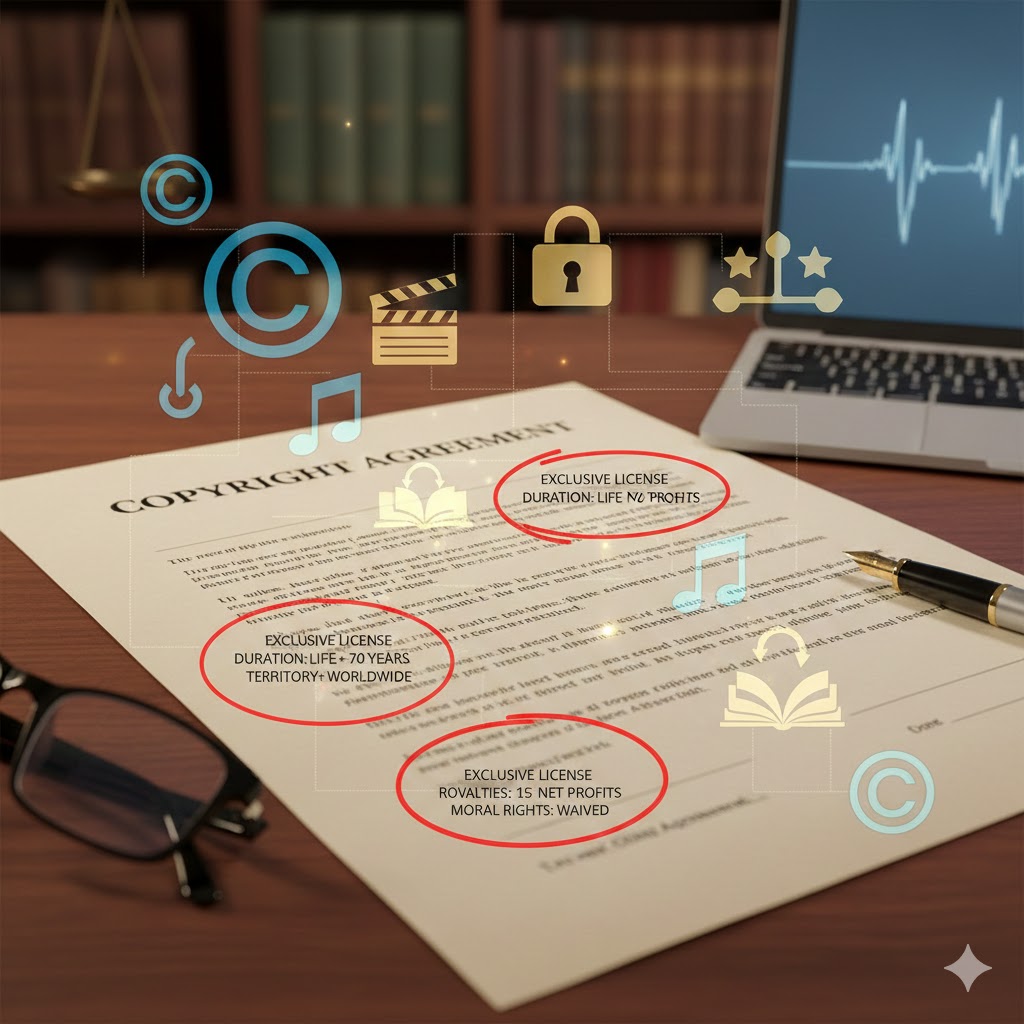
Scenario: When a Copyright Contract Goes Wrong
X just got an offer from a big publishing house that wants to use her illustrations in a children’s book. The contract looks long and filled with legal jargons, but she’s excited and signs it without much thought. Months later, she sees her art being used on T-shirts, bags, and even in an animated series. None of this was in the original deal, not what she thought. She isn’t getting paid extra, and she’s definitely not credited.
What went wrong?
Why Copyright Contract Matters
Copyright contract exist, from publishing deals to licensing agreements, production contracts to freelance commissions. These agreements define who controls creative work, how it can be used, and who gets paid when it’s exploited.
Unfortunately, many creators sign away vital rights without realising the long-term consequences. Imagine you create something valuable, sign a copyright contract without understanding the fine print, and suddenly, you’ve given away more than you bargained for. Copyright is protected in nIgeria by the Copyright Act.
Important Clauses in a Copyright Contract
Thus, it is essential to understand the key clauses that often shape the entire deal. Here are six clauses every creator or rightsholder should carefully review before signing a copyright contract.
1. Grant of Rights in a Copyright Contract: What Exactly Are You Giving Away?
Think of this as the heart of the contract. It spells out who can use your work, how they can use it, where, and for how long. It outlines whether rights are being assigned (permanently transferred) or licensed (shared or temporarily granted) and should specify exactly what uses are permitted, such as reproduction, distribution, adaptation, public performance, digital transmission, and so on.
The grant should also be limited by time (how long it lasts), territory (where the rights apply), and media (how the work can be used). A vague or overly broad grant can result in the other party gaining far more control than the creator intended, including the ability to sublicense or alter the work without further approval.
Many contracts ask for broad rights, sometimes more than is reasonable for the deal. That’s why it’s important to first get a lawyer.
2. Royalty Clause in a Copyright Contract: How and When Will You Be Paid?
The royalty clause addresses how the creator will be compensated. Depending on the industry and the nature of the agreement, payment may come as a one-time, flat fee, recurring royalties based on revenue, or a combination of both.
It’s important to look at the royalty rate. You should ask: How much will you earn per use or sale? How often will you be paid? Will you get reports showing how your work was used? What counts as “net revenue”?
Some contracts also allow for accounting audits, giving creators the right to verify that they’re being paid accurately. Without careful attention to this clause, creators may earn far less than their work is worth.
If your work is expected to generate long-term income, a royalty arrangement (with clear accounting rights) might be the smarter move.
3. Ownership Clause in a Copyright Contract: Who Keeps the Copyright?
This clause defines who legally owns the copyright after the contract is executed. In some cases, especially in work-for-hire scenarios, the hiring party may automatically claim ownership of the work. In other agreements, the creator might be transferring ownership without fully realising the implications.
Ownership determines long-term control and the ability to license or monetise the work in the future. Let’s say you composed a jingle, and a client uses it in their ad campaign. Do you still own that jingle, or did you give it away entirely?
Copyright contracts often include a clause about the assignment of ownership. If you assign it, you’re handing over your rights forever. If you license it, you still own the work, but allow them to use it under agreed conditions. Assignment is governed by
The difference? If you assign it, they can reuse, resell, or remix it however they want, and you won’t have a say or a share. So always ask: Am I licensing my work or transferring full ownership?
4. Identification or Credit Clause: Will You Be Acknowledged?
While often overlooked, the identification or credit clause is vital to a creator’s visibility and professional reputation. It governs how the creator is acknowledged when the work is used—whether in publication, display, marketing, or performance.
This clause should specify when and how credit must be given and what recourse exists if it’s not. In some countries, this ties into moral rights, which protect the creator’s name and reputation in connection with their work. Don’t let your name be left out of your own success story.
5. Exclusivity Clause in a Copyright Contract: Can You Work With Others?
The exclusivity clause determines whether the rights are exclusive or non-exclusive. An exclusive agreement means only the receiving party can use or exploit the work, while a non-exclusive agreement allows the creator to license the same work to others.
This clause can significantly impact the creator’s flexibility and earning potential. Broad or indefinite exclusivity can tie your hands creatively and commercially.
Tip: To protect yourself to limit exclusivity by time, region, or use. That way, you still have freedom after the term ends or outside the scope.
6. Termination and Reversion Clause: Can You Get Your Rights Back?
Termination and reversion clauses outline how the contract can be terminated and when the rights might revert to the creator. These clauses are especially important for long-term agreements or where the work is no longer being actively used.
Common triggers for termination include breach of contract, failure to pay royalties, or non-use of the work for a specified period. A well-drafted clause ensures the creator can reclaim control rather than be locked into an outdated or unproductive agreement indefinitely.
This clause is your safety net. Without it, you might be locked into a dead deal or lose control of your work.
Conclusion: Important Clauses in Copyright Contract
In the creative world, your work is your asset. A copyright contract can either protect that asset or give it away for less than it’s worth.
So before you sign:
Read everything, especially the six clauses above;
Ask for clarification on anything vague or technical;
Don’t forget to get a lawyer!
CONTRIBUTORS

Ojienoh Segun Justice Esq.,
Lead Partner, Eko Solicitors & Advocates

Rindap Nanjul Danjuma Esq.,
Counsel eko solicitors & Advocates

Bessie Obort Ofuka
Graduate Trainee, Eko Solicitors & Advocates