

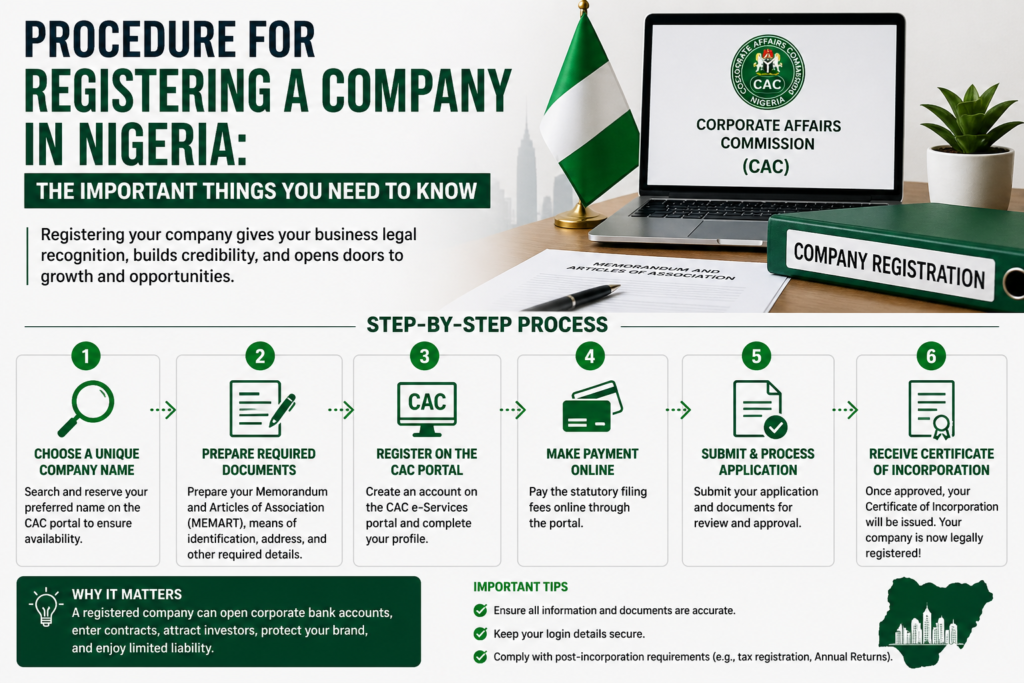
Introduction to registering a company
Company registration is not merely a procedural formality; it confers legal personality on the business, enabling it to exist independently of its owners, own assets, sue and be sued, and enjoy perpetual succession.
This article sets out, in detail, the step-by-step procedure for registering a company in Nigeria, alongside the legal implications of each stage.
STEP-BY-STEP PROCEDURE FOR REGISTERING A COMPANY
1. Preliminary Considerations: Choosing the Appropriate Business Structure
The first and most crucial step is determining the type of company to be registered. Under CAMA 2020, the recognized forms of companies include:
- Private Company Limited by Shares (Ltd)
- Public Company Limited by Shares (PLC)
- Company Limited by Guarantee
- Unlimited Company
A private company limited by shares remains the most commonly used structure for entrepreneurs due to its distinct advantages:
- Liability of members is limited to unpaid shares
- It requires a minimum of one shareholder
- restricted from offering shares to the public
- It enjoys less stringent regulatory requirements compared to public companies
By virtue of Section 18(2) of CAMA 2020, a single individual may form and incorporate a company, a significant departure from the previous requirement of at least two persons.
2. Name Availability Search and Reservation before registering a company
A company must be registered under a unique and distinguishable name. The proposed name must comply with statutory requirements and must not:
- Be identical or confusingly similar to an existing registered entity
- Contain restricted expressions such as “National,” “Government,” or “Holdings” without approval
- Be deceptive, misleading, or contrary to public policy
An application for name reservation is made through the CAC online portal. Upon approval, the name is reserved for 60 days, within which incorporation must be completed.
The legal significance of this stage is that it prevents duplication and protects the identity of the business in the corporate registry.
3. Preparation of Incorporation Documents
Once the name is reserved, the promoter proceeds to prepare the statutory incorporation documents. These documents are foundational, as they define the company’s structure, governance, and operational scope.
a. Memorandum of Association
This document sets out:
- The name of the company
- The registered office address
- The object(s) of the company
- The liability of members
- The share capital clause
It essentially defines the external scope of the company’s activities.
b. Articles of Association registering a company
The Articles regulate the internal management of the company, including:
- Appointment and powers of directors
- Conduct of meetings
- Transfer of shares
- Voting rights
Under CAMA 2020, model articles may be adopted or modified.
c. Statement of Share Capital registering a company
For a private company, the minimum issued share capital is ₦100,000. The shareholding structure must be clearly stated, including:
- Number of shares allotted
- Shareholders and their respective holdings
d. Particulars of Directors and Shareholders
The following details must be provided:
- Full names
- Residential addresses
- Occupation
- Date of birth
- Valid means of identification
Directors must not be disqualified under the law (e.g., undischarged bankrupts or persons convicted of fraud-related offences).
e. Registered Office Address
Every company must have a registered address in Nigeria where official correspondence can be served.
f. Statement of Compliance
A legal practitioner or accredited agent certifies that all requirements of CAMA have been complied with.
4. Filing and Submission through the CAC Portal
The incorporation process is carried out electronically via the CAC Company Registration Portal (CRP). The steps include:
- Completion of the online application form (CAC Form 1.1)
- Upload of incorporation documents
- Payment of filing fees
The CAC examines the submitted documents to ensure compliance with statutory requirements. Where discrepancies exist, queries may be raised for correction.
5. Payment of Statutory Fees and Stamp Duties
Stamp duties are payable on the company’s share capital and are assessed in accordance with applicable laws. This payment is processed through integration with the Federal Inland Revenue Service (FIRS).
Additionally, CAC filing fees are based on the company’s share capital. Proper payment is essential, as underpayment or non-payment may invalidate the registration process.
6. Approval and Issuance of Certificate of Incorporation
Upon successful verification, the CAC registers the company and issues:
- Certificate of Incorporation
- Memorandum and Articles of Association (stamped and certified)
- Status Report (showing company details)
The legal effect of incorporation was famously established in the case of Salomon v Salomon & Co Ltd, where the court affirmed that a registered company becomes a separate legal entity distinct from its shareholders.
7. Post-Incorporation Compliance Requirements
Incorporation is not the final step. Companies must comply with several post-registration obligations:
a. Tax Registration
The company must obtain a Tax Identification Number (TIN) from the Federal Inland Revenue Service (FIRS). This is necessary for tax compliance, including Companies Income Tax and Value Added Tax (VAT).
b. Opening a Corporate Bank Account
Banks typically require:
- Certificate of Incorporation
- MEMART
- Board resolution authorizing account opening
c. Business Permits and Licenses
Depending on the nature of the business, additional regulatory approvals may be required (e.g., NAFDAC, SEC, or industry-specific licenses).
d. Statutory Registers and Records
Companies are required to maintain:
- Register of members
- Register of directors
- Minutes of meetings
e. Filing of Annual Returns
Every company must file annual returns with the CAC to confirm that it is still in operation. Failure to do so may result in penalties or striking off.
8. Practical and Legal Considerations before registering a company
While the registration process has been simplified, certain practical issues should be noted:
- Errors in documentation can delay approval
- Engaging a legal practitioner ensures compliance and proper drafting of MEMART
- Choice of shareholding structure has long-term implications for control and investment
- Regulatory compliance continues beyond incorporation
CONCLUSION
The procedure for registering a company in Nigeria, though systematic, requires careful attention to statutory requirements under the Companies and Allied Matters Act 2020. From name reservation to post-incorporation compliance, each stage carries legal significance that impacts the validity and operation of the business. A properly registered company enjoys the benefits of legal recognition, limited liability, and credibility, positioning it for sustainable growth within Nigeria’s dynamic business environment. Your Legal Practitioner plays a vital role in the registration of your company; do not forget.
Contributors

OJIENOH SEGUN JUSTICE, ESQ.,
Lead Partner, EKO SOLICITORS AND ADVOCATES

Counsel EKO SOLICITORS AND ADVOCATES

Faith Ogunleye
Graduate Trainee, EKO SOLICITORS AND ADVOCATES