

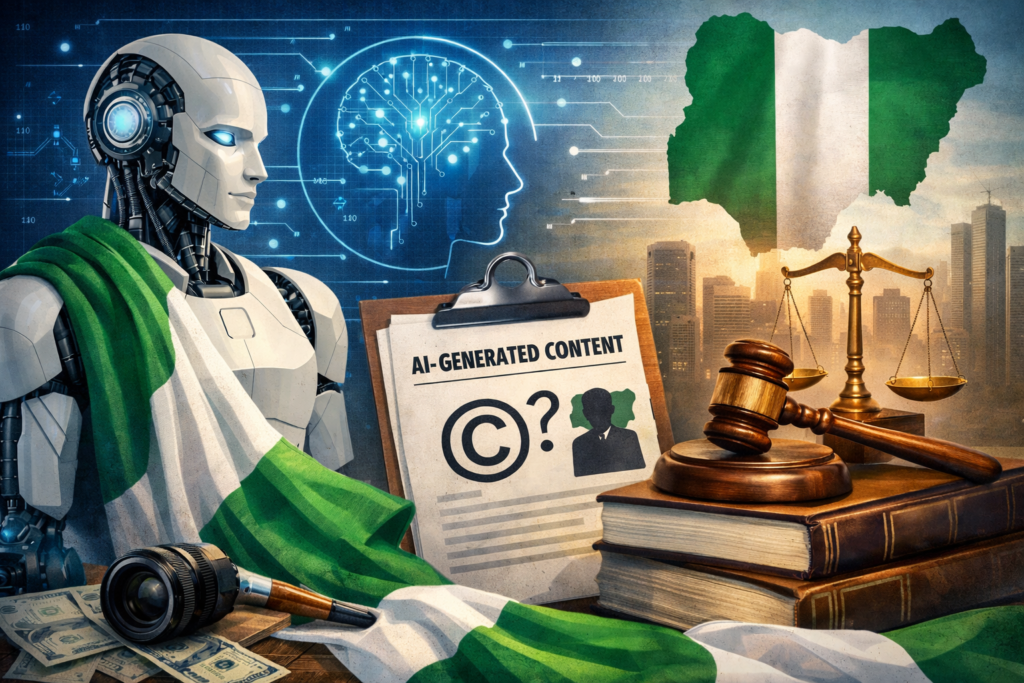
Introduction to ownership of AI-generated content
Chukwuemeka, a young software developer from Enugu, had always dreamed of becoming a celebrated digital artist. One evening, armed with his laptop and an AI tool called ArtGenius, he generated a breathtaking digital painting of the Niger Delta at sunset, a scene so vivid it appeared as though a master painter had spent weeks on it. Excited, he uploaded the artwork to his online gallery and began selling prints across Nigeria.
Weeks later, Adaeze, a Lagos-based entrepreneur, stumbled upon the image and used it as the cover art for her bestselling novel, without Chukwuemeka’s permission. When Chukwuemeka threatened to sue for copyright infringement, Adaeze’s lawyer fired back with a simple but devastating question: “Who owns copyright in a work that no human hand truly made?”
This fictional encounter mirrors a very real and urgent legal question now confronting Nigerian creators, businesses, and legal practitioners: in the age of Artificial Intelligence, who owns the copyright in AI-generated content?
The rapid emergence of Artificial Intelligence has redefined the boundaries of creativity. From generating literary works and musical compositions to producing digital art and software code, AI systems are now capable of creating complex, original works that rival those produced by humans. This new frontier has, however, created a profound legal conundrum one that sits at the intersection of copyright law and Artificial Intelligence.
Copyright law has long served as the cornerstone of intellectual property protection. As a property right, it grants exclusive ownership and control over original creative works, incentivizing artistic and literary expression. Yet, the Nigerian Copyright Act 2022, like most copyright frameworks around the world was drafted with human authors in mind. The question of whether AI-generated content can attract copyright protection in Nigeria is therefore not merely academic; it has far-reaching implications for creators, businesses, investors, and the broader digital economy.
This article examines the copyright status of AI-generated content under Nigerian law, the statutory framework governing authorship and originality, and the emerging legal grey areas that await judicial clarification.
OWNERSHIP OF AI-GENERATED CONTENT: THE STATUTORY FRAMEWORK
The foundation of copyright protection in Nigeria rests on two essential requirements established under the Nigerian Copyright Act 2022. First, a work must be original. It must have gone through the creative process independently and must not be a mere copy of another person’s work. Second, a work must be fixed in a tangible medium of expression, making it permanent and capable of being perceived, reproduced, or communicated.
Section 2 of the Act further provides that a work is not eligible for copyright unless “some effort has been expended on making the work, to give it an original character.” The Act lists eligible works including literary, musical, artistic, audiovisual works, sound recordings, and broadcasts but critically, it requires human creative input for protection. Section 108 defines an “author” in terms that imply a natural or legal person. Since AI is neither a natural person nor a legal entity under Nigerian law, content generated solely by AI arguably lacks a cognisable author and may fall into the public domain.
This position was reinforced by the court in the landmark case of Ifeanyi Okoyo v Prompt and Quality Services & Anor ([2003-2007] 5 IPLR 117-135), where the court stated:
“It is pertinent to observe that a literary or musical work is not eligible for copyright unless sufficient effort has been expended in making it in order to give it an original character. This is a matter of fact which must be proved by evidence.”
The court’s emphasis on human-expended effort as a prerequisite for originality underscores the difficulty in extending copyright protection to AI-generated works. While a human programmer may expend effort in building or training an AI system, the AI’s autonomous generation of a specific work involves no further directed human creative effort in respect of that particular output.
Instructively, some foreign jurisdictions have gone further. In the United States, the Supreme Court in Feist Publications, Inc. v. Rural Telephone Service Co., 499 U.S. 340, 346, held that copyright protection requires not merely effort, but a minimum degree of creativity. Under this standard, AI-generated works which lack any human creative spark would similarly fail to qualify for protection. Though Nigeria’s threshold is rooted in “sufficient effort” rather than creativity per se, the spirit of the requirement points in the same direction: some traceable human authorial contribution.
OWNERSHIP OF AI-GENERATED CONTENT: THE GREY ZONES
The legal picture is not entirely bleak for users of AI-generated content in Nigeria. Section 28 of the Nigerian Copyright Act 2022 addresses the first owner of copyright and offers a potential lifeline: if a human uses AI merely as a tool much like a painter uses a brush ownership may still vest in the human creator. It is arguable that Section 2(2)(a) of the Act could extend protection to AI-generated works where there is demonstrable and significant human input in the creative process. The more a human directs, selects, arranges, and refines the AI’s output, the stronger the claim to copyright ownership.
However, this human-AI collaboration framework creates a dangerous paradox for users. Since AI output lacks a legal “author,” a user may find themselves unable to sue for infringement of “their” AI-generated art. Conversely, under Section 37 of the Copyright Act 2022, if the AI was trained on unlicensed Nigerian music, literature, or other protected works, the user as publisher could themselves face liability for copyright infringement. The legal risk, in other words, runs in both directions.
Where copyright protection is unavailable, Nigerian law offers alternative avenues. The Business Facilitation (Miscellaneous Provisions) Act, 2022 expanded the definition of trademarks under Section 67 of the Trademarks Act to include shapes of goods, packaging, and combinations of colours. Since AI excels at generating unique colour palettes and abstract shapes, Nigerian tech startups may leverage this provision to protect AI-generated brand elements through trademark registration, even where copyright status remains uncertain.
Under the Trademarks Act (Cap T13 LFN 2004), however, AI-generated marks must still satisfy the test of distinctiveness under Section 9. Where an AI tool such as Midjourney or DALL-E generates a logo that closely resembles an existing brand due to its training data, the Nigerian Trademarks Registry will reject such a mark under Section 13, which prohibits the registration of identical or confusingly similar marks.
Beyond statutory provisions, it must be noted that there is currently no reported case law from Nigerian courts directly addressing the copyright status of AI-generated works. This absence of judicial precedent means that the protection of AI-generated content under Nigerian copyright law remains deeply uncertain and largely untested.
CONCLUSION
The question that haunted Chukwuemeka and Adaeze in our opening story is one that Nigerian law has not yet fully answered. The Nigerian Copyright Act 2022, with its firm anchoring of copyright protection in human authorship and original creative effort, leaves AI-generated content in a precarious legal position. Works produced autonomously by Artificial Intelligence without substantial human creative direction are presently ineligible for copyright protection under Nigerian law and risk falling into the public domain.
Nevertheless, human-AI collaborative works, where humans play a significant creative role in directing, curating, or refining AI output, may attract copyright protection under a purposive interpretation of Section 2(2)(a) of the Act. Creators and businesses operating in this space must therefore be deliberate about documenting their creative contributions to AI-assisted works.
As AI technology continues to evolve at a pace that far outstrips legislative response, there is an urgent need for the Nigerian Copyright Commission and the National Assembly to issue clear guidelines or enact targeted amendments addressing the copyright status of AI-generated content. Until then, Nigerian creators, entrepreneurs, and legal practitioners must navigate a complex and shifting legal landscape, guided only by statutory inference, comparative jurisprudence, and as yet no binding Nigerian precedent.
Contributors

OJIENOH SEGUN JUSTICE, ESQ.,
Lead Partner, EKO SOLICITORS AND ADVOCATES

Counsel EKO SOLICITORS AND ADVOCATES
Idowu-Agida Nifemi
Counsel EKO SOLICITORS AND ADVOCATES
OWNERSHIP OF AI-GENERATED CONTENT, OWNERSHIP OF AI-GENERATED CONTENT, OWNERSHIP OF AI-GENERATED CONTENT, OWNERSHIP OF AI-GENERATED CONTENT, OWNERSHIP OF AI-GENERATED CONTENT, OWNERSHIP OF AI-GENERATED CONTENT