

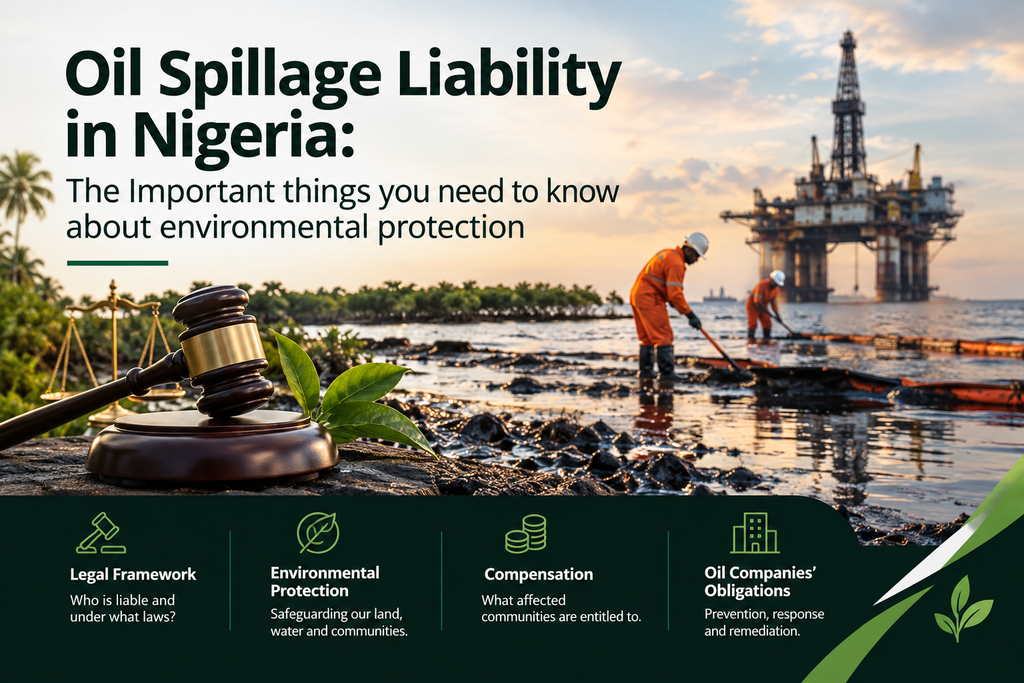
Introduction to oil spillage liability
Oil exploration in Nigeria started in the Niger Delta, and it dates back to years before Nigeria gained independence. The Niger Delta is Nigeria’s fundamental infrastructure for its oil economy. The Niger Delta is a very rich land; it is very fertile for farming and good for fishing as well. The residents depend on it for their livelihood. The Niger Delta is one of the largest mangrove forests in the world.
However, due to poor management, this exploration has led to several oil spillages over the years, which have affected thousands of lives. The land has become polluted, the waters are contaminated, and they are no longer suitable for farming and fishing. Even the health of the residents is affected.
For over 66 years now, several oil spills have been recorded, majorly in areas like Ogoniland, Bomu Community, Bodo Community, Yorla Community, etc.
This always lead to thesame question that has been raised many times by the residents of these areas: “Who should be held accountable for the damages caused?” This article provides answers to this question.
Legal Framework for Oil Spillage Liability in Nigeria
Section 20 of the CFRN[1] places a responsibility on the State to protect and improve the environment and safeguard the water, air, land, forest, and wildlife of Nigeria. Although this is non-justiciable, the State still bears this responsibility.
Section 33 of the CFRN[2] provides for the right to life of every Nigerian citizen. This right has been interpreted to cover situations that threaten the lives of citizens. Oil spills have been recorded to be very hazardous to the health and livelihood of the residents, hence restricting their exercise of this right.
Section 34 of the CFRN[3] protects the dignity of the human person. The pollution caused by oil spills has led the residents to live in severely hazardous conditions, thereby limiting the dignity of the residents.
Section 6(2) and (3) of the National Oil Spill Detection and Response Agency (Establishment) Act (NOSDRA)[4] provides that an oil spiller shall report an oil spill to the Agency in writing not later than 24 hours after the occurrence of an oil spill, in default of which the failure to report shall attract a penalty in the sum of five hundred thousand Naira (N500,000.00) for each day of failure to report the occurrence.
(3) The failure to clean up the impacted site, to the extent practicable, including remediation, shall attract a further fine of one million Naira.
Section 11(5)(a)-(c) of the Oil Pipelines Act[5] provides that the holder of a licence shall pay compensation:
(a) to any person whose land or interest in land (whether or not it is land in respect of which the licence has been granted) is injuriously affected by the exercise of the right conferred by the licence, for any such injurious affection not otherwise made good; and
(b) to any person suffering damage by reason of any neglect on the part of the holder or his agents, servants, or workmen to protect, maintain, or repair any work, structure, or thing executed under the licence, for any such damage not otherwise made good; and
(c) to any person suffering damage (other than on account of his own default or on account of the malicious act of a third person) as a consequence of any breakage of or leakage from the pipeline or an ancillary installation, for any such damage not otherwise made good.
And if the amount of such compensation is not agreed between any such person and the holder, it shall be fixed by a court in accordance with Part IV of this Act.
Section 102 of the Petroleum Industry Act (PIA)[6] provides that a licensee or lessee who engages in upstream and midstream petroleum operations shall, within:
(a) one year of the effective date; or
(b) six months after the grant of the applicable licence or lease,
submit for approval an environmental management plan in respect of projects which require environmental impact assessment to the Commission or Authority, as the case may be.
Section 103(1) of the PIA[7] provides that, “as a condition for the grant of a licence or lease and prior to the approval of the environmental management plan by the Commission or Authority, a licensee or lessee shall pay a prescribed financial contribution to an environmental remediation fund established by the Commission or Authority, as the case may be, for the rehabilitation or management of negative environmental impacts with respect to the licence or lease.”
Section 104(1)(4) of the PIA[8] provides that a licensee, lessee, or marginal field operator that flares or vents natural gas, except:
(a) in the case of an emergency;
(b) pursuant to an exemption granted by the Commission; or
(c) as an acceptable safety practice under established regulations,
commits an offence under this Act and is liable to a fine as prescribed by the Commission in regulations under this Act.
(4) Money received from gas flaring penalties by the Commission under this section shall be for the purpose of environmental remediation and relief of the host communities of the settlers on which the penalties are levied.
Part VIII, Article B, 1.1.1 of the EGASPIN Guidelines[9] provides that licence holders for exploration, prospecting, exploitation, hydrocarbon processing, transportation, marketing, etc. of petroleum resources are required by legislation to take/adopt practical precautions and/or all practicable steps to prevent pollution.
Part VIII, Article B, 2.11.1 of the EGASPIN Guidelines[10] provides that: “It shall be the responsibility of a spiller to restore to as much as possible the original state of any impacted environment. The process of restoration shall vary from one environment type to another.”
Part VIII, Article B, 8.1[11] provides that: “A spiller shall be liable for the damage from a spill for which he is responsible. Where more than one spiller is responsible and liable, the liability shall be joint and several.”
Part VIII, Article F, 1.2.2[12] provides that: “The polluter is required to remove the remaining contamination as completely as is practicable and as may be directed by the Director, Petroleum Resources.”
Part IX, Article 4.6.2(b) and (c)[13] provides that: “The spiller (operator or owner of the vessel) shall pay adequate compensation to those affected; and the spiller shall restore/remediate the polluted environment to an acceptable level as shall be directed by the Director of Petroleum Resources.”
Who Should Pay for Oil Spillage Liability? The Primary Stakeholders
The Polluter Pays Principle
This is an environmental law principle which requires that the cost of preventing, reducing, controlling, restoring, cleaning up, and compensating the affected residents should be paid by the person or company responsible for the environmental pollution. This principle is not explicitly stated in any legal framework in Nigeria, but some statutes contain provisions that serve its purpose, such as the provisions of the EGASPIN Guidelines and the NOSDRA Act stated above.
Operators/Licensees oil spillage liability
The law requires licensees to take all necessary measures in order to prevent pollution. By virtue of this requirement, the licensee will be held accountable if they fail to take the necessary measures.
Joint Ventures oil spillage liability
According to the law dictionary, a joint venture is a commercial enterprise similar to a partnership, in which two or more parties join together for the purpose of carrying out a single commercial enterprise, for which they share assets, liability, and control.
These two parties bear the liability together, as in the case of Ibeno Communities v. Mobil and NNPC, where the applicants suffered economic losses as a result of oil spillages through old pipe leakages, which polluted their water and land. The court ordered Mobil and NNPC, as joint ventures, to pay N81.9 billion as damages to communities affected by the oil spill[14].
Contractors
Generally, the company bears the liability for oil spills. However, where the spill occurred as a result of the contractor’s negligence or breach of duty, the contractor would be held directly liable for the oil spill.
N.B.: The company responsible for the oil spill will be held corporately liable where the spill occurs as a result of its poor management, weak equipment, or slow emergency response, which impacts the community’s economy and health.
Oil Spillage Liability: Complications in Assigning Liability
- Sabotage/Third-Party Interference
This is where the oil spillage is caused by an illegal act done by a third party, where the third party deliberately destroys the oil company’s infrastructure, such as vandalising pipelines, stealing oil, etc.
In such an instance, the oil company uses this as a defence and refuses to bear liability for the damages caused by the sabotage, backing up its defence with Section 11(5)(c) of the Oil Pipelines Act[15]. This has often been used as a defence by oil companies.
- Joint Investigation Visits (JIVs)
This is an investigation that is carried out to determine the cause of the oil spill and whether the community will receive compensation. If the oil spill is a result of sabotage or third-party interference, then the community will receive no compensation by virtue of Section 11(5)(c). However, if the oil spill is caused by the oil company, then the company will be liable and would pay compensation to the community.
The investigation is usually conducted by a representative of the community, a representative of the oil company, and representatives of the regulatory body. This investigation complicates the assignment of liability because, due to the process in which it is conducted, there are possibilities of the results being influenced.
The oil company is the one who decides when the investigation is to be carried out, which could be days or weeks after the oil spill, whereas the clean-up commences 24 hours after the spill, and the investigation ought to be conducted before the clean-up.
There is also technical incompetence in this process, as many times, the representatives of the regulatory body and the community do not understand how oil companies operate and cannot properly determine the cause of oil spills. The process of the investigation is the main cause of the complications in assigning liability[16].
- Corporate Asset Divestment
This is the sale of oil wells, pipelines, equipment, or other oil assets from one company to another. However, the major issue occurs where high-risk assets are sold by a large oil company to a small oil company. This leads to complications in assigning liability.
The buying company most times lacks the managerial and financial capacity to maintain these assets; hence, at the occurrence of an oil spill, they are unable to perform due diligence. Complications may also arise where the mismanagement by the selling company later leads to a failure after the divestment. Questions arise as to who bears the liability.
Key Defences for Oil Companies
In situations where oil spills occur, oil companies may claim certain defences to protect themselves from liability under the law. Some of these defences are:
1. Act of Third Party/Sabotage:
The oil company may claim that the oil spill was caused by third-party interference or sabotage. However, the company has to be able to prove sabotage with the JIV.
2. Act of God: oil spillage liability
Where the spillage occurs as a result of a natural disaster or a situation beyond human intervention, the oil company may use this as a strong defence.
3. Negligence of Victim:
Where the victim carelessly contributed to the damage caused, the oil company may raise this defence in order to reduce the damages awarded to them by the court.
In the case of Shell Petroleum Development Company Ltd v. Councillor F.B. Farah and Others[17], where there was an oil well blowout which damaged crops, trees, and farmland, Shell paid for the damaged crops and trees but failed to compensate them for the loss or rehabilitation of the land. The court ruled in their (claimants’) favour and held that they were entitled to fair compensation.
In The Bodo Community and Others v. The Shell Petroleum Development Company of Nigeria Ltd[18]Two massive crude oil leaks from a 24-inch Shell pipeline in the Bodo area poured nearly half a million barrels of oil into local creeks and swampland. The community sued Shell for gross negligence, environmental damage, and loss of livelihood. Shell agreed to a historic £55 million out-of-court settlement, dividing compensation directly to individual residents and community funds while committing to a comprehensive clean-up.
Who Should Really Pay? oil spillage liability
Following the polluter pays principle, the oil company, operator, or licensee is the one to pay for the oil spill caused by them. However, where the spill is caused by a third party, then such a party will pay. In the case of joint venture partners, both partners will pay for the oil spill.
In reality, however, due to delays in clean-up and compensation, protracted litigation, delayed settlements, and the regulatory bodies’ lack of enforcement power to secure swift remediation, the communities still bear the health, livelihood, and economic toll.
Way Forward
1. Proper and thorough surveys should be conducted before asset divestment.
2. NOSDRA’s powers should be made stronger so as to levy binding fines and mandate swift clean-up timelines.
3. The JIV should be independent. They should be able to conduct investigations without relying on the directive of the oil company.
4. Insurance funds, provided for in Section 103 of the PIA[19], should be made mandatory.
Conclusion on oil spillage liability
When there is an oil spill, operators are the ones who pay for the damage done, unless they can strictly prove sabotage or other defences. There has to be an establishment of clear financial responsibility before operators exit onshore assets, ensuring communities are not left with the legacy costs of extraction.
The PIA provisions on funds also need to be enforced in order to ensure environmental justice in the Niger Delta.
[1] Section 20, Constitution of the Federal Republic of Nigeria 1999 (as amended).
[2] Section 33, Constitution of the Federal Republic of Nigeria 1999 (as amended).
[3] Section 34, Constitution of the Federal Republic of Nigeria 1999 (as amended).
[4] Section 6(2)–(3), National Oil Spill Detection and Response Agency (Establishment) Act, Cap. N157, LFN 2004.
[5] Section 11(5)(a)–(c), Oil Pipelines Act, Cap. O7, LFN 2004.
[6] Section 102, Petroleum Industry Act, No 6, 2021, Cap. P28, LFN.
[7] Section 103(1), Petroleum Industry Act, No 6, 2021, Cap. P28, LFN.
[8] Section 104(1) and (4), Petroleum Industry Act, No 6, 2021, Cap. P28, LFN.
[9] Department of Petroleum Resources, Environmental Guidelines and Standards for the Petroleum Industry in Nigeria (EGASPIN, revised edn 2018) Part VIII-B, para 1.1.1.
[10] Department of Petroleum Resources, Environmental Guidelines and Standards for the Petroleum Industry in Nigeria (EGASPIN, revised edn 2018) Part VIII-B, para 2.11.1.
[11] Department of Petroleum Resources, Environmental Guidelines and Standards for the Petroleum Industry in Nigeria (EGASPIN, revised edn 2018) Part VIII-B, para 8.1.
[12] Department of Petroleum Resources, Environmental Guidelines and Standards for the Petroleum Industry in Nigeria (EGASPIN, revised edn 2018) Part VIII-F, para 1.2.2.
[13] Department of Petroleum Resources, Environmental Guidelines and Standards for the Petroleum Industry in Nigeria (EGASPIN, revised edn 2018) Part IX, para 4.6.2(b)–(c).
[14] A Ojekunle, ‘Oil Spills: Court Awards N82bn Damages Against Mobil, NNPC’ TheCable (Lagos, 15 June 2021) https://www.thecable.ng/oil-spills-court-awards-n82bn-damages-against-mobil-nnpc accessed 20 September 2026.
[15] Section 11(5)(c), Oil Pipelines Act, Cap. O7, LFN 2004.
[16] A Rim-Rukeh, ‘Oil Spill Management in Nigeria: SWOT Analysis of the Joint Investigation Visit (JIV) Process’ (2015) 6 Journal of Environmental Protection 259.
[17] Shell Petroleum Development Company Ltd v. Councillor F.B. Farah and Others ([1995] 3 NWLR (Pt. 382) 148).
[18] The Bodo Community and Others v The Shell Petroleum Development Company of Nigeria Ltd [2014] EWHC 1973 (TCC).
[19] Section 103, Petroleum Industry Act, No 6, 2021, Cap. P28, LFN.
CONTRIBUTORS

Ojienoh Segun Justice, ESQ
Lead Partner, EKO SOLICITORS AND ADVOCATES

Counsel EKO SOLICITORS AND ADVOCATES

Olaboye Marvellous Adebanke
INTERN, EKO SOLICITORS AND ADVOCATES
oil spillage liability, oil spillage liability, oil spillage liability, oil spillage liability, oil spillage liability, oil spillage liability