

Introduction
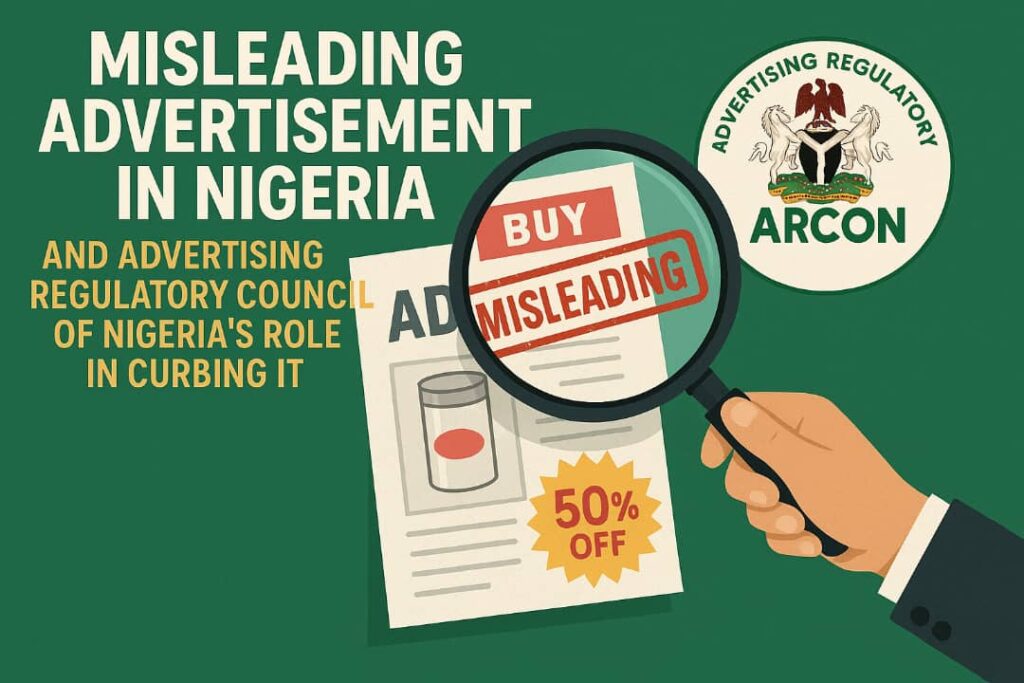
Advertising is a powerful tool used to inform, persuade, and influence consumer behavior. However, when advertisements contain false, exaggerated, or deceptive information, they not only mislead the public. But also violate Nigeria’s Advertising law, consumer rights and undermine public trust.
In Nigeria, misleading advertising is not only unethical, it is a criminal offense.
The Advertising Regulatory Council of Nigeria (ARCON) plays a central role in curbing such practices and protecting Nigerian consumers from deceptive marketing tactics.
Most recently the advertising regulatory council of Nigeria, pursuant to the Advertising law raised an alarm on the 16th of June 2025. On how there have been circulation of fake adverts on Meta Inc.’s social media platforms such as Facebook and instagram, targeting unsuspecting Nigerian customers.
Some persons fraudulently used an advert that portrayed two very popular Nigerian figures—Pastor Enoch Adeboye, the General Overseer of the Redeemed Christian Church of God (RCCG), and Seun Okinbaloye, the host of Politics Today on Channels Television—in Facebook ads to promote dubious health products, breaching Nigeria’s Advertising law.
In Nigeria’s bustling marketplace, where brands fiercely compete for consumer attention, advertising is a powerful engine mainly used to drive sales and brand loyalty. However, when this power is wielded deceptively, it becomes a weapon against consumers, eroding trust and distorting fair competition and amounting to a crime punishable under Nigeria’s Advertising law.
What is Misleading Advertising?
Misleading advertising occurs when an advert provides false or deceptive claims about a product, service, or brand with the intent to deceive or manipulate consumers. This includes false claims about health benefits, exaggerated product effectiveness, Concealing critical information (e.g., hidden costs), Fake testimonials or endorsements; comparative advertising that disparages other brands unfairly. Some commercials actively lure customers with attractive offers, only to push a different, often more expensive product—a practice known as bait and switch—which violates Nigeria’s advertisement law.
Hiding crucial limitations, side effects, or conditions (common in financial services, health products, and tech) also known as Omission of Material Facts, they also use fake or unverified testimonials, or failing to disclose paid endorsements adequately.Another tactic involves using images or graphics to create a false impression (e.g., edited photos for beauty products, unrealistic property depictions), a practice known as visual manipulation.
another is Advertising a low headline price but burying significant mandatory fees, also known as hidden costs. These practices harm consumers financially and sometimes physically for example ineffective medicines, unsafe products. They also stifle genuine innovation by allowing dishonest players to undercut competitors who play by the rules.
Provisions in Nigeria’s Advertising law against False Ads.
Misleading advertising is not just unethical; it is punishable under Nigeria’s Advertising law. The following laws prohibits deceptive advertising practices in Nigeria, these laws ranges from Advertising Regulatory Council of Nigeria 2022, Federal Competition and Consumer Protection Act (FCCPA, 2018), Criminal Code Act (Cap C38, LFN 2004).
The Advertising Regulatory Council of Nigeria Act 2022, the Act establishes the Advertising Regulatory Council of Nigeria (ARCON) and gives it the authority to regulate and control all advertising in Nigeria. Section 17(1) states unequivocally that publishing, broadcasting, or exposing an advertisement without ARCON’s approval (where required) is an offense.
Liabilities Of Persons And Corporate Bodies.
Also Section 17(2) declares that a person shall not publish, broadcast or expose an advertisement which is false, misleading, and deceptive or which is in violation of any prevailing law, rule or regulation. Section 17(4) Specifies the penalties upon conviction, a person is liable to a fine of up to N5, 000,000 (Five Million Naira), imprisonment for up to 3 years, or both.
ARCON will also hold directors or senior managers of offending companies personally liable. Furthermore, Section 17(5) empowers ARCON to remove non-compliant ads and impose substantial administrative fines—up to N5 million for individuals and N10 million for organizations—even before initiating criminal prosecution
READ ALSO: TRANSFER PRICING SIMPLIFIED: BASICS, BENEFITS AND EXPERT INSIGHTS
Section 123 Federal Competition and Consumer Protection Act (FCCPA) 2018 also provides that a person shall not, in trade or commerce, in connection with the supply or possible supply of goods or services, make a false or misleading representation, thereby making any form of misrepresentation,
Subsection 1 of section 123 prohibits persons or corporate bodies falsely representing that goods or services have sponsorship, approval, performance characteristics, uses, or benefits they do not have in areas such as Misrepresenting a testimonial or endorsement as genuine, Misrepresenting price or availability, Misleading consumers about the need for a particular service or part. Just like the ARCON Act a person who contravenes Section 123 commits an offense, and is liable to a fine or imprisonment, or both pursuant to the advertising law.
Section 419 of the Criminal Code Act (Cap C38, LFN 2004), that:
“any person who, by any false pretense, and with intent to defraud, obtains from any other person anything capable of being stolen, is guilty of a felony, If a misleading advert causes someone to part with money under false belief (e.g., fake health claims), this can qualify as an offense under this section and punishable for Up to 7 years imprisonment, or more if aggravated.”
Also Article 7.2.2(c) Nigerian Broadcasting Code (6th Edition, 2019, as amended) provides that no advertisement shall be broadcasted if it contains statements, suggestions or visuals which directly or by implication are misleading, exaggerated or untrue. The National Broadcasting Commission may suspend, fine, or ban broadcast media that air deceptive ads.
The Role Advertising Regulatory Council of Nigeria ARCON in Protecting Consumers
The Advertising Regulatory Council of Nigeria (ARCON), empowered by the ARCON Act, regulates and controls advertising across all media platforms in Nigeria. It plays a critical and multi-faceted role in combating misleading ads. Its key responsibilities include:
1. The Advertising Regulatory Council of Nigeria (ARCON) is responsible for vetting and approving all advertisements before public dissemination.
2. The Advertising Regulatory Council of Nigeria (ARCON) actively monitors media platforms and enforces compliance through penalties and litigation.
3. They are responsible for setting advertising standards and codes of practice to ensure ethical advertising.
4. ARCON works with other agencies like the FCCPC to ensure that consumer interests are not compromised.
5. The Council engages in public campaigns to inform citizens about their rights and how to report misleading ads.
READ ALSO: TAX EVASION Vs TAX AVOIDANCE: A COMPARATIVE ANALYSIS
Notable Enforcement Actions by the Advertising Regulatory Council of Nigeria (ARCON)
In recent years, the Advertising Regulatory Council of Nigeria (ARCON) has taken firm steps against misleading adverts. A notable example was in 2023, when ARCON sued Meta Platforms (Facebook) and, its Nigerian agent for publishing unapproved political ads. Setting a precedent for digital ad regulation.
Additionally, several local companies have been fined or banned from advertising due to exaggerating the effectiveness of health-related products. Especially in the herbal and supplement markets. These actions underscore ARCON’s commitment to sanitizing the advertising ecosystem in Nigeria.
The court can impose possible penalties for contravening Nigeria’s Advertising law.
The consequences of publishing or promoting misleading advertisements in Nigeria include fines. which could be imposed on erring corporate bodies and individuals by ARCON or the courts. The court could also Order Imprisonment In cases involving fraud or endangerment, sentence to prison may apply.
ARCON may order the immediate suspension or ban of the offending advertisement. If advertisers repeatedly violate the Advertising law, ARCON can withdraw their advertising licenses. It may also compel advertisers to issue retractions or public apologies when they infringe on Nigeria’s Advertisement law.
Conclusion
Misleading advertising in Nigeria is not just a breach of ethics; it is a criminal act against Nigeria’s Advertising law, which may possibly attract serious legal consequences.
The establishment of ARCON, and the strengthening of the advertising law, there is now a more robust framework for protecting Nigerian consumers.
Advertisers must ensure honesty, transparency, and social responsibility in their campaigns or face the full weight of Nigeria’s Advertising law. The public also has a role to play by reporting false advertising and demanding accountability. Only through joint efforts can Nigeria achieve a fair, safe, and trustworthy advertising environment.
CONTRIBUTORS

Lead Partner EKO SOLICITORS & ADVOCATES

Counsel EKO SOLICITORS & ADVOCATES
