

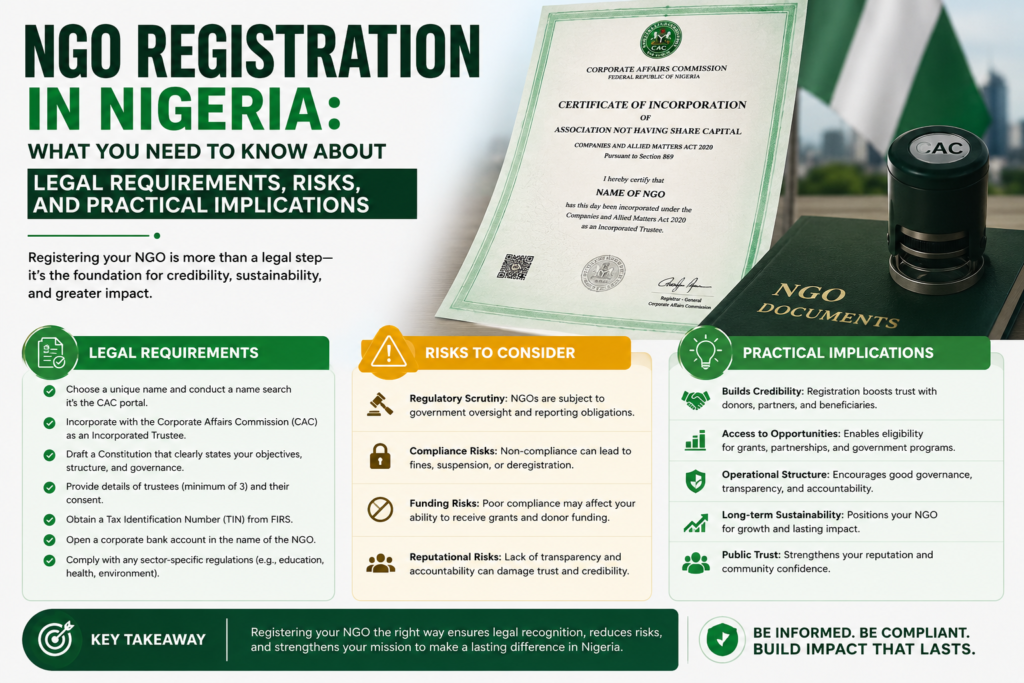
Introduction to ngo registration in nigeria
Many community-driven groups in Nigeria begin informally. A youth group may start by raising funds to support education. A foundation may begin as a family initiative to assist widows. A church may start as a small fellowship in a rented space. At the early stage, legal structure is often not the priority. However, as these activities expand, especially when money is collected, property is acquired, or partnerships are formed, the law begins to treat them differently. What starts as informal volunteering becomes an organized activity that requires legal recognition. In Nigeria, the law does not regulate charity itself; it regulates organized bodies that operate in society.
Legal Requirement for NGO Registration in Nigeria
Under the Companies and Allied Matters Act (CAMA) 2020, any organization operating for charitable, religious, educational, or social purposes is required to register with the Corporate Affairs Commission (CAC) as an Incorporated Trustee. This applies to NGOs, foundations, churches, ministries, youth groups, and community associations. Registration gives the organization legal personality, meaning it is recognized as an independent entity separate from the individuals who formed it.
Why NGO Registration Matters in Nigeria
Once registered, an organization can:
- Open a bank account in its name
- Own property legally
- Enter into contracts
- Receive grants and donations formally
- Be recognized in court as a legal entity
Without registration, the group remains an informal association of individuals. This limits its legal capacity and creates practical risks as it grows.
Legal and Practical Implications of Not Registering
- Limited Legal Recognition: An unregistered organization has no full legal personality. This means contracts may not be enforceable in the organization’s name, and property ownership may be legally unclear.
- Personal Responsibility of Founders or Trustees: In disputes or financial obligations, responsibility may fall on individuals managing the group. While not automatic in every case, the legal separation between the organization and individuals is weak, which increases exposure.
- Banking and Financial Limitations: Banks and financial institutions require legal documentation before opening organizational accounts or processing large transactions. Unregistered groups may face: Restrictions on opening formal accounts, Difficulty receiving grants or donations, and Additional compliance checks. These measures are tied to financial regulation and transparency requirements.
Funding and Partnership Challenges NGO REGISTRATION IN NIGERIA
Most institutional donors, international NGOs, and corporate partners require proof of registration before providing funding or collaboration. Without registration, access to structured funding becomes limited.
Internal Governance Issues
Without formal registration, internal rules are often informal. This can lead to:
- Leadership disputes
- Lack of clear decision-making structures
- Difficulty resolving internal disagreements
Registration usually requires a constitution, which helps define governance and reduce conflict.
Religious and Community Organizations
Religious bodies are not exempt from registration when they operate as structured institutions managing funds, property, or public activities. Registration helps ensure:
- Legal ownership of church property
- Proper financial accountability
- Clear leadership structure
- Stability during leadership transitions
Registration does not affect religious beliefs or practices; it simply provides legal recognition for organizational activities.
What the Nigerian Law Views Unregistered Associations
Under Nigerian legal principles, unincorporated associations have limited legal capacity. They may face restrictions in suing or being sued in their own name unless specific conditions are met. Courts generally recognize that legal personality comes from incorporation, meaning organizations gain stronger legal standing once registered with the CAC.
To become legally recognized, organizations typically:
- Select trustees
- Draft a constitution
- File incorporation documents with CAC
- Publish required notices
- Receive a certificate of incorporation
Once completed, the organization becomes a legal entity with full rights and obligations.
Final thoughts on NGO registration in Nigeria
Operating an NGO, church, foundation, or youth organization without registration may be possible at an early, informal stage, but it becomes increasingly limiting as the organization grows. Registration under CAC provides legal recognition, financial credibility, governance structure, and long-term stability. It is not simply a regulatory requirement but a framework that supports transparency, accountability, and sustainable impact.
NOTE: DO CONSULT A LAWYER FOR FURTHER ADVICE
References
Companies and Allied Matters Act, 2020 (Nigeria).
Corporate Affairs Commission. (2024). Incorporated the trustees’ registration guidelines. https://www.cac.gov.ng/
Federal Republic of Nigeria. (2020). Companies and Allied Matters Act (CAMA) 2020.
Financial Reporting Council of Nigeria. (2023). Governance standards for non-profit organizations in Nigeria.
Top of Form
Bottom of Form
Contributors

OJIENOH SEGUN JUSTICE, ESQ.,
LEAD PARTNER, EKO SOLICITORS AND ADVOCATES

Faith Ogunleye
Graduate Trainee, EKO SOLICITORS AND ADVOCATES