

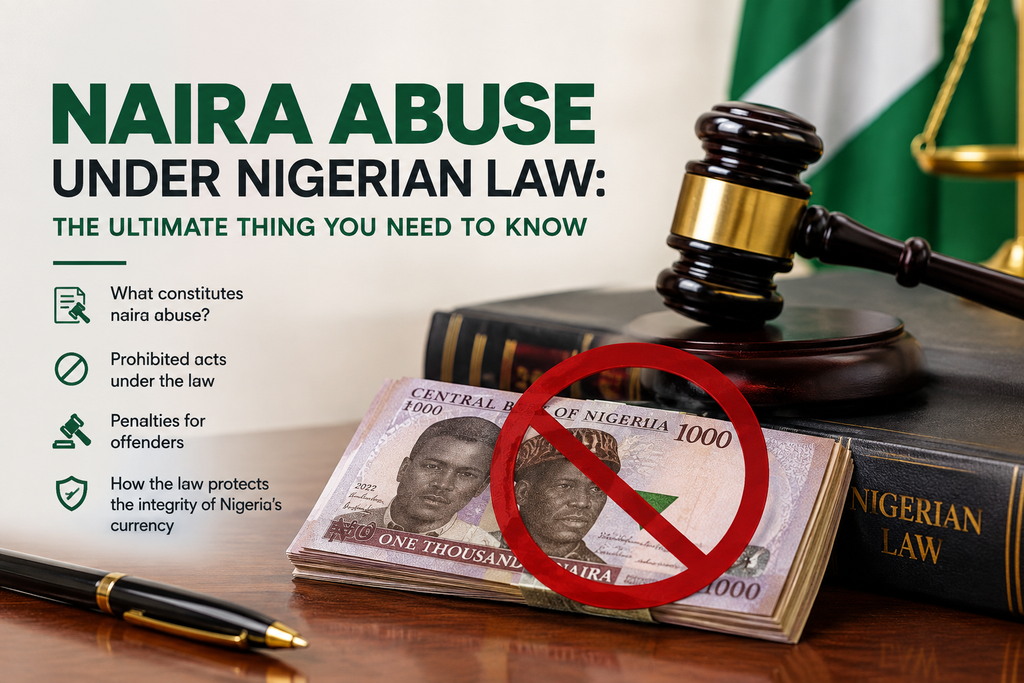
Introduction to naira abuse
One of the defining characteristics of a sovereign State is its unique legal identity. Every nation possesses distinct elements that differentiate its authority and distinguish it within the comity of nations. A citizen can distinguish the Federal Republic of Nigeria from the United States or the United Kingdom by its recognized national symbols; the National Anthem, the National Pledge/Oat, the National Flag, and its national currency.
While flags and anthems embody national identity, currency occupies a unique position, it functions both as a sovereign emblem and as the lifeblood of domestic commerce. Hence, safeguarding its physical and economic integrity is a matter of statutory duty and public order.
WHAT IS CURRENCY? NAIRA ABUSE
Generally, when asked the question, the common answer is “money”.Now in as much as that is true, it is not all money that is a particular country’s currency, hence the need to look at the real definition of currency and what it entails. Currency can be defined as that which is authorized and recognized as a legal tender for the transaction of goods and representation of economy by a particular country. It is one where title passes automatically upon hand-to-hand delivery to a recipient in good faith, free from prior claims of ownership. Justice Darling also, defined currency in the case of Moss v. Hancock[1];
“…currency is that which passes freely from hand to hand in the nation, and is treated as money in its transactions.”
Thus it can be said that currency is the unique means of transaction authorized and recognized by a particular State. In simple terms, currency is the money of a State.
CURRENCY AS IT RELATES TO NIGERIA naira abuse
As earlier stated, currency is the money of a state. So what is the money of Nigeria? Although the 1999 Constitution of Federal Republic of Nigeria (as amended) does not explicitly give details as to the area of currency, apart from Item 15 of the Exclusive Legislative List[2], which grants the Federal Government exclusive authority over “Currency, coinage and legal tender.” However, the National Assembly per its power under Section 4(1) 1999 Constitution has enacted the Central Bank of Nigeria Act[3] to specifically deal with the issue of currency and money in Nigeria. The Central Bank is the mother of all banks in Nigeria and is empowered to govern the unit of Naira and its effect in the society.
Pursuant to the CBN Act, the unit of currency in Nigeria shall be the Naira[4]. This is the legal tender in Nigeria for the payment of any amount[5]. Thus, the Naira is the currency of Nigeria as the legal tender authorized and recognized by the government for the use of transactions in Nigeria.
ABUSE OF THE NAIRA
As earlier stated, one of the unique elements of a sovereign state is the currency, and it has been established that the Naira is the currency in Nigeria. This means that the Naira must be treated with dignity and respect. Section 24 (a) of the 1999 Constitution states that it is the duty of every citizen to respect the ideals and institution of the country. Although it is not explicitly stated that the Naira should be respected, it can be implied that Naira forms part of the ideals and institution of Nigeria, thus it should be respected.
Narrowing it down, the abuse of Naira is a misdemeanor that is punishable under the CBN Act. Section 21(1) states that;
“A person who tampers with a coin or note issued by the Bank is guilty of an offence and shall on conviction be liable to imprisonment for a term not less than six months or to a fine not less than N50,000 or to both such fine and imprisonment.”
Thus, the abuse of naira is a punishable offense in Nigeria. This has been seen in a number of cases, including; Federal Republic of Nigeria v. Oluwadarasimi Omoseyin[6] and the popular case of Federal Republic of Nigeria v. Idris Olanrewaju Okuneye[7]. Here, a popular, cross dressing influencer known as “Bobrisky”, was charged with the offence of abuse of the naira note. He was tried and found guilty of the offense and was sentenced to six months imprisonment, without an option to pay fine.
Section 21 (2)[8] explicitly states;
“A coin or note shall be deemed to have been tampered with if the coin or note has been impaired, diminished or lightened otherwise than by fair wear and tear or has been defaced by stumping, engraving, mutilating, piercing, stapling, writing, tearing, soiling, squeezing or other forms of deliberate and wilful abuse whether the coin or note has or has not been thereby diminished or lightened”
WAYS OF ABUSING THE NAIRA naira abuse
For the purpose of the naira, there are certain ways/ acts by which the naira note can be said to be abused. Sec 21(2) states that “stumping, engraving, mutilating, piercing, stapling, writing, tearing, soiling, squeezing or other forms of deliberate and wilful abuse” are ways the naira can be abused.
“A coin or note shall be deemed to have been tampered with if the coin or note has been impaired, diminished or lightened otherwise than by fair wear and tear or has been defaced by stumping, engraving, mutilating, piercing, stapling, writing, tearing, soiling, squeezing or other forms of deliberate and wilful abuse whether the coin or note has or has not been thereby diminished or lightened”
Pointing a touch on the specific ways by which abuse can be done, Sec 21(3) of the Act clearly states that “spraying of naira and dancing or matching of naira” is a form of abuse.
“For the avoidance of doubt, spraying of, dancing or stepping on the Naira notes or coin, or any other coin issued by the Bank during social occasions or however manner, constitutes an abuse and defacing of the Naira or such coin and shall be punishable under Sub-section (1) of this section.”
Sec 21(4) also sees “hawk, sell or otherwise trade..” as an abuse too.
“It shall also be an offence punishable under Sub-section (1) of this section for any person to hawk, sell or otherwise trade in the Naira notes, coins or any other note issued by the Bank”
CONCLUSION
There is a popular saying that goes, “where there is no law, there is no sin”. The Central Bank of Nigeria has explicitly stated that the act of abusing the naira note is a misdemeanour punishable under the law. It has also gone a step further to state ways by which the naira note can be said to be abused, and ignorantia juris non excusat, ignorance of the law is no excuse, applies strictly to currency enforcement in Nigeria. Hence, it is safe to state that the compliance with the CBN Act, specifically Section 21 of the Act, will prevent arresting and criminal liability.
[1] [1899] 2 Q.B. 111
[2] Second Schedule, Part I, 1999 CFRN
[3] CBN Act 2007
[4] Sec 15 CBN Act
[5] Sec 20(1) CBN Act
[6] FHC/L/30C/2023
[7] FHC/L/248C/2024
[8] CBN Act 2007
CONTRIBUTORS

OJIENOH SEGUN JUSTICE, ESQ.,
LEAD PARTNER, EKO SOLICITORS AND ADVOCATES

Counsel EKO SOLICITORS AND ADVOCATES

OLOKUN OREOLUWA JOSEPH
INTERN, EKO SOLICITORS AND ADVOCATES
NAIRA ABUSE, NAIRA ABUSE, NAIRA ABUSE