

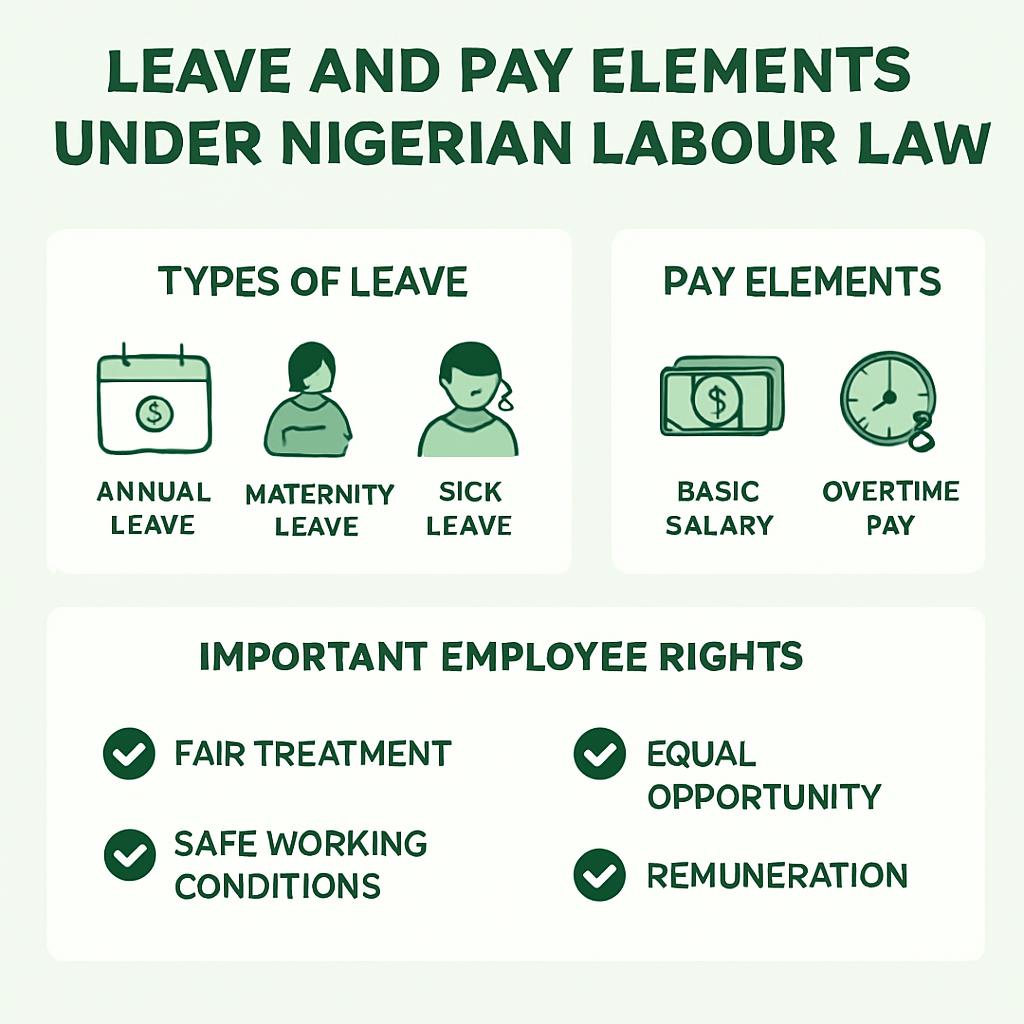
Introduction to Leave and Pay Entitlements
In Nigeria, issues of leave and pay entitlement frequently arise when employees are absent from work due to pregnancy, illness, or personal circumstances. Many workers assume that Nigerian law recognises broad concepts such as “family leave” or extended medical leave. However, Nigerian labour law takes a strict and conservative approach. It also recognises only specific categories of leave created by statute or regulation.
The National Industrial Court of Nigeria (NICN), have consistently emphasised that employee entitlements must be traced either to statute, public service rules, or the contract of employment.
This article examines leave and pay entitlements recognised under Nigerian law, with emphasis on the public and private sectors.
Maternity leave is the most clearly protected form of leave under Nigerian labour law.
In the private sector, maternity leave is governed by section 54 of the Labour Act, Cap L1, Laws of the Federation of Nigeria 2004. A female employee who has worked for at least six months is entitled to a minimum of 12 weeks maternity leave, with pay of not less than 50% of her wages, subject to medical certification. In the public sector, maternity leave is regulated by the Public Service Rules and relevant government circulars, which generally provide for maternity leave with full pay.
The courts have treated maternity leave as a legal entitlement, not a discretionary benefit. In Mrs. Yetunde Olatunji v. Access Bank Plc[1], the National Industrial Court reaffirmed that maternity leave is a protected employment right and that an employer cannot lawfully deny a female employee maternity benefit provided by law or contract.
Maternity Leave and Pay entitlements Under Nigerian Law
Sick Leave and Medical Absence
Sick leave is recognised under section 16 of the Labour Act, which permits an employee to be absent from work on medical grounds, provided the illness is supported by a medical certificate. In the private sector, the Labour Act does not prescribe the duration of sick leave or mandate full salary during medical absence. As a result, payment during sick leave depends on the contract of employment or staff handbook.
The NICN has consistently held that where an employer provides for paid sick leave, such provision is binding. In Aloysius v. Diamond Bank Plc[2], the Court emphasised that employment benefits voluntarily granted by an employer form part of the contract and must be honoured.
In the public sector, sick leave is governed by the Public Service Rules, which allow sick leave with full pay for a defined period, subject to medical board recommendations for extended leave.
Annual Leave with Pay
Annual leave is a mandatory statutory entitlement. In the private sector, section 18 of the Labour Act guarantees employees annual leave with full pay after at least 12 months of continuous service. Employers are not permitted to deny or indefinitely postpone annual leave.
The NICN has described prolonged denial of annual leave as an unfair labour practice. In John Mowette v. O.K. Isokariari & Sons Nigeria Ltd[3], the Court held that preventing an employee from enjoying annual leave over several years was unlawful and inconsistent with fair labour standards.
In the public sector, annual leave is similarly guaranteed under the Public Service Rules, subject to approval and scheduling by the appropriate authority.
Compassionate, Bereavement and Special Leave
Nigerian law does not create statutory rights to compassionate, bereavement, or paternity leave. In the private sector, such leave exists only where it is expressly provided for in the employment contract or staff handbook. Once provided, however, Nigerian courts treat it as enforceable.
This principle flows from the Court of Appeal decision in Afribank (Nig.) Plc v. Osisanya[4], where the Court held that conditions of service form part of the employment contract and are binding on both parties. The NICN has consistently applied this principle in employment disputes.
Salary Payment During Leave: Judicial Approach
Across both sectors, Nigerian courts have taken a firm position that salary payment during leave must be determined by:
- Statute,
- Public Service Rules, or
- Contractual terms.
The National Industrial Court has repeatedly condemned the practice of placing employees on unpaid leave without legal justification. In Christian sioma Okafor v. Metro Digital Ltd[5]the Court held that placing an employee on indefinite unpaid leave without contractual backing amounted to unfair labour practice.
Similarly, in Uchelor Chibuzor Charles v. Heritage Bank Plc[6] the Court ordered the payment of withheld salaries where the employer could not justify unpaid suspension or leave under the contract.
What Nigerian Law Does Not Recognise on leave and pay entitlements
The courts have been clear that they will not create rights that do not exist in law. Accordingly, Nigerian labour law does not rcognise:
- General family leave,
- Caregiver leave,
- FMLA-style medical leave,
- Automatic paid leave for family emergencies.
Any entitlement in this category must arise strictly from contract, policy, or public service regulation
Conclusion
Leave and pay entitlements in Nigeria are governed by a clear but limited legal framework, applicable to both public and private sector employment. Nigerian law recognises maternity leave, sick leave, and annual leave by statute, while other forms of leave depend entirely on service rules or contractual provisions. The courts, particularly the National Industrial Court of Nigeria, have consistently enforced statutory and contractual rights.
[1] (NICN/LA/161/2014)
[2] [2015] 58 NLLR (Pt. 199) 92
[3][3] (NICN/YEN/24/2016) Unreported
[4] [2000] 1 NWLR (Pt. 642) 592
[5] (NICN/LA/282/2022) Unreported
[6] (NICN/LA/540/2018) Unreported
Contributors

Lead Partner, EKO SOLICITORS AND ADVOCATES

Counsel, EKO SOLICITORS AND ADVOCATES

Counsel, EKO SOLICITORS AND ADVOCATES