

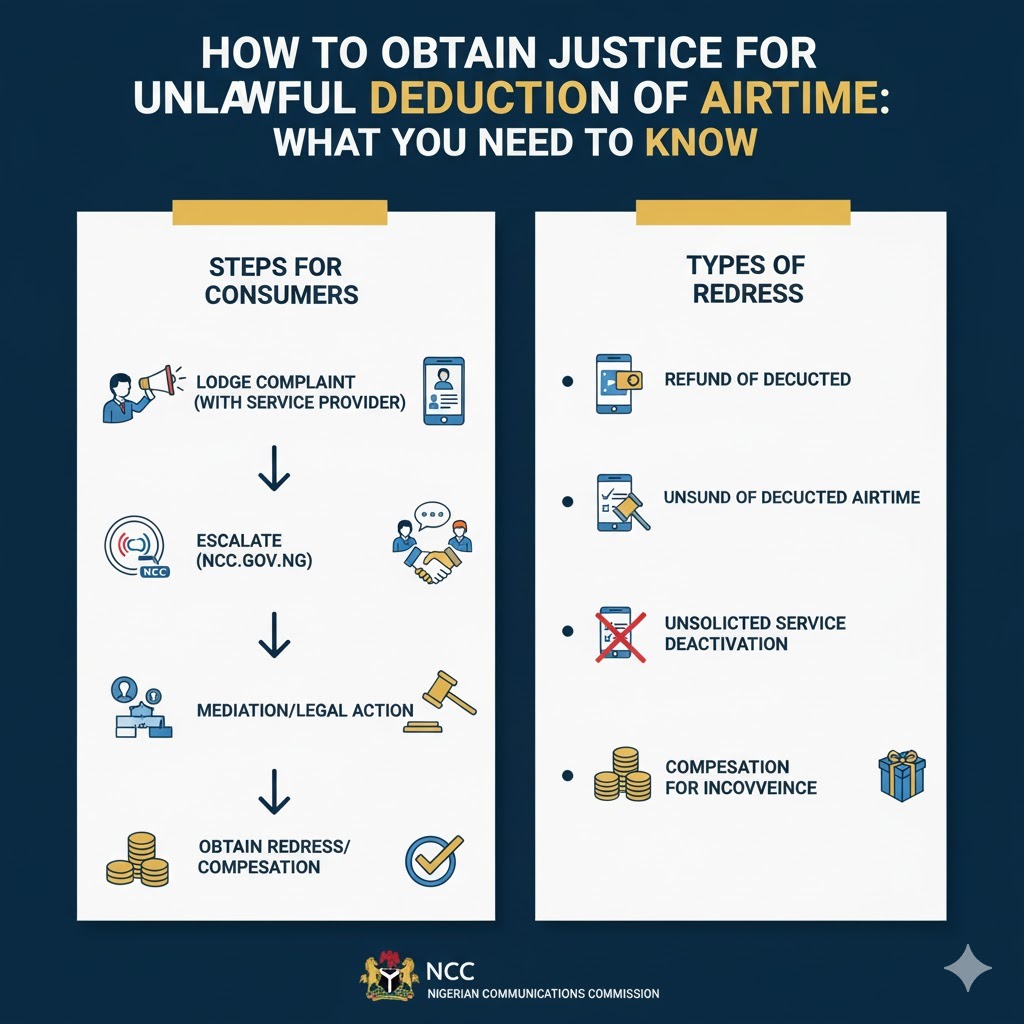
INTRODUCTION ON UNLAWFUL DEDUCTION OF AIRTIME
In recent years, many Nigerian mobile subscribers have repeatedly experienced unexplained deductions of airtime from their phones. These deductions often occur as a result of unsolicited text messages, hidden service subscriptions, or automatic renewals of value-added services (VAS) that the subscriber neither requested nor consented to. The problem has become so widespread that it now raises questions about consumer protection and regulatory enforcement in the telecommunications sector.
The unlawful deduction of airtime not only erodes public trust in mobile network operators but also undermines the rights of consumers guaranteed under Nigerian law. This article examines the legal and regulatory framework governing airtime deductions in Nigeria, the remedies available to aggrieved subscribers, and the need for stronger enforcement mechanisms to safeguard consumers.
Despite the existence of various consumer protection laws, including the Nigerian Communications Commission’s (NCC) Consumer Code of Practice Regulations and the Federal Competition and Consumer Protection Act (FCCPA) 2018, unlawful deductions remain a recurring issue. This underscores the importance of understanding both the legal remedies and the constitutional protections available to subscribers.
Legal and Regulatory Framework Governing Airtime Deductions
The Role of the Nigerian Communications Commission (NCC)
The Nigerian Communications Commission (NCC) is the principal regulatory body overseeing the telecommunications industry in Nigeria. The NCC is mandated by law to ensure fair competition, consumer protection, and transparency among service providers. Under the Consumer Code of Practice Regulations, particularly Regulation 28, service providers are required to obtain informed consent before enrolling a subscriber in any value-added or paid service.
Section 1 of the Nigerians communications Act 2003 states that one of the primary objects of the Act is to protect the rights and interests of service providers and consumers. Unlawful deductions directly infringe upon the consumer’s financial interest, making it a violation of this core objective. Also Regulation 9 of the quality of Service (QoS) Regulations, 2012 & (Business Rules) mandates that explicit customer consent must be obtained before subscribing a customer to any value added service (VAS). The method of obtaining consent must be documented and verifiable by the NCC.
Constitutional and Statutory Provisions
The Nigerian Constitution provides a fundamental basis for consumer protection against unauthorized deductions. Section 37 of the 1999 Constitution (as amended) guarantees the right to privacy of citizens, including their telephone communications and correspondence. When a subscriber’s airtime is deducted for unsolicited services or without consent, it infringes upon that right, as it constitutes interference with private communication and financial control.
Furthermore, the Federal Competition and Consumer Protection Act (FCCPA) 2018 complements the Constitution by prohibiting unfair, misleading, or deceptive business practices. Section 123 of the Act empowers consumers to demand redress where a service provider acts fraudulently or without informed consent. Thus, subscribers affected by unlawful deductions may rely not only on telecom regulations but also on the broader framework of consumer protection law.
Meaning and Nature of Unlawful Deduction Of Airtime
Unlawful deduction refers to the withdrawal or reduction of a subscriber’s airtime balance without the subscriber’s explicit consent, authorization, or prior knowledge. Such deductions may arise from hidden subscriptions, unsolicited SMS-based services, automatic renewals, or deceptive promotional offers. For a deduction to be lawful, the following conditions must be satisfied, there must be Consent that is the subscriber must clearly agree to the service and its cost. Another is transparency that is the service provider must disclose all relevant charges and terms. There must also be an Opt-out Mechanism Subscribers must be able to unsubscribe easily at any time. Finally there must be Regulatory Compliance hence the provider must comply with NCC and FCCPA guidelines.
Any deduction that fails to meet these standards is deemed unlawful and amounts to a violation of consumer rights. Repeated deductions, even if small in amount, may be considered cumulative economic harm and actionable under law.
At its core, the legal definition of unlawful deduction hinges on the principle of absence of explicit informed consent. This means that any charge deducted from a user’s airtime balance without their prior, specific, and unambiguous authorization is considered unlawful under the regulations of the Nigerian Communications Commission (NCC) and the Nigerian Communications Act (NCA) 2003.
Practices that can be deemed as unlawful deduction
There are certain practices that can be associated and deemed as unlawful deductions which are usually done by telecommunication companies to their customers
1. Slamming
This is the unauthorized activation or subscription of a customer to a telecommunications service, most commonly a Value-Added Service (VAS), without their knowledge or consent. This usually happens when a user might accidentally click a pop-up ad or a link in an SMS or a service provider which is often a third-party VAS company uses deceptive marketing, such as a free trial that automatically converts to a paid subscription without clear warning. Why it’s unlawful is because it violates the fundamental consumer right to choose which services they pay for. The NCC mandates that “positive consent” for example sending a keyword to a short code and receiving a confirmation is required before any service is activated.
2. Cramming
This is the practice of placing unauthorized, misleading, or hidden charges on a customer’s telephone bill (or airtime balance). While similar to slamming, cramming often involves smaller, recurring charges that are harder for the customer to notice. It happens when there is Charges for services that are entirely fictitious or Charges for services that the customer never used, even if they were once legitimately subscribed.
It is unlawful because it is a direct violation of the NCC’s requirement for transparency and accuracy in billing according to the NCC Consumer Code of Practice Regulations and Regulations 4(1) of the Quality of Service (QoS) Regulations, 2012 & (Business Rules) It mandates transparency in billing and requires that all charges be clearly explained in the customer’s bill or airtime deduction history. It reinforces the right of consumers to be protected from unfair trading practices, which includes slamming, cramming, and phantom billing.
3. Phantom Billing
This is charging a user for a service, call, data session, or SMS that never actually occurred or was never consumed. This is billing for non-existent usage. This happens when the network’s billing system glitches and records a call that was never connected or you get charged for a for an SMS that failed to send or perhaps You are billed for data usage during a period when your phone was switched off or you were not actively using it.
This is unlawful because it constitutes a fundamental breach of contract and a failure of the service provider to maintain an accurate billing system, as required by the NCC. You are being charged for a service that was not rendered. Furthermore it also goes contrary to Regulations 5(2) of the Quality of Service (QoS) Regulations, 2012 & (Business Rules), which stipulates a licensee shall ensure that its billing system does not charge a customer for a service that has not been activated or used by the customer.
4. Incorrect Billing (or Tariff miscalculation)
This is when a service provider applies the wrong tariff rate or plan to a customer’s usage, resulting in higher-than-agreed-upon charges. It happens when you are on a “#25 per second” call plan, but you are billed at a “#50 per second” rate which is actually more expensive for the calls you make or your data bundle expires, but instead of switching you to the standard pay-as-you-go rate, the system charges you at a premium, unpublicized rate.
Or also when you are being charged for on-net calls (calls within the same network) as if they were off-net calls. This is unlawful because it breaches the contractual terms of service that the customer agreed to upon subscribing to a specific tariff plan. The NCC mandates that service providers must provide clear and accurate information about tariffs and adhere to them. It further goes contrary to the provisions of Regulations 4(2) of the Quality of Service (QoS) Regulations, 2012 & (Business Rules) which states that a licensee shall not alter, modify or manipulate the billing system to the detriment of the consumer.
5. Failure to Unsubscribe
This is the continued charging of a customer for a service after the customer has followed the proper procedure to unsubscribe or cancel the service. It happens you send “STOP” to a short code to cancel a subscription, but the deductions continue or alternatively you successfully unsubscribe via the service provider’s app or USSD menu, but the billing does not cease. It’s Unlawful because The NCC’s regulations state that the process for unsubscribing from a service must be as simple as the process for subscribing. Once a valid cancellation request is made, the contract for that service is terminated, and any further charges become unauthorized.
EMMANUEL ANENIH vs. MTN: A CASE STUDY
In October 2014, Emmanuel Anenih, a subscriber of MTN Nigeria, brought legal action against MTN alleging that his airtime balance was being deducted for unsolicited caller-tunes services which he never subscribed to. At the trial court level (the Federal Capital Territory High Court, Abuja), the court found in favour of Anenih. It held that MTN had acknowledged the deduction (in correspondence) yet offered only a nominal bonus (₦700) to him, which the court found insufficient to compensate for the breach of his right to quiet enjoyment of service.
The court awarded damages of ₦5 million for disturbance of his peace, and ₦500,000 for costs. Subsequent appellate or higher-court review is reported in summary form: some sources indicate that the Supreme Court of Nigeria, on appeal, set aside a decision of the Court of Appeal and upheld the trial court’s award. The case is frequently cited in Nigerian telecom and consumer-law commentary as a landmark for telecom subscribers’ rights and unlawful deductions, illustrating that even small monetary deduction (₦50 in the claim) could lead to substantial damages when the provider’s conduct disrupts the customer’s peace and enjoyment of service.
Conclusion
Unlawful deduction of airtime is not only unethical but also illegal under Nigerian law. It violates both the regulatory framework established by the NCC and the constitutional right to privacy under Section 37 of the 1999 Constitution. Recent judicial decisions, especially the ₦15 million damages awarded against MTN in 2024, underscore the fact that telecom companies can and should be held accountable for infringing consumer rights. To effectively curb this practice, regulatory enforcement must be consistent, consumer education must improve, and telecom operators must prioritize transparency and accountability. Ultimately, the protection of subscribers is essential to maintaining public confidence and ensuring fairness in Nigeria’s growing telecommunications industry.
CONTRIBUTORS

Managing Partner, EKO SOLICITORS AND ADVOCATES

Counsel, EKO SOLICITORS AND ADVOCATES

Counsel, EKO SOLICITORS AND ADVOCATES
(UNLAWFUL DEDUCTION OF AIRTIME, UNLAWFUL DEDUCTION OF AIRTIME, UNLAWFUL DEDUCTION OF AIRTIME, UNLAWFUL DEDUCTION OF AIRTIME, UNLAWFUL DEDUCTION OF AIRTIME) #TopLawFirmLawFirmInLagos, #TopLawFirmInNigeria