

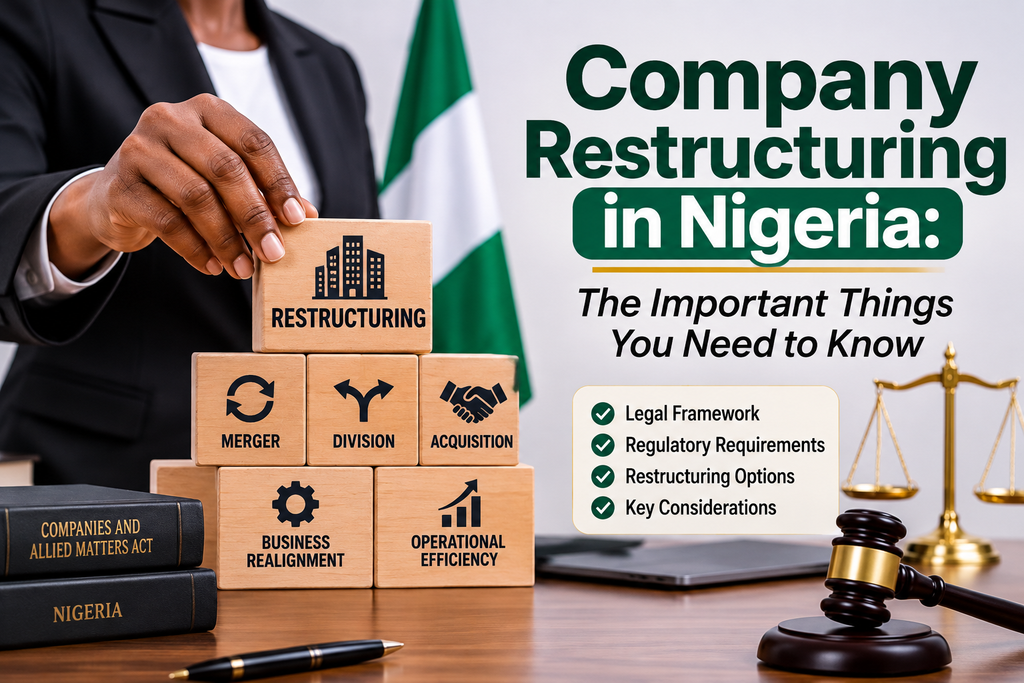
Introduction to company restructuring in Nigeria
Company restructuring is the process involved in changing the organization of a business. It involves rearranging the business for increased efficiency and profit. It is a way of altering the state or position and the general outlook of a company with a view to positioning such company in such a way that it can meet certain commercial challenges or take some opportunities. Thus, rather than fizzle out due to harsh circumstances, stiff competition or difficult regulatory compliance, companies avoid liquidation by adoption of various corporate restructuring option as a survival strategy. Similarly, the companies concerned with expansion can also explore the corporate restructuring options to achieve greater corporate growth.
A company may decide to restructure for a number of reasons. Some include;
- For greater economic value
- Expansion of its business
- Better economic advantage
- Liquidation or distress which could arise as a result of mismanagement or fraud by the directors or managers of the company
- Government policy
- Change in ownership of the company
Corporate restructuring can be internal or external. It is internal when a company has a large debt profile and it desires to retain its corporate identity without the involvement of any third party (it is within one company alone). Examples are Arrangement and Compromise,Arrangement on Sale, Management Buy-Out, Reduction in share-capital, Share reconstruction/Consolidation, and Recapitalization.
External Corporate Restructuring is a transaction whereby assets or operations of two or more companies not previously under common ownership or control are combined,whether by merger, acquisition, or sales/purchase of asset.
A necessary condition precedent before any court can sanction the scheme of reconstruction is that, “ the company must comply with the provisions of the act.” Any reconstruction scheme must be for the interest of the company. In Re Alabama, New Orleans, Texas and Pacific Junction Railway, the court held that; “the court must look at the scheme and see whether the Act has been complied with whether the majority are acting bonafide and if they are coercing the minority in order to promote interests that are adverse and then see whether or not the scheme is reasonable or if there is any reasonable objection to it….”.
CONDITION PRECEDENT FOR COMPANY RESTRUCTURING IN NIGERIA
- Corporate Authorization.
- Board Approval; The Board of Directors must pass a resolution approving restructuring approval.
- Shareholder approval(Special resolution); A special resolution of not less than 3/4 of the votes cast by shareholders is required, particularly for mergers, acquisition or significant changes to capital structure.
- Scheme of arrangement; where a compromise is proposed between a company and its creditors or members, a court ordered meeting must be held to approve the arrangement.
- Regulatory approvals
- FEDERAL COMPETITION AND CONSUMER PROTECTION COMMISSION( FCCPC); For mergers and acquisitions, approvals are required to ensure compliance with competition laws. Section 165 of the FCCPA.
- SECURITIES AND EXCHANGE COMMISSION(SEC). Approval is needed from SEC if restructuring involves a public company or a takeover( taking control over the management of a company by another in ways such as the holding of majority ownership;30-50% of the shares. Section 131(1) ISA)
- CORPORATE AFFAIRS COMMISSION(CAC). Approval and filing of all relevant documents such as resolutions or court orders must be done with the CAC.
- Investment and Security Act
- Sector specific regulations. Approvals from regulations such as CBN for banks or National Insurance Commission for insurance companies. Nigeria Revenue Services for compliance with task acquisition including clearance regarding capital based tax and VAT on asset transfers. Banking sector needs approval from BANK AND OTHER FINANCIAL INSTITUTIONS ACT (2020). Telecommunications sector is governed by NIGERIAN COMMUNICATIONS COMMISSION(NCC) and so on. Upstream petroleum sector restructuring is governed by the PIA(2021)
- Stakeholder consent/approval
- Creditor consent; Secured creditors must consent to any restructuring that affects their rights or interest in the company.
- Employee consultation; In cases of acquisition or significant restructuring, consultations with employees and their representatives is necessary.
- Judicial approval ( court sanction). For schemes of arrangement and compromise, the restructuring scheme must be sanctioned by Federal High Court of Nigeria to become legally binding.
FOREIGN PARTICIPATION AND THE PRINCIPLE OF 100% FOREIGN OWNERSHIP company restructuring in nigeria
Who are Expatriates?
An expatriate is a person who resides, works, or undertakes a professional, managerial, technical, commercial, or investment-related activity in a country other than the country of which that person is a national. In the context of Nigerian corporate and investment law, the term commonly refers to a foreign national who enters or resides in Nigeria to undertake employment, provide specialized services, manage business operations, or participate in commercial activities. Expatriates may be employees, directors, technical experts, entrepreneurs, or investors, depending on the nature of their involvement in the host country.
For the purposes of company restructuring and foreign ownership in Nigeria, however, expatriate status must be distinguished from foreign shareholding. A foreign national may own shares in a Nigerian company without being employed by or physically resident in Nigeria, while a foreign national employed by a Nigerian company may have no ownership interest in that company. Accordingly, the legal right of a foreign national to own shares in a Nigerian company is distinct from the immigration permissions and employment-related approvals that may be required where that person intends to work or reside in Nigeria.
There are two ways through which foreigners can participate in business in Nigeria;
- Foreign direct investment. This involves a foreigner(s) directly establishing a business in Nigeria or acquiring a significant amount of shares in an existing company thereby gaining control over the running and management of the business.
- Parterning with a Nigerian create a joint venture business in Nigeria.
STATUTORY FRAMEWORKS GOVERNING FOREIGN PARTICIPATION IN NIGERIA
- Companies and Allied Matters Act( CAMA) 2020
This is the principal legislation that regulate the formation, registration and administration of companies in Nigeria. Foreigners desirous of carrying on business in Nigeria are required to register the company before they can be able to legitimately carry on their business activities in Nigeria. It is the registration that would give the company an independent legal personality distinct from its owners.SECTION 42 of CAMA
The CAC is the regulatory body empowered under CAMA to register companies that have satisfied the conditions for registration under s36(1)-(4) of the Act. SECTION 8 of CAMA
For the purpose of registration, the authorized minimum share capital requirement is N100,000,000 million as seen in Handbook on Expatriate Quota Administration. Foreigners are allowed to own 100% equity in the company without local participation,(SECTION 17 and 18 NIPC)except in sectors contained in the negative list(section 31 NIPC) which include;
- Production of arms and ammunitions
- Production or dealing in narcotic drugs
- Psychotropic substances
- Production of military and paramilitary wears and other items that the federal executive council may determine.
Section 18(2)-26 CAMA provides that a foreigner can register a company limited by shares, public limited company,partnerships,incorporated trustees or company limited by guarantee for non profits and an unlimited company. Section 271(1) states that such companies must appoint at least 2 directors with the exception of a small company.
- Nigeria Investment Promotion Commission(NIPC) Act of 1995
Section 17 of the Act allows for foreigners to invest and participate in the operation of any enterprise in Nigeria. Section 4 establishes the commission charged with the responsibility of overseeing all foreign investments in Nigeria.
- Foreign Exchange Act
The act governs the inflow of foreign currency in and out of Nigeria. It allows foreigners to open and operate domiciliary accounts in foreign currencies for smooth and seamless running of their business.
- Nigeria Immigration Act 2015
Foreigners who wish to operate their business in Nigeria and to employ foreign nationals for positions where suitably qualified Nigerians are unavailable to fill up, must comply with the provisions of the Nigerian Immigrations Act and the 2017 Immigration Regulations s11-14 by obtaining the requisite expatriate quota.The foreign investor must obtain a business permit from the Ministry of Interior to legally carry out their business,pursuant to section36(1)of the Nigerian Immigration Act 2015. This ensures that they work in Nigeria and also remit their income abroad. They also need the Combined Expatriate Resident Permit and Alien Card(CERPAC) where they wish to live and work in Nigeria.It is issued by Nigeria Immigration Service.
- Nigeria Startup Act
Section 13 provides that for a foreign company to be granted the startup label, it must be registered as a Limited Liability company under CAMA, not be older than 10 years and be engaged in innovation and technology and must have at least 1/3 of its ownership held by Nigerian citizens.
- Ministry of Interior
The expatriate must obtain a business permit from MOI, pursuant to s36(1) immigration act as well as the CERPAC.
- Federal Inland Revenue Service
Every company incorporated in Nigeria is obligated to have tax identification number and always pay taxes to FIRS in line with the company tax act.
VII. Securities and Exchange Commission(SEC)
Where the company intends to raise capital through the public for expansion or for other ventures, it may trade its shares in the Nigerian Stock exchange and raise capital provided it is registered as a public company.
SECTOR SPECIFIC REGULATIONS company restructuring in nigeria
- Oil and Gas sector; Foreigners wishing to participate in this sector must comply with certain regulatory and licensing requirements such as obtaining oil and gas industry service permits from NUPRC, submission of tax clearance certificate to FIRS and so on.
- Banking and Financial Sector; Foreigners with interest in this sector are governed by BOFIA. A foreigner which intends to establish a bank or operate a financial institution must incorporate the company, meet the minimum capital requirement stipulated by CBN and obtain necessary banking licenses from CBN. Section 2-4 of BOFIA.
- Telecommunications sector; Foreign participation here is governed by Nigerian Communication Act. Foreigners must obtain operating licenses and must also comply with the various regulations and guidelines issued by NCC such as Type Approval Regulations,Numbering Regulations, etc. Also, there are local content requirements that require foreign telecommunication companies wishing to venture in nigerian telecommunications market to partner with Nigerian firms under certain special instances.
- Real Estate Sector; Foreigners are allowed to invest in this sector but subject to compliance with the LUA and the various states land instruments legislations. In Gerhard Huebner v Aeronautical Industrial Engineering and Project Management Company Limited, the SC held that foreigners are not entitled to land in Nigeria as of right.
Challenges Foreign Expatriates face in owning companies in Nigeria
- Regulatory and legal complexities; foreign investors must comply with several Nigerian corporate, tax, immigration and investment laws. Navigating these requirements can be time consuming and complex.
- Sector-specific regulations may require local content or ownership requirements that affect the complete foreign ownership.
- Immigration and work permit requirements; ownership does not automatically give an expatriate the right to work or reside in Nigeria. They also need CERPAC and other relevant approvals.
- Difficultly understanding the Nigerian Business Environment
- Foreign exchange and repatriation difficulties. Investors may face challenges when transferring dividends, profits and capital out of Nigeria.
RECOMMENDATIONS
- Government agencies should simplify regulatory processes by streamlining registration, licensing and approval procedures for foreign investors.
- Provide clear investment guidelines on foreign ownership and sector specific regulations
- The government should ensure a more stable and transparent system for the repatriation of legitimate profits and capital.
- Nigeria should continue improving legal and institutional mechanisms that protect foreign investments and provide efficient dispute resolution mechanisms.
CONCLUSION company restructuring in nigeria
100% foreign ownership is generally permissible in Nigeria, but it is not an absolute right across every sector. The ability of an expatriate to achieve complete ownership depends on the nature of the business, applicable sector-specific legislation, licensing requirements, local-content rules and compliance with Nigerian corporate, immigration and tax laws.
Contributors

OJIENOH SEGUN JUSTICE, ESQ.,
LEAD PARTNER, EKO SOLICITORS AND ADVOCATES

Counsel, EKO SOLICITORS AND ADVOCATES

GOLLY-STANLEY AMANDA
GRADUATE TRAINEE, EKO SOLICITORS AND ADVOCATES
COMPANY RESTRUCTURING IN NIGERIA, COMPANY RESTRUCTURING IN NIGERIA,COMPANY RESTRUCTURING IN NIGERIA,COMPANY RESTRUCTURING IN NIGERIA,COMPANY RESTRUCTURING IN NIGERIA,COMPANY RESTRUCTURING IN NIGERIA,COMPANY RESTRUCTURING IN NIGERIA,COMPANY RESTRUCTURING IN NIGERIA