

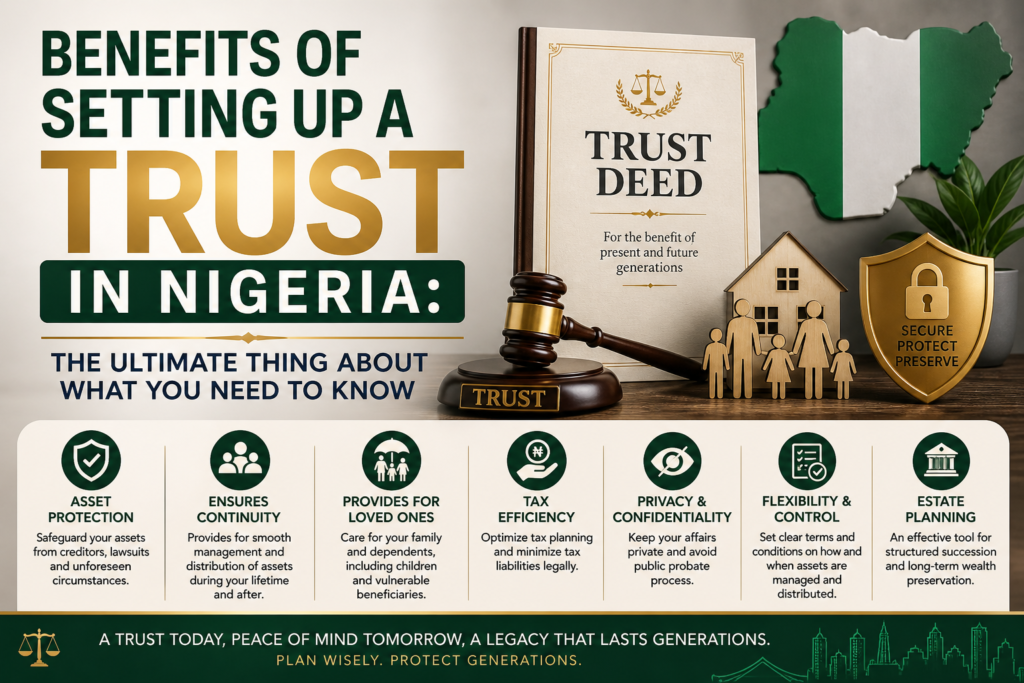
INTRODUCTION ON TRUST IN NIGERIA
In Nigeria today, more individuals, families, and business owners are looking for smarter ways to protect their assets, secure their legacy, and plan for the future. One of the most effective tools for achieving these goals is a trust.
But what exactly is a trust, and why should you consider setting up a trust in Nigeria? This article breaks it down in clear terms while highlighting the powerful benefits of trust structures under Nigerian law.
WHAT IS A TRUST IN NIGERIA?
A trust is a legal arrangement where a person (called the settlor) transfers assets to another person or entity (called the trustee) to hold and manage for the benefit of certain people (called the beneficiaries). In Nigeria, trusts are governed by a mix of common law principles, statutes like the Trustee Laws of various states, and equitable doctrines developed by the courts.
WHY YOU SHOULD SET UP A TRUST IN NIGERIA
1. Asset Protection and Wealth Preservation
One of the biggest benefits of setting up a trust in Nigeria is asset protection. When assets are placed in a properly structured trust:
- They are legally separated from your personal ownership
- It is protected from creditors (in many cases)
- They are shielded from unnecessary risks
This is especially useful for business owners, professionals, and high-net-liabilities worth individuals who want to safeguard their wealth from the unforeseen
2. Smooth Succession Planning
Trusts are a powerful alternative to relying solely on wills. Unlike wills, which go through probate, trusts allow assets to be transferred seamlessly after death, reduce delays in inheritance distribution and minimise family disputes.
This makes trusts an excellent tool for estate planning in Nigeria, particularly for individuals with complex family or asset structures.
3. Avoidance of Probate Delays TRUST IN NIGERIA
In Nigeria, probate processes can be time-consuming, bureaucratic and expensive. Assets held in a trust do not form part of the settlor’s estate for probate purposes. This means beneficiaries can access assets faster without going through the long probate process.
4. Confidentiality and Privacy TRUST IN NIGERIA
Wills become public documents once submitted for probate. Trusts, on the other hand remain private and do not require public disclosure of assets or beneficiaries. If privacy is important to you, setting up a trust is a more discreet option for managing your estate.
5. Control over Asset Distribution
A trust allows you to decide who gets what, when they get it and how they use it. For example, you can provide funds for a child’s education, delay access to assets until a beneficiary reaches a certain age and protect beneficiaries from mismanaging wealth. This level of control is not easily achievable with a standard will.
6. Protection for Vulnerable Beneficiaries
Trusts are ideal for protecting minors, persons with disabilities and financially inexperienced beneficiaries. The trustee ensures that assets are managed responsibly and used strictly for the beneficiaries’ welfare.
7. Business Continuity and Stability
If you own a business, a trust can help ensure continuity after your death or incapacity. By placing business interests in a trust, ownership transitions smoothly, management disruptions are minimized and the business can operate without interruption.
This is crucial for family-owned businesses in Nigeria.
8. Flexibility in Wealth Management
Trusts can be structured in different ways depending on your goals. By setting up a trust, you are not forced to give everything at once. For instance, it can be stated in the trust that: “My child should get N5million at age 25, and the rest at 30”, “My spouse should receive monthly support instead of a lump sum. This helps prevent misuse or reckless spending. You can also attach conditions to how the money is used. For instance: only for education, healthcare, only for starting a business. By so doing, the money serves a purpose, not just consumption.
9. Tax Planning Advantages (With Proper Structuring)
While Nigeria does not have a highly developed trust tax regime compared to some jurisdictions, trusts can still be used for efficient tax planning when properly structured. Professional advice is key here, as tax implications depend on the type of trust, the assets involved and applicable tax laws
10. Reduced Family Disputes
Family conflicts over inheritance are common in Nigeria. A well-drafted trust helps to clearly define beneficiaries’ rights, eliminate ambiguity and reduce litigation risks. By setting clear terms, you minimize the chances of disputes after your passing.
WHEN SHOULD YOU CONSIDER SETTING UP A TRUST IN NIGERIA?
You should seriously consider setting up a trust in Nigeria if:
- You own significant assets or property
- want to protect your wealth from risks
- you have young children or dependents
- want to avoid probate delays
- You own a business and want continuity
- You desire privacy in your estate planning
IMPORTANCE OF A LEGAL PRACTITIONER IN SETTING UP A TRUST IN NIGERIA
A lawyer ensure proper legal structuring, tailor the trust to your specific needs and draft clear and enforceable instructions.
CONCLUSION
Setting up a trust in Nigeria is not just for the wealthy. It is for anyone who wants control, protection, and peace of mind when it comes to their assets and legacy. With benefits ranging from asset protection and succession planning to privacy and flexibility, trusts remain one of the most effective legal tools available for long-term wealth management in Nigeria.
Contributors

Lead Partner, EKO SOLICITORS AND ADVOCATES

Counsel EKO SOLICITORS AND ADVOCATES

Counsel, EKO SOLICITORS AND ADVOCATES