

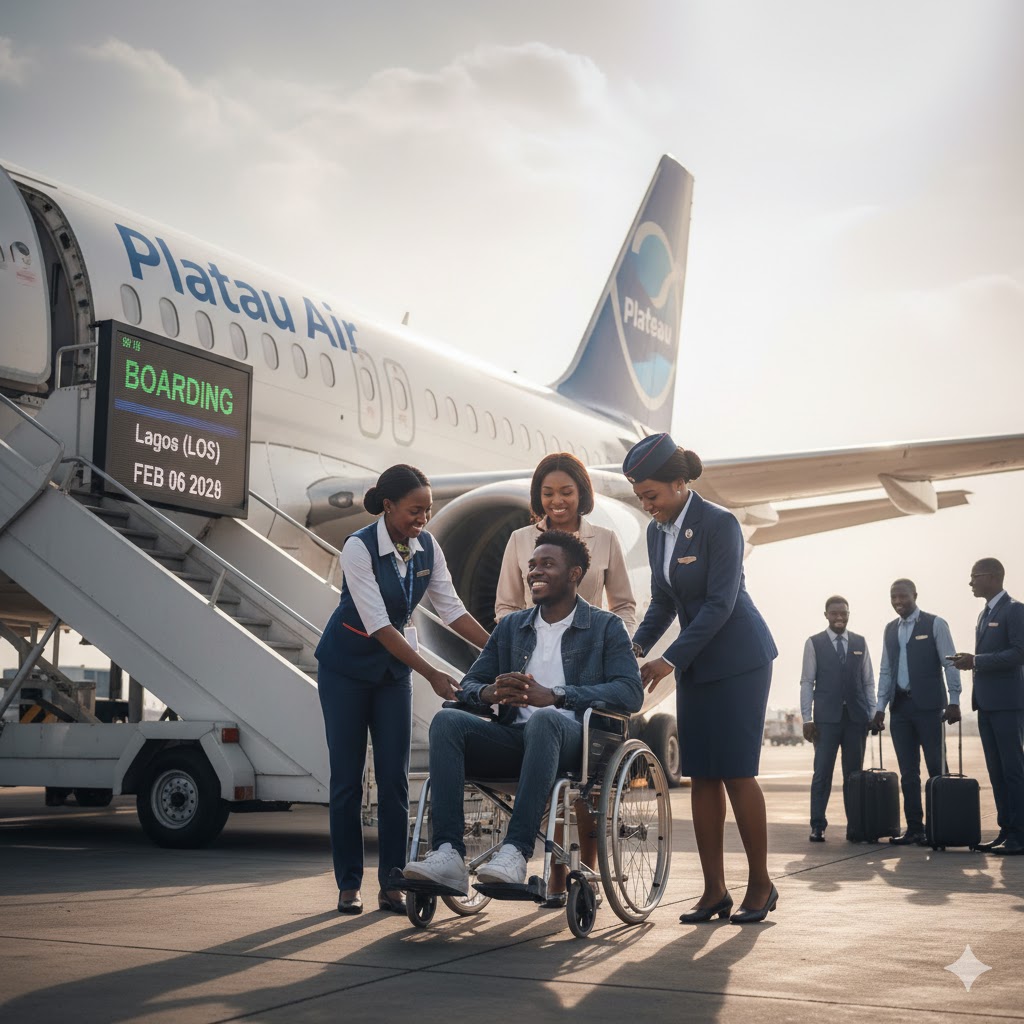
ASSIST SPECIAL-NEEDS PASSENGERS
On a bright Monday morning at Murtala Muhammed International Airport, Lagos, a young woman who uses a wheelchair, arrived early for her flight. She had thoughtful plans meeting family in Abuja for her sister’s graduation. Yet, every previous journey had an all too familiar stress: uncertainty about whether airline staff would be prepared to assist her in boarding, navigating the terminal, or addressing her needs onboard. Like many passengers with disabilities or reduced mobility, Aisha often had to call airlines days ahead, beg for assistance, or arrive hours early just to be sure she wouldn’t be left waiting in the corridor with no help.
Air travel should connect people not, create barriers. But until recently, Nigeria’s airline reservation systems rarely offered an option for passengers like Aisha to request assistance when buying a ticket. That changed dramatically in January 2026, when the Nigerian Civil Aviation Authority (NCAA) issued a seven-day ultimatum to domestic airlines to integrate a mandatory special-needs assistance request feature into ticket booking platforms.
This directive signals a legal and policy shift toward inclusive aviation, one that recognises the right of passengers with disabilities or reduced mobility to dignity, access, and meaningful participation in air travel. This article seeks to explain the legal framework supporting this new NCAA order, the relevant regulatory provisions, enforcement context, and broader implications for inclusion and passenger rights in Nigeria’s aviation sector.
1. NCAA’s Mandate and Regulatory Authority (ASSIST SPECIAL-NEEDS PASSENGERS)
1.1 The Civil Aviation Act 2022: Establishing NCAA’s Powers
The Civil Aviation Act, 2022 is the principal statute governing civil aviation in Nigeria. It establishes the Nigeria Civil Aviation Authority (NCAA) as the autonomous regulator with jurisdiction over safety, economic and consumer protection aspects of the aviation sector. Sections 8-9 of the Act grant the Authority broad powers to regulate civil aviation, including “to make and enforce regulations for the safety, security, economic development, and consumer protection of civil aviation services.”
The NCAA is empowered to issue directives and regulations to ensure compliance with internationally recognised standards of aviation conduct, including protection of passengers. The Act also authorises NCAA to monitor, enforce and sanction airlines and other aviation operators in accordance with law.
1.2 Nigeria Civil Aviation Regulations (NCAA Regulations) 2023 – Part 19
The NCAA issues subsidiary legislation under the Civil Aviation Act known as the Nigeria Civil Aviation Regulations (Nig. CARs 2023). Part 19 – Consumer Protection Regulations specifically deals with passengers’ rights and responsibilities, and obligations of airlines, travel agents, tour operators, and airport operators.
Regulation 19.12 of the Nig. CARs 2023 is central to the NCAA’s recent order. It lays down detailed obligations owed to Persons with Reduced Mobility (PRM) or passengers with special needs, including:
- Airlines must not discriminate against passengers on the basis of disability or reduced mobility.
- Airlines and airport operators must provide assistance facilities and prioritise persons with reduced mobility as well as give priority to them.
- Under Regulation 19.12.3.1, during reservation, airlines and travel agents must provide passengers the opportunity to request assistance across all ticket sales points, including telephone and online booking platforms; and must place a mandatory field/column on ticket portals to capture special-needs assistance requests.
This regulatory requirement is the legal foundation for NCAA’s directive that airlines amend their reservation systems to include a conspicuous special-needs assistance request feature.
2. NCAA’s New Special-Needs Assistance Directive
2.1 What the Directive Requires
In late January 2026, the NCAA formally instructed all domestic airline operators in Nigeria to integrate a mandatory “Special Needs/Assistance Request” option into their ticket booking systems, whether online, mobile app, or telephone channels, within seven (7) days of receiving the directive. This seven day directive was give on the 30th of Janjuary 2026 and will come to an end on the 6th of February 2026.
The directive emphasises:
- Airlines must allow passengers to request assistance at the point of booking across all ticket sales pipelines.
- The ticket portal must include a clearly designated field or column for passengers with disabilities or PRMs (or their assistants) to make special needs requests before ticket purchase.
- Seat reservation systems and agents must actively inquire whether any passenger in a booking party requires assistance, rather than merely waiting for spontaneous disclosure.
This reverses the common practice where passengers had to contact airlines separately, sometimes after ticket purchase, to make special assistance arrangements.
2.2 Rationale and Consumer Protection Focus
The NCAA’s order reinforces the consumer-protection obligations in Part 19 of the Nig. CARs 2023 and aligns Nigeria with international best practices on accessibility (similar to persons-with-reduced-mobility rights in EU Regulation 1107/2006). The new requirement is intended to prevent the exclusion of PRMs from air travel, eliminate uncertainty around assistance provision, and allow airlines to plan adequately for boarding, equipment needs (such as ambulifts, aisle chairs), and staff allocation.
2.3 Enforcement and Sanctions
The directive warns that non-compliance may attract regulatory enforcement actions consistent with the Civil Aviation Act 2022 and the Nig. CARs. While the specific sanctions are not enumerated in the press releases, NCAA has previously fined or sanctioned airlines for passenger rights violations under Part 19 consumer provisions including mishandling delays, refunds and absorption of passenger complaints.
3. Broader Legal and Human Rights Context
3.1 Discrimination Against Persons with Disabilities (Prohibition) Act 2018
Beyond aviation regulations, Nigeria has a general anti-discrimination law: the Discrimination Against Persons with Disabilities (Prohibition) Act 2018 (“PWD Act”). Section 14(1) of the PWD Act mandates that public accommodations and service providers including airlines ensure accessibility and equal treatment for persons with disabilities, and prohibits discriminatory practices that deny them access to services.
This law reinforces NCAA’s aviation-specific obligations, giving a general statutory backdrop against which discriminatory practice in any sector including air travel is unlawful.
3.2 International Standards and the Civil Aviation Act Objectives
Under Section 1 of the Civil Aviation Act 2022, one objective is “to ensure that Nigeria’s obligations under international aviation agreements are implemented,” including those related to consumer protection and PRM rights. Nigeria is a member of ICAO, whose standards recommend that states ensure non-discrimination and accessibility for PRMs in air transport.
While Nigeria has not domesticated an exact equivalent to the EU’s Persons with Reduced Mobility Regulation (EU) 1107/2006, NCAA’s Part 19 provisions closely resemble international best-practice norms in the field.
4. Legal Considerations and Judicial Principles On (ASSIST SPECIAL-NEEDS PASSENGERS)
4.1 Regulatory Discretion and Judicial Review
NCAA’s powers to issue directives derive from the Civil Aviation Act 2022 and the Nig. CARs 2023. Nigerian courts have long recognised that statutory agencies have wide regulatory discretion when acting within their legal mandate, subject to reasonableness and fairness. In Director, Department of State Services v. Olisa Agbakoba, the court held that administrative decisions must conform to statutory authority and constitutional principles.
Similarly, any airline challenging NCAA’s directive would likely face judicial review on legality, rationality, and fairness grounds with the courts generally upholding agency action so long as it is grounded in empowering law and respects procedural fairness.
4.2 Right to Non-Discrimination
Nigerian constitutional law also protects dignity and non-discrimination. Section 42 of the Constitution prohibits discrimination on the basis of place of origin, sex, religion, political opinion, or personal disability (which courts have interpreted broadly). This constitutional backdrop supports regulatory protections that seek to remove transport barriers for PRMs.
5. Practical Impacts and Industry Response
5.1 Benefits for Passengers
The mandatory inclusion of special-needs assistance fields in ticketing systems will reduce logistical uncertainty, ensure advance preparation by airlines and ground staff, and reduce stress for passengers with disabilities who historically have had to make ad hoc arrangements. This system promotes dignity, independence and safety in travel.
5.2 Airline Operational Implications
Airlines must update digital and telephone reservation systems promptly, train staff on the new requirement, and ensure that assistance requests are integrated with operational planning (e.g., booking, staffing, equipment). Failure to comply may lead to NCAA enforcement and reputational harm.
Conclusion
Nigeria’s aviation landscape is evolving towards inclusivity and consumer protection. NCAA’s directive requiring airlines to integrate mandatory special-needs assistance options into ticket reservation platforms is grounded in clear statutory and regulatory authority particularly the Civil Aviation Act 2022 and Nig. CARs 2023 Part 19. The directive complements broader anti-discrimination law under the Discrimination Against Persons with Disabilities (Prohibition) Act 2018 and reflects international best practices. By anchoring regulatory action in explicit legal provisions and prioritising the needs of passengers with disabilities and reduced mobility, Nigeria moves closer to ensuring that air travel is accessible and respectful to all citizens.
Contributors

Lead Partner, EKO SOLICITORS & ADVOCATES

Counsel EKO SOLICITORS AND ADVOCATES

Graduate Trainee, EKO SOLICITORS & ADVOCATES
(ASSIST SPECIAL-NEEDS PASSENGERS, ASSIST SPECIAL-NEEDS PASSENGERS, ASSIST SPECIAL-NEEDS PASSENGERS,ASSIST SPECIAL-NEEDS PASSENGERS, ASSIST SPECIAL-NEEDS PASSENGERS )