

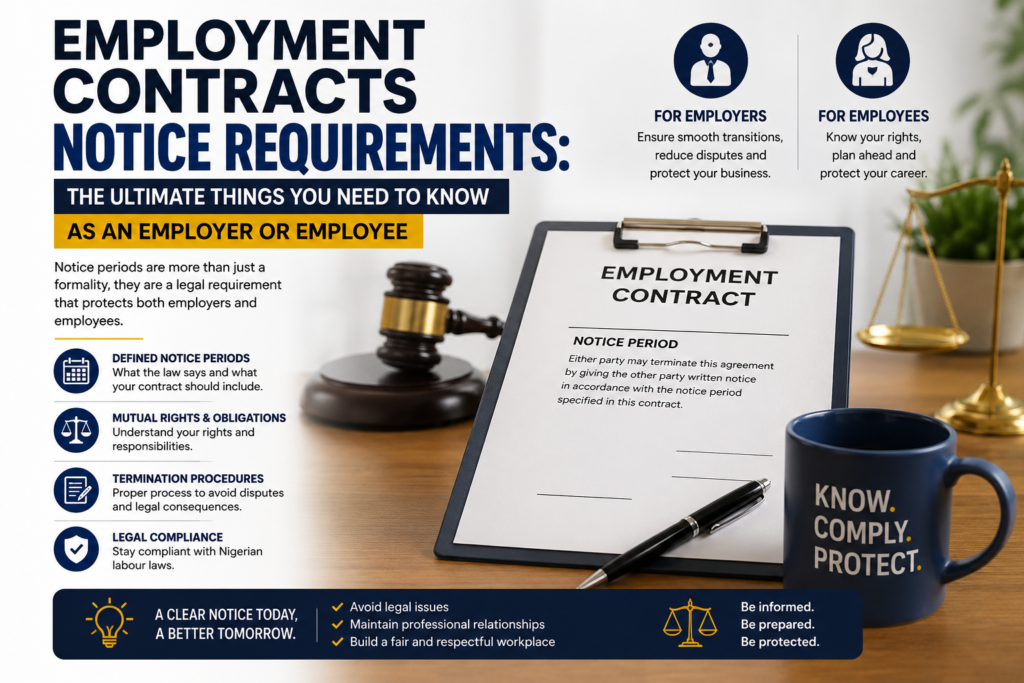
Introduction to EMPLOYMENT CONTRACTS NOTICE REQUIREMENTS
It was a Monday morning when Emeka arrived at his office desk, coffee in hand, only to find an envelope bearing the company letterhead. Inside was a single typed sheet: a termination letter, effective immediately. No prior warning, no transition period, and no explanation beyond a terse “restructuring of operations.” Emeka had served the company loyally for six years. As he cleared his desk and walked out into the Lagos sun, bewildered and shaken, one question consumed him: was this legal? The answer, as Nigerian law makes plain, is nuanced but decisive. The manner of his departure was not merely unkind. In critical respects, it was unlawful.
Employment relationships, however they begin, must end with a measure of dignity and legal order. One of the most fundamental protections the law extends to an employee is the right to adequate notice before termination. In Nigeria, this protection is anchored in statute, shaped by the common law, and increasingly influenced by international labour standards. Understanding the rules that govern mandatory notice periods, and the exceptions and remedies that surround them, is therefore essential, whether one is an employer navigating a workforce decision or an employee seeking to know their rights.
The Statutory Framework: The Labour Act
The primary legislation governing minimum notice periods in Nigeria is the Labour Act (Cap. L1, Laws of the Federation of Nigeria 2004). It is, however, critical to appreciate the precise scope of this statute from the outset. The protections of the Labour Act apply only to “workers” as that term is defined under the Act[1]. A “worker” is an employee engaged in manual labour or clerical work. The Act expressly excludes persons employed in an administrative, executive, technical, or managerial capacity.
This distinction, though seemingly technical, carries enormous practical consequences for millions of Nigerian employees, since it determines which statute, if any, governs their termination.
For those who fall within its protective ambit, the Act prescribes what may be described as a graduated notice ladder[2]. The notice period due to an employee scales upward with the length of their service, reflecting the legislative recognition that longer serving employees have a greater stake in the employment relationship and therefore deserve more time to reorganise their affairs. The table below sets out the statutory minimum.
- Less than three months: One day
- Three months or more, but less than two years: One week
- Two years or more, but less than five years: Two weeks
- Five years or more: One month
Beyond the duration of the notice itself, the Act prescribes additional procedural rules of equal importance[3]. Any notice exceeding one week must be given in writing, creating a documentary record that protects both parties. The calculation of the notice period excludes the day on which notice is actually given, thus ensuring the employee receives the full benefit of the stipulated period. Finally, either party may waive their right to notice or agree to accept payment in lieu, providing a measure of flexibility without compromising the underlying protective purpose of the statute.
White Collar Employees: The Common Law Doctrine of Reasonable Notice
The Labour Act, robust as it is within its scope, leaves a significant category of employees without its direct protection. Senior, managerial, technical, and professional staff fall outside the statutory framework and are instead governed by the express terms of their individual contracts of employment. For these employees, the contract is the primary source of rights and obligations, and the notice period stipulated therein is the one that must be honoured by both parties.
The more legally interesting situation arises where the contract of employment is silent on the question of notice. This gap is not uncommon, particularly in respect of older or informally structured employment arrangements. In such circumstances, the common law steps in through the doctrine of “reasonable notice.” Under this doctrine, the courts will imply into the contract a notice period that is objectively reasonable, having regard to the nature of the employment, the employee’s rank and seniority, the length of service, and the norms and customs of the relevant industry.
The doctrine received authoritative application by the National Industrial Court of Nigeria (NICN) in Talo Tuwa Sunday v. Zenith Bank Plc[4]. The Court held that where a contract of employment is silent as to the applicable notice period, one month constitutes a reasonable notice period for a professional banking employee with a relatively short period of continuous service. This decision provides a useful judicial benchmark, though the precise period to be implied will always depend on the specific circumstances of each case, and courts elsewhere have implied considerably longer periods, sometimes several months, for highly senior executives whose seniority and remuneration make a swift re-engagement elsewhere unlikely.
Payment in Lieu of Notice in Employment Contracts Notice Requirements
There are circumstances in which an employer, for operational or practical reasons, requires an employment relationship to terminate with immediate effect rather than after the expiration of a notice period. The law accommodates this commercial reality through the mechanism of payment in lieu of notice. Rather than allowing the employee to serve out the notice period, the employer extinguishes the obligation by paying the equivalent salary and benefits for that period in a lump sum.
However, this mechanism comes with a critical and often misunderstood procedural requirement: the payment must, as a general rule, be made contemporaneously with the act of termination. It is not sufficient for an employer simply to hand an employee a termination letter and thereafter promise to include the in lieu payment in the next payroll cycle. Such an approach risks being treated as a breach of contract.
This principle finds firm support in Shena Security Co. Ltd v. Afropak (Nig.) Ltd[5], where the Supreme Court affirmed that an employee terminated on notice is entitled to be placed, financially, in the position that immediate and proper payment would have secured. An employer who defers the in lieu payment to a future date invites a claim in damages, since the employee has in the interim been deprived of both employment and the financial security the payment was meant to provide.
It is worth noting that the Supreme Court’s own earlier decision in Chukwumah v. Shell Petroleum Development Company of Nigeria Ltd[6] introduces a degree of nuance often overlooked. There, the Court observed that the mode and timing of payment in lieu of notice may depend on the circumstances of each case, such as an employee’s usual method of salary payment.
The Paradigm Shift: Towards Termination With Cause
Historically, Nigerian common law afforded employers an almost unfettered right to terminate an employment relationship. Provided proper notice was given, an employer was under no legal obligation to furnish any reason for the decision. This position was authoritatively stated in Chukwumah, which confirmed that an employer could terminate employment for any reason, or indeed for no reason at all, so long as the required notice was observed. Notably, the Supreme Court has not abandoned this common law position even in recent years; it was reaffirmed as late as 2018 in Obanye v. Union Bank of Nigeria Plc[7].
Yet that legal landscape has, for a distinct category of disputes, undergone a profound transformation. The establishment and constitutional entrenchment of the National Industrial Court of Nigeria as a court of superior record has been the primary engine of this change. The NICN is expressly mandated to apply international best practices and international labour standards in the resolution of employment disputes[8], a mandate that builds on the jurisdiction the Court had already begun to exercise under its enabling statute[9].
Acting on this mandate, the NICN has drawn heavily from the International Labour Organisation’s Termination of Employment Convention, which provides that employment shall not be terminated without a valid reason connected to the capacity or conduct of the employee, or the operational requirements of the enterprise[10]. The Court has progressively moved away from the old common law orthodoxy and now heavily discourages terminations that are not accompanied by a stated and justifiable cause, even as the Supreme Court, sitting outside the specialised labour jurisdiction, continues to apply the traditional rule in ordinary contractual disputes.
The practical implication of this jurisprudential tension is significant. A technically correct notice period may still insulate an employer from a claim of wrongful termination in the strict contractual sense, but it will not necessarily shield an employer from a finding of unfair labour practice before the NICN.
The Exception: Summary Dismissal for Gross Misconduct
Every legal framework that requires notice as a precondition for termination must also grapple with the employee who forfeits their entitlement to that notice by their own conduct. Nigerian law achieves this through the doctrine of summary dismissal, which permits an employer to terminate an employment relationship without any notice and without payment in lieu, where the employee has been guilty of gross misconduct.
Gross misconduct is not a precise statutory term. It is a common law concept, and the courts have consistently described it as conduct of a grave and weighty character that fundamentally and irreparably destroys the bond of trust and confidence upon which the employment relationship rests. The paradigmatic examples are theft, fraud, bribery, embezzlement, deliberate corporate sabotage, and other acts of dishonesty or serious breach of duty. The defining characteristic is not merely that the conduct is wrong or undesirable, but that it renders the continuation of the employment relationship practically and morally untenable.
It is, however, at this juncture that many employers make a costly and legally fatal error. The right to dismiss summarily is not a right to dismiss arbitrarily or without process. Even where the misconduct alleged is of the gravest kind, the constitutional requirement of fair hearing[11] must be satisfied before the dismissal can have legal effect.
In practical terms, this constitutional obligation requires the employer to issue the employee with a formal query setting out the allegations against them in clear and sufficient detail, and to afford the employee a genuine and meaningful opportunity to respond and to defend themselves. Only after this process has been properly completed may the employer proceed to the decision to dismiss. An employer who dispenses with this step, however compelling the evidence of misconduct may appear, risks having the dismissal set aside by a court as a nullity, notwithstanding the gravity of the underlying conduct.
Comparative Perspectives in Employment Contracts Notice Requirements
Nigeria’s graduated approach to statutory notice, in which the minimum period increases with length of service, mirrors an approach found in a number of other common law jurisdictions. In the United Kingdom, for instance, statutory notice similarly scales upward with continuous service, running from a modest minimum for shorter service to a substantially longer period for long serving employees[12].
This convergence is not accidental. It reflects a widely shared regulatory judgment that the disruption caused by termination, and the time realistically needed to secure alternative employment, grows with tenure. What distinguishes the Nigerian experience, however, is the widening gap between the modest statutory minimums under the Labour Act and the far more demanding standards that the NICN has begun to import from international labour instruments, a gap that has no direct parallel in jurisdictions where a single statute governs the generality of employees[13].
Remedies for Breach of the Notice Requirement
Where an employer terminates employment without the requisite notice, and without a valid payment in lieu, the ordinary common law remedy is damages, generally quantified as the salary and identifiable benefits the employee would have earned during the unserved notice period. Nigerian courts have, as a matter of settled principle, generally declined to order specific performance of a contract of employment or to compel reinstatement in an ordinary master and servant relationship, since a relationship of trust cannot readily be restored by judicial order once it has broken down.
A narrow exception exists for employment said to enjoy “statutory flavour,”, broadly, employment whose terms are substantially regulated by statute or subsidiary legislation rather than by ordinary contract, where reinstatement has occasionally been ordered[14]. Beyond the question of reinstatement, an employee who succeeds before the NICN on a claim of unfair labour practice may in addition recover compensation calibrated to the unfairness of the process itself, rather than merely to the value of the missed notice, reflecting the Court’s broader remedial mandate. Appeals from the NICN’s civil decisions lie, as of right or with leave depending on the subject matter, to the Court of Appeal[15], which remains the final port of call for most labour disputes given the constitutional restriction on further appeals to the Supreme Court.
Practical Guidance for Employers and Employees
For employers, the recurring pitfalls are avoidable with modest foresight. Every contract of employment, irrespective of the seniority of the role, should contain an express and unambiguous notice clause, since silence invites the uncertainty of judicially implied reasonable notice. Where payment in lieu of notice is contemplated, the funds should be available and disbursed at, or immediately upon, the date of termination, not left to a subsequent payroll cycle. Finally, even where the underlying conduct appears to justify summary dismissal, the employer should pause to issue a query and to genuinely consider the employee’s response before finalising any decision to dismiss.
For employees, the corresponding lesson is one of documentation and prompt advice. An employee served with a termination letter should note the effective date, whether payment in lieu has actually been credited rather than merely promised, and whether any misconduct allegation was ever put to them in writing. These details determine, often decisively, whether a subsequent claim before the NICN is likely to succeed.
Conclusion in Employment Contracts Notice Requirements
Emeka, whose Monday morning dismissal opened this discussion, had a viable legal claim on multiple fronts. As a six year employee, he was entitled to one month’s notice under the Labour Act, if his role fell within its protective scope. His instant dismissal without payment in lieu, or with payment deferred to a future date, would have exposed his employer to a claim in damages. If his role was managerial in character, the common law doctrine of reasonable notice would have operated to similar effect.
The law of mandatory notice periods is, in essence, a law of minimum decency in the employment relationship. It recognises that an employee’s livelihood is not a commodity to be extinguished without warning or preparation. Whether the applicable framework is the Labour Act, the contract of employment, or the evolving jurisprudence of the NICN, the central message is consistent: termination must be conducted with procedural integrity, adequate notice, and, increasingly, with a justifiable and stated cause.
For employers, the lesson is one of preparation and process. For employees, it is one of awareness and assertiveness. And for the Nigerian legal system, the progressive alignment of its labour jurisprudence with international standards signals a maturing recognition that the employment relationship deserves not merely contractual enforcement, but genuine protection grounded in fairness, dignity, and the rule of law.
REFERENCES in Employment Contracts Notice Requirements
[1]Labour Act (Cap. L1, Laws of the Federation of Nigeria 2004), s. 91.
[2]Labour Act, s. 11(1) and (2).
[3]Labour Act, s. 11(3), (4) and (6).
[4]Talo Tuwa Sunday v. Zenith Bank Plc (2015) 56 N.L.L.R. (Pt. 192) 460 (NICN). The employee in that case had served for one year and eight months.
[5]Shena Security Co. Ltd v. Afropak (Nig.) Ltd & Ors (2008) 18 NWLR (Pt. 1118) 77 (SC)
[6]Chukwumah v. Shell Petroleum Development Company of Nigeria Ltd (1993) 4 NWLR (Pt. 289) 512 (SC).
[7]Obanye v. Union Bank of Nigeria Plc (2018) LPELR-44702 (SC).
[8]Constitution of the Federal Republic of Nigeria 1999, s. 254C(1)(f) and (h), as inserted by the Constitution (Third Alteration) Act 2010.
[9]National Industrial Court Act 2006, s. 7, which first conferred on the NICN exclusive jurisdiction over labour and industrial relations matters ahead of the 2010 constitutional entrenchment.
[10]International Labour Organisation Convention No. 158 on Termination of Employment (1982), art. 4.
[11]Constitution of the Federal Republic of Nigeria 1999, s. 36.
[12]Employment Rights Act 1996 (UK), s. 86(1), which scales statutory notice from one week, after one month of service, up to a maximum of twelve weeks after twelve years of continuous service.
[13]See generally B. B. Kanyip, Labour and Employment Law in Nigeria (National Industrial Court of Nigeria, 2015), on the graduated development of statutory and judge made notice standards in Nigeria.
[14]See Olaniyan & Ors. v. University of Lagos (1985) 2 NWLR (Pt. 9) 559, on the limited circumstances, chiefly statutory flavour employment, in which reinstatement rather than damages may be ordered.
[15]Skye Bank Plc v. Iwu (2017) 16 NWLR (Pt. 1590) 24 (SC), on the appellate structure governing decisions of the National Industrial Court.
CONTRIBUTORS

OJIENOH SEGUN JUSTICE, ESQ.,
LEAD PARTNER, EKO SOLICITORS AND ADVOCATES

IDOWU-AGIDA NIFEMI
COUNSEL, EKO SOLICTORS AND ADVOCATES
Employment Contracts Notice Requirements,Employment Contracts Notice Requirements,Employment Contracts Notice Requirements,Employment Contracts Notice Requirements,Employment Contracts Notice Requirements,Employment Contracts Notice Requirements,Employment Contracts Notice Requirements,V,Employment Contracts Notice Requirements,V,Employment Contracts Notice Requirements,Employment Contracts Notice Requirements,Employment Contracts Notice Requirements