

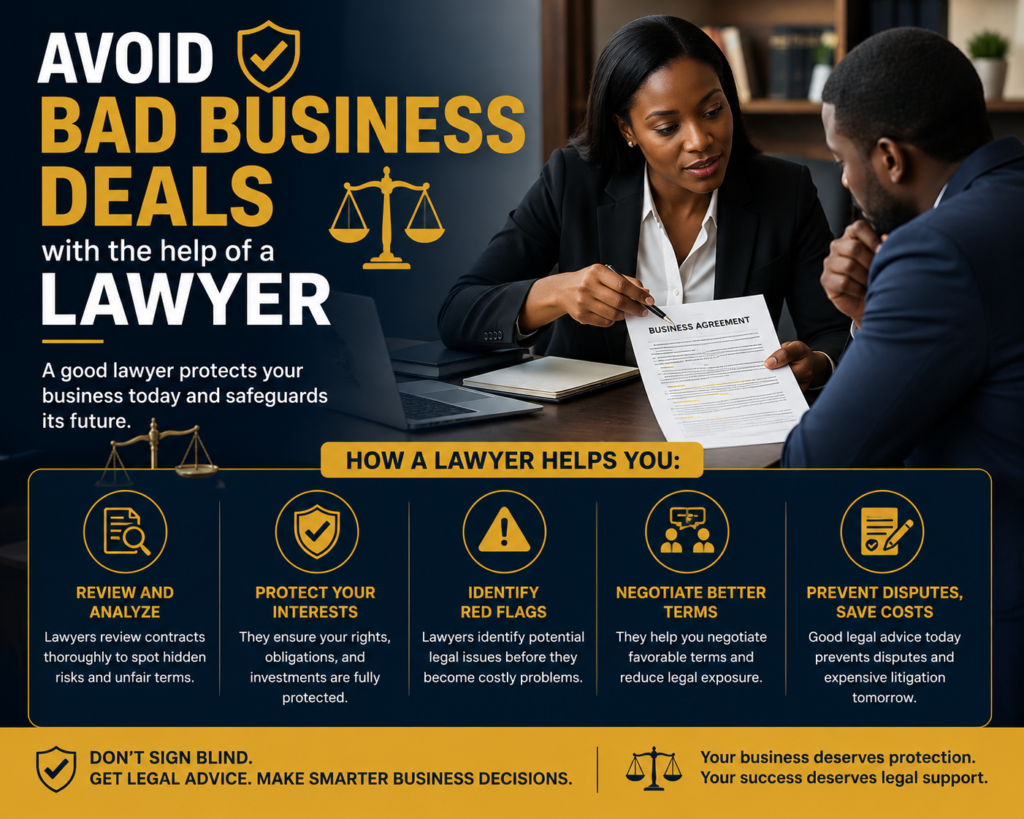
Introduction to avoid bad business deals
In a serious commercial transaction, a lawyer is often the difference between a calculated risk and an expensive mistake. In Nigeria, a competent transactional lawyer does not merely review a draft agreement; the lawyer tests the deal for legal validity, commercial imbalance, hidden risk, unenforceable clauses, and future exit problems before the client signs.
The lawyer’s real job Avoid Bad business deals
A good business lawyer is part legal risk manager, part deal architect, and part negotiation strategist. The work is not limited to correcting grammar or inserting boilerplate; it includes checking capacity, authority, consideration, title, regulatory compliance, dispute resolution, warranties, indemnities, and the commercial consequences of default.
In top-tier practice, the central question is not whether a contract looks professional, but whether it can survive a dispute and whether the client can live with the allocation of risk embedded in it. That is where many bad deals are detected early enough to be renegotiated or abandoned.
Nigerian legal foundation Avoid Bad business deals
Under Nigerian contract law, a binding agreement generally requires offer, acceptance, consideration, intention to create legal relations, and capacity. But even where those elements exist, the contract may still be vulnerable if it is tainted by misrepresentation, duress, undue influence, mistake, illegality, fraud, or lack of authority.
That is why legal review matters so much. A deal may be commercially unattractive yet still enforceable, or legally defective even though the business terms look fine on paper. A lawyer’s role is to spot which category the transaction falls into before signature.
Misrepresentation in business deals
Misrepresentation is one of the most dangerous features of a bad business deal because it often hides in optimistic projections, incomplete disclosure, and selective answers. If a counterparty misstates revenue, suppresses litigation, exaggerates asset quality, or misrepresents regulatory status, the client may be induced into a transaction on a false foundation.
Nigerian law recognizes that fraudulent misrepresentation may entitle the innocent party to rescind the contract, while other forms of misrepresentation may still support rescission or damages depending on the facts. That makes due diligence indispensable, because many of the worst commercial losses come not from bad drafting but from false factual premises.
Duress, pressure, and consent Avoid Bad business deals
A deal signed under illegitimate pressure is not the same as a deal signed under hard bargaining. Nigerian contract doctrine recognizes that duress and undue influence can undermine consent where one party’s will is overborne by coercion, exploitation, or improper pressure.
Commercial pressure alone will not always invalidate a transaction, but a lawyer should know when pressure has become legally significant. This is especially true in refinancing, settlement, share transfers, and urgent investment deals where one party insists on immediate signature without meaningful review.
Illegality and regulatory risk Avoid Bad business deals
A lawyer can save a client from entering a deal that is invalid, unenforceable, or dangerous because it conflicts with a statute or regulatory requirement. In Nigeria, many business deals are not just contract issues; they also implicate corporate law, tax, land, banking, foreign exchange, sectoral regulation, competition rules, and licensing obligations.
A document that appears commercially acceptable may still be a bad deal if it exposes the client to sanctions, hidden tax liabilities, unlawful transfer restrictions, or regulatory invalidity. Good counsel identifies those risks before the transaction closes, not after the problem surfaces.
Authority and capacity
A large number of commercial disputes begin with a simple but fatal issue: the wrong person signed. Nigerian lawyers should confirm board approvals, signatory mandates, shareholder consent where required, and the legal authority of the counterparty to bind itself.
If authority is defective, the client may face delays, enforceability problems, or outright nullity arguments later. That is why a proper transaction review should always include a capacity and authority check as part of the closing process.
Promptness matters
Even where a client has grounds to challenge a bad deal, the law expects prompt action. In C.F.A.O. v. Bamgbala & Anor, the court emphasized that a claim for rescission must be brought promptly, and that delay can bar equitable relief even where the substantive complaint is serious.
That principle is commercially important. A client who signs a bad deal and waits too long may lose the chance to unwind it later, especially where the other side has altered its position in reliance on the agreement. A lawyer who spots the problem early can preserve options that may disappear with time.
What strong legal advice looks like
A high-quality lawyer does not only mark up the draft. The lawyer asks what is missing, what is assumed, what is one-sided, what is hard to prove, and what will happen if the deal breaks down.
That review should usually cover:
- the commercial pricing structure,
- payment timing and conditions,
- default triggers,
- termination and exit rights,
- warranties and disclosures,
- indemnities and liability caps,
- dispute resolution,
- governing law,
- regulatory approvals, and
- post-closing obligations.
If those points are not properly addressed, the document may be more dangerous than useful. A polished contract can still be a bad deal if the risk allocation is heavily skewed against the client.
What lawyers cannot do
A lawyer cannot turn a fundamentally poor bargain into a good one. If the price is too high, the risk too open-ended, or the counterparty too weak financially, legal drafting can only reduce damage; it cannot manufacture commercial advantage.
A lawyer also cannot save a client who insists on ignoring clear advice. If the risks are fully explained and the client proceeds anyway, the lawyer’s role becomes documentation, mitigation, and future enforcement planning rather than rescue.
Practical advice for business owners
Business owners should involve counsel before terms are finalized, not after the handshake. The earlier the legal review begins, the more likely it is that harmful terms can be removed rather than merely explained.
Clients should also disclose the full commercial context. Hidden side agreements, undocumented assurances, unpaid debts, and informal promises are often what make a deal “bad” in practice, even where the written contract appears acceptable.
Before signing, every serious client should ask:
- What could go wrong if the other side defaults?
- What is my worst-case liability?
- Can I exit cleanly if the deal turns sour?
- Is the agreement consistent with the real commercial understanding?
Conclusion Avoid Bad business deals
Yes, your lawyer can save you from signing a bad business deal in Nigeria, but only if the lawyer is engaged early, given complete information, and empowered to negotiate, reject, or restructure the transaction. Nigerian law provides real remedies for misrepresentation, duress, illegality, and lack of authority, but those remedies are strongest before signature and weaker after delay. The best commercial deals are not merely profitable; they are legally clean, properly documented, and exit-ready. That is what competent legal advice is designed to secure.
References
C.F.A.O. v. Bamgbala & Anor.[ng.vlex]
Koriat Law. (2021, December 2). Grounds for invalidating a contract in Nigeria.[koriatlaw]
NOUN. (n.d.). Law of Contract II (LAW 234).[nou.edu]
GJETA. (2023). Understanding vitiating elements and ensuring fairness in Nigerian contracts.[gjeta]
Nigerian Law Guru. (2024). A critical evaluation of the appropriateness of duress and undue influence in Nigerian contract law.[nigerianlawguru]
CONTRIBUTORS

LEAD PARTNER, EKO SOLICITORS AND ADVOCATES

ITSEDE VICTORY
GRADUATE TRAINEE, EKO SOLICITORS AND ADVOCATES