

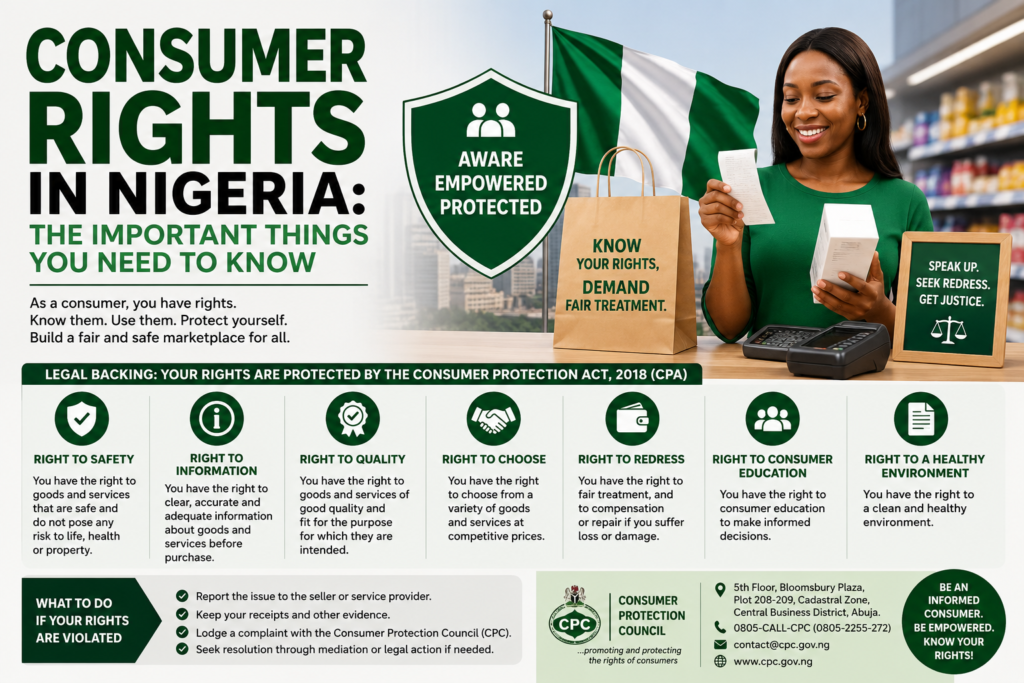
Introduction to consumer rights in nigeria
In an increasingly complex marketplace where transactions occur at the speed of a click and consumer choices multiply daily, the protection of consumer rights has become more critical than ever. Nigeria, as Africa’s largest economy[1] and most populous nation,[2] has developed a comprehensive legal framework designed to safeguard the interests of its consumers against unfair trade practices, defective products, and substandard services. Yet, despite the existence of these legal protections, a significant knowledge gap persists: many Nigerian consumers navigate the marketplace unaware of their fundamental rights or the remedies available when those rights are violated.[3]
Consumer rights in Nigeria are not merely aspirational principles; they are legally enforceable entitlements backed by specific legislation and regulatory bodies empowered to act on behalf of aggrieved consumers. From the purchase of everyday goods in local markets to sophisticated digital transactions, from accessing healthcare services to receiving electricity and telecommunications services, Nigerian law provides a safety net designed to ensure fairness, transparency, and accountability. Understanding these rights is the first step toward creating a more equitable marketplace where consumers can transact with confidence and businesses compete on the basis of quality and integrity rather than exploitation and deceit.
This article provides an in-depth examination of consumer rights in Nigeria, tracing the primary legislative framework, sector-specific protections, enforcement mechanisms, and the practical steps consumers can take to assert their rights.
Part I: The Primary Legal Framework for Consumer Rights in Nigeria
1.1 The Federal Competition and Consumer Protection Act 2018
The cornerstone of consumer protection in Nigeria is the Federal Competition and Consumer Protection Act (FCCPA) of 2018,[4] which effectively serves as the constitution of consumer rights in the country. This landmark legislation repealed the outdated Consumer Protection Council Act,[5] introduced comprehensive protections that address the realities of modern commerce, and established the Federal Competition and Consumer Protection Commission (FCCPC) as the apex consumer protection body.
Section 115 of the FCCPA establishes the right to clear disclosure of prices for goods and services, ensuring that consumers are not misled by hidden charges or ambiguous pricing structures.[6] Section 116 guarantees the right to adequate trade description and labeling, requiring that products accurately represent their contents, origins, and characteristics.[7] Perhaps most importantly for everyday transactions, Section 132 introduces an implied warranty of quality, commonly referred to as the six-month rule, which automatically entitles consumers to repair or replacement of defective goods within six months of purchase, regardless of what a seller might claim about their “no refund” policy.[8]
The FCCPA further protects consumers against unfair contract terms. Provisions addressing unconscionable conduct and unfair dealing[9] make it illegal for suppliers to impose contractual terms that are oppressively one-sided or exploit a consumer’s lack of bargaining power, education, or understanding of contract language. These provisions have particular significance in Nigeria’s market, where pre-printed standard-form contracts are pervasive and many consumers sign without reading or understanding the terms.
1.2 The Sale of Goods Act 1893 consumer rights in nigeria
Beyond the FCCPA, Nigerian consumer rights also draw from foundational commercial law principles embedded in the Sale of Goods Act of 1893, which, despite its age, remains applicable as a statute of general application.[10] This Act establishes implied conditions and warranties that govern virtually every transaction involving goods in Nigeria.
Section 12 implies that the seller has the right to sell the goods in question, protecting consumers from unknowingly purchasing stolen or disputed property.[11] Section 13 creates an implied condition that goods must correspond with their description: if a consumer purchases “100% cotton” fabric, it must indeed be cotton and not a synthetic blend.[12] Section 14 introduces the crucial concept of merchantable quality and fitness for purpose, meaning that goods must be of reasonable quality and suitable for their intended use.[13] Section 15 ensures that when goods are sold by sample, the bulk must correspond with the sample in quality, preventing the common practice of displaying superior samples while delivering inferior products.[14]
While the Sale of Goods Act predates Nigeria’s independence by over six decades, its implied terms continue to provide a robust baseline of consumer protection and interact harmoniously with the more modern provisions of the FCCPA. Courts routinely apply both frameworks in resolving commercial disputes involving defective goods.
Part II: Sector-Specific Consumer Protections
2.1 Healthcare consumer rights in nigeria
The National Health Act of 2014[15] together with the Patients’ Bill of Rights establishes fundamental entitlements that many Nigerians exercise without realising they are legally protected rights. Section 20 of the Act makes it a criminal offence for any hospital or health establishment to refuse emergency medical treatment to a person in need, rendering the widespread practice of demanding payment before treating emergency cases not merely unethical but illegal.[16]
Section 23 guarantees patients the right to full knowledge of their health status and treatment options, ensuring informed consent and medical autonomy.[17] This means that a doctor or hospital may not proceed with a non-emergency surgical procedure without the patient’s informed, written consent. Patients also retain the right to refuse treatment, seek a second opinion, and be involved in decisions affecting their health. Section 26 protects the confidentiality and privacy of medical records, establishing a framework for medical privacy that mirrors international standards.[18] Unauthorised disclosure of a patient’s medical information by a healthcare provider exposes that provider to both regulatory sanctions and civil liability.
These healthcare consumer rights assume additional importance in a country where private healthcare providers are prominent and where patients are frequently in a position of informational disadvantage. The combination of the right to information, the right to emergency treatment, and the right to privacy creates a legally enforceable patient charter that any aggrieved patient may invoke before the relevant medical regulatory bodies or the courts.
2.2 Electricity and Utilities consumer rights in nigeria
The electricity sector, governed by the Electricity Act of 2023,[19] provides specific consumer protections against the arbitrary practices that have long frustrated Nigerian electricity consumers. The Act, together with the Nigerian Electricity Regulatory Commission’s regulations, establishes frameworks for tariff transparency and minimum consumer protection standards. Importantly, distribution companies may not disconnect a consumer for non-payment without providing at least ten days’ prior written notice, and consumers have a guaranteed right to a functional, accurately calibrated meter.[20]
Consumers also have the right to dispute estimated billing, demand actual meter readings, seek compensation for equipment damage caused by power surges attributable to the distribution company, and lodge formal complaints with the NERC and its Customer Complaints Unit. The devolution of significant regulatory powers to state governments under the 2023 Act introduces a more localised layer of consumer protection, potentially enabling states to adopt stricter
standards than the federal minimum.
2.3 Telecommunications consumer rights in nigeria
The Nigerian Communications Act of 2003[21] and the NCC Consumer Code of Practice outline rights to accurate billing, protection of personal data, and a 48-hour resolution window for common service issues, with more complex billing disputes to be resolved within 30 days.[22] These protections are particularly relevant in an era where telecommunications services have become essential utilities. Consumers are entitled to be informed of all charges applicable to a service before subscribing and may not be charged for services they did not subscribe to or for data they did not consume.
The right to port a mobile number between networks without losing the number, established under the NCC’s Number Portability framework, is also a meaningful consumer right that promotes competition and prevents consumer lock-in. Where a telecommunications provider fails to resolve a billing dispute within the prescribed period, the consumer may escalate the matter directly to the NCC.
2.4 Digital Commerce and Cybersecurity
The digital economy receives dedicated protection through the Cybercrimes (Prohibition, Prevention, Etc.) (Amendment) Act of 2024.[23] Section 14 protects against computer-related fraud and electronic fund transfer theft,[24] while Section 32 guards against phishing and spamming that compromises consumer data.[25] The Nigeria Data Protection Act of 2023 further strengthens the framework by giving consumers rights over their personal data, including the right to know what data is held about them, to correct inaccuracies, and in certain circumstances, to request deletion.[26]
For consumers engaged in e-commerce, the FCCPA’s general protections apply with equal force online as they do offline. A defective product purchased through an online marketplace is subject to the same implied warranty of quality as one bought in a physical store. Similarly, misleading product descriptions on e-commerce platforms attract the same trade description liabilities as false labelling on a physical shelf.
Part III: Enforcement Mechanisms and Regulatory Bodies for Consumer Rights in Nigeria
3.1 The Federal Competition and Consumer Protection Commission (FCCPC)
The FCCPC serves as the primary agency for general consumer complaints, with authority to investigate violations, impose administrative penalties of up to 10% of a company’s annual turnover, and order restitution to aggrieved consumers.[27] Consumers may lodge complaints directly with the FCCPC through its offices, website, and designated complaint channels. Upon receiving a complaint, the FCCPC may issue compliance notices, conduct investigations, and where warranted, prosecute offenders. The FCCPC also has the power to initiate investigations on its own motion where it identifies systemic or widespread consumer protection violations.[28]
3.2 Sector-Specific Regulators consumer rights in nigeria
The National Agency for Food and Drug Administration and Control (NAFDAC) protects consumers’ rights regarding food, drugs, cosmetics, and medical devices, ensuring that products meet safety and quality standards before reaching the market.[29] NAFDAC has prosecutorial powers and may seize and destroy substandard products. The Standards Organisation of Nigeria (SON), operating under the SON Act of 2015, enforces manufacturing standards and combats fake or substandard products in other sectors.[30]
For financial services, the Central Bank of Nigeria’s Consumer Protection Department addresses banking complaints, including issues of overcharging, unauthorised debits, and unfair banking practices. Consumers should first complain to their bank and escalate to the CBN if the matter is unresolved within the prescribed timeframe.[31] The Nigerian Communications Commission handles telecoms complaints, while the Nigerian Electricity Regulatory Commission’s Consumer Complaints Unit addresses electricity-related grievances.
3.3 Judicial Remedies consumer rights in nigeria
Beyond regulatory channels, consumers retain the right to seek judicial redress. Small claims courts and Magistrates’ Courts offer accessible forums for lower-value consumer disputes, typically without requiring legal representation.[32] For larger claims or systemic violations, the Federal High Court and State High Courts have jurisdiction to award damages, grant injunctions, and make orders of specific performance.[33] The FCCPA expressly contemplates class actions, which allow multiple consumers affected by the same unlawful conduct to pool their claims, making litigation economically viable even where individual losses are modest.
Part IV: Practical Steps for Consumers
Knowing one’s rights is necessary but insufficient. Consumers must also know how to exercise those rights effectively. The following steps provide a practical roadmap for asserting consumer rights in Nigeria:
- Document everything: Keep receipts, warranties, invoices, and written communications. Photograph defective products before returning them. A well-documented complaint is substantially more likely to succeed.
- Complain in writing first: Send a formal written complaint to the seller or service provider, specifying the statutory basis for the complaint (for example, the implied warranty under Section 132 of the FCCPA) and stating a clear deadline for resolution.
- Escalate to the regulator: If the trader does not respond satisfactorily within the stated deadline, file a formal complaint with the relevant regulatory body: the FCCPC for general consumer complaints, NAFDAC for food and drug issues, the CBN Consumer Protection Department for financial services, or the NCC for telecoms.
- Consider small claims court: For disputes below the jurisdictional threshold of the relevant Magistrates’ Court, a small claims action is often the fastest and most cost-effective judicial remedy.
- Seek legal advice for complex matters: Where the dispute involves significant financial loss, medical harm, or systemic wrongdoing, consulting a consumer protection lawyer can help identify the full range of remedies available.
Conclusion consumer rights in nigeria
The legal framework for consumer protection in Nigeria is both comprehensive and robust, offering protections that compare favourably with international standards enshrined in the United Nations Guidelines for Consumer Protection.[34] From the broad protections of the Federal Competition and Consumer Protection Act to the specialised safeguards in healthcare, electricity, telecommunications, and digital services, Nigerian consumers possess significant legal rights that can be enforced through multiple regulatory and judicial channels.
The story of Amaka with which we began is ultimately a story of empowerment through knowledge. When she walked into the FCCPC office, she was no longer a powerless customer at the mercy of an indifferent retailer; she was a consumer exercising her legal rights under Section 132 of the FCCPA. The store that had dismissed her complaints was eventually compelled to replace her refrigerator and pay an administrative penalty for violating consumer protection laws. Her story demonstrates that the machinery of consumer protection does work, but only for those who know how to engage it.
However, the existence of rights without awareness is like having a key without knowing which door it opens. The challenge facing Nigeria is not a lack of consumer protection laws but rather a persistent deficit of consumer awareness and education.[35] For these legal protections to fulfil their purpose, they must transition from the pages of legislation into the consciousness of everyday Nigerians. Consumers must know that when a hospital demands payment before treating an emergency, when an electricity company disconnects service without notice, when a telecommunications provider bills incorrectly, or when a retailer refuses to honour a warranty, they are not powerless. They have rights, backed by law, and institutions ready to enforce those rights. The path to a fairer marketplace begins with a single step: knowing that you, as a Nigerian consumer, are protected by law.
References
[1]World Bank, ‘Nigeria Overview’ (World Bank, April 2024) <https://www.worldbank.org/en/country/nigeria/overview> accessed 8th June 2026.
[2]National Bureau of Statistics, ‘Nigeria Population Census Projections’ (NBS, 2023).
[3]Consumer Awareness and Advisory Council of Nigeria (CAACON), ‘State of Consumer Awareness in Nigeria’ (CAACON, 2021).
[4]Federal Competition and Consumer Protection Act 2018 .
[5]Consumer Protection Council Act, Cap C25, Laws of the Federation of Nigeria 2004, now repealed by the FCCPA 2018.
[6]FCCPA 2018, s 115.
[7]FCCPA 2018, s 116.
[8]FCCPA 2018, s 132(1). The section provides: ‘Where a supplier supplies goods to a consumer, the supplier impliedly warrants that the goods comply with the requirements and standards contemplated in this Act.’ See also s 132(3) for the six-month rebuttable presumption.
[9]FCCPA 2018, ss 17-18.
[10]Sale of Goods Act 1893 , applicable in Nigeria as a statute of general application by virtue of the Interpretation Act, Cap I23, LFN 2004, s 45, and various High Court (Civil Procedure) Laws of the states.
[11]Sale of Goods Act 1893, s 12.
[12]Sale of Goods Act 1893, s 13.
[13]Sale of Goods Act 1893, s 14.
[14]Sale of Goods Act 1893, s 15.
[15]National Health Act 2014 (No 8 of 2014), assented to on 31 July 2014.
[16]National Health Act 2014, s 20. The section is peremptory: ‘A health establishment must not refuse a person emergency medical treatment.’ Violation attracts a fine or imprisonment under s 20(2).
[17]National Health Act 2014, s 23. Informed consent must be in writing for non-emergency procedures; minors require parental or guardian consent except where life is at risk.
[18]National Health Act 2014, s 26. Personal health information may only be disclosed in limited circumstances including patient consent, court order, or public health necessity.
[19]Electricity Act 2023 (No 29 of 2023), which repealed the Electric Power Sector Reform Act 2005. The new Act devolves significant powers to states and reinforces consumer protection frameworks.
[20]Electricity Act 2023, ss 116-117; Nigerian Electricity Regulatory Commission, ‘Customer Service Standards Regulations’ (NERC, 2007, as amended). The minimum notice period for disconnection due to non-payment is ten working days.
[21]Nigerian Communications Act 2003 (No 19 of 2003), s 106. The Act establishes the Nigerian Communications Commission as the sector regulator with powers to protect consumer interests.
[22]Nigerian Communications Commission, ‘Consumer Code of Practice Regulations’ (NCC, 2007), reg 30. Telecommunications providers must resolve standard complaints within 48 hours and complex billing disputes within 30 days.
[23]Cybercrimes (Prohibition, Prevention, Etc.) (Amendment) Act 2024. The Amendment Act strengthened digital consumer protections originally introduced by the Cybercrimes Act 2015.
[24]Cybercrimes (Prohibition, Prevention, Etc.) (Amendment) Act 2024, s 14. This section criminalises computer-related fraud and theft of electronic funds with penalties of up to seven years’ imprisonment.
[25]Cybercrimes (Prohibition, Prevention, Etc.) (Amendment) Act 2024, s 32. Phishing and spamming that compromise consumer data attract fines and imprisonment.
[26]Nigeria Data Protection Act 2023 (No 14 of 2023). The Act establishes the Nigeria Data Protection Commission and gives consumers rights including the right to access, rectify, and request deletion of their personal data.
[27]Federal Competition and Consumer Protection Commission, ‘About the FCCPC’ <https://www.fccpc.gov.ng> accessed 1 June 2025. The FCCPC may impose administrative penalties of up to 10% of a company’s annual turnover for consumer protection violations.
[28]FCCPA 2018, s 104. The FCCPC may investigate any practice that is unfair, unreasonable, or unjust to consumers on its own motion or upon complaint.
[29]National Agency for Food and Drug Administration and Control Act, Cap N1, LFN 2004 (as amended by NAFDAC Amendment Act 2014). NAFDAC has powers of seizure, forfeiture, and prosecution of offenders.
[30]Standards Organisation of Nigeria Act 2015. SON may seal premises, seize products, and prosecute manufacturers of substandard goods.
[31]Central Bank of Nigeria, ‘Consumer Protection Framework’ (CBN, 2016). The CBN Consumer Protection Department handles complaints against deposit money banks, microfinance banks, and other CBN-regulated entities.
[32]Small Claims Courts (or Magistrates’ Courts exercising civil jurisdiction in most states) provide an accessible forum for consumer disputes typically below NGN 5,000,000, with simplified procedures that do not require legal representation.
[33]FCCPA 2018, s 129. A consumer may approach the court for injunctive relief, damages, and consequential relief. Class actions are also possible under the Act where multiple consumers are affected by the same conduct.
[34]United Nations Guidelines for Consumer Protection (as revised in 2015), UN Doc A/RES/70/186. The Guidelines identify eight basic consumer rights: safety; information; choice; to be heard; redress; consumer education; a healthy environment; and basic needs.
[35]Consumer Awareness and Advisory Council of Nigeria, supra n 5. The same survey found that only 15% of respondents had ever filed a formal consumer complaint with any regulatory body.
CONTRIBUTORS

OJIENOH SEGUN JUSTICE, ESQ.,
LEAD PARTNER, EKO SOLICITORS AND ADVOCATES

IDOWU-AGIDA NIFEMI
COUNSEL, EKO SOLICITORS AND ADVOCATES
consumer rights in nigeria, consumer rights in nigeria , consumer rights in nigeria , consumer rights in nigeria , consumer rights in nigeria , consumer rights in nigeria ,consumer rights in nigeria