

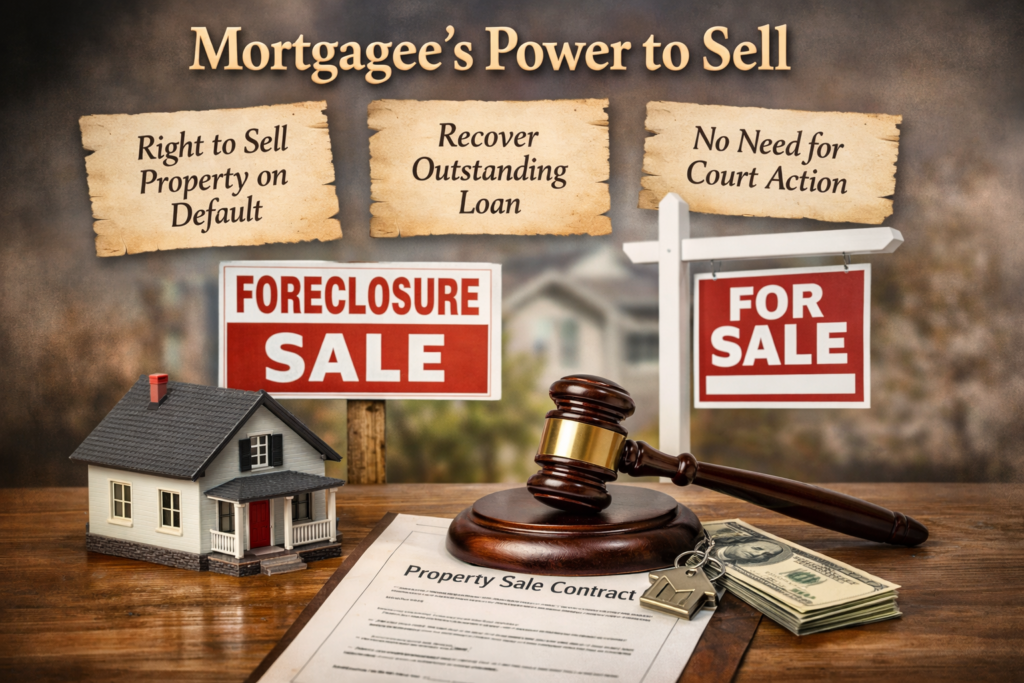
Introduction to Mortgagee’s power to sell
Chukwuemeka had always dreamed of owning a commercial property in the heart of Abuja. In 2019, he approached Zenith Mortgage Bank and secured a loan of ₦50,000,000, pledging his newly acquired property along Wuse II as collateral. The mortgage deed was duly executed, and the repayment schedule was set for five years.
By 2022, Chukwuemeka’s business had taken a severe hit. Desperate, he called his childhood friend, Babatunde, a seasoned property lawyer in Lagos. “Baba,” he said, “the bank says they will sell my property if I don’t pay by next month. Can they just do that?”
Babatunde sighed. “Chukwu, listen carefully. The bank has a legal right called the Power of Sale. Once that legal due date passes and you default, they can sell but only if they follow the right steps. Let me explain the law to you.”
Chukwuemeka’s story is not unique. Across Nigeria, countless property owners find themselves in similar situations confused about their rights and the legal powers of their lenders. Understanding the mortgagee’s power of sale is therefore not just a legal nicety; it is a financial survival skill.
Important things
In the Nigerian financial sector, real estate serves as the primary collateral for securing credit facilities. When a borrower defaults on a loan, the lender’s most potent remedy is the Power of Sale which is the right of a mortgagee (the lender) to sell the mortgaged property and recover the outstanding debt from the proceeds. However, for this power to be exercised validly, specific legal pre-conditions must be satisfied; otherwise, the sale may be set aside by a court of law.
Mortgagee’s Power to Sell: The Legal Framework
1. Mortgagee’s Power to sell: Source of the Power of Sale
The power of a mortgagee to sell a mortgaged property does not exist in a vacuum; it is either express (expressly written in the mortgage deed) or statutory (implied by operation of law). Even where the mortgage deed is silent on the power of sale, Nigerian legislation implies this power into every mortgage made by deed.
Section 19(1) of the Conveyancing Act 1881 (applicable in Northern and Eastern Nigeria and Lagos): This section provides that a mortgagee, where the mortgage is made by deed, shall have the power, when the mortgage money has become due, to sell the mortgaged property.
Section 123 of the Property and Conveyancing Law (PCL) 1959 (applicable in Western and Mid-Western Nigeria): This provision mirrors the Conveyancing Act by granting the mortgagee the power of sale once the mortgage money is due.
2. Mortgagee’s power to sell: When It Becomes Exercisable
There is a critical legal distinction between the power of sale “arising” and it becoming “exercisable.” A sale carried out before the power becomes exercisable is premature and potentially unlawful, even if the power has technically arisen.
A. When the Power Arises
The power arises as soon as the Legal Due Date which is the date fixed for repayment in the mortgage deed has passed. At this point, the mortgagee has a nascent right to sell, but this right is not yet fully activated.
B. When the Power Becomes Exercisable
Even after the power has arisen, the mortgagee cannot validly exercise it unless one of three conditions under Section 20 of the Conveyancing Act (or Section 125 of the PCL) is satisfied:
- Notice of Default: A notice requiring payment of the mortgage money has been served on the mortgagor, and default has been made in payment for three (3) months after such service.
- Interest in Arrears: Some interest under the mortgage is in arrears and unpaid for two (2) months after becoming due.
- Breach of Covenant: There has been a breach of some provision contained in the mortgage deed other than the covenant for payment of the mortgage money.
3. The Mortgagee’s Duty During the Sale
While a mortgagee is not a trustee for the mortgagor and may exercise its power of sale at a time that suits the bank, it nevertheless owes a duty of good faith. The mortgagee must act honestly and take reasonable care to obtain the proper price that is, the current market value of the property at the time of sale. It must not recklessly or wilfully sacrifice the mortgagor’s property.
It is important to note that a mere allegation that the mortgagee sold at an undervalue will not be sufficient ground to set aside a sale to a bona fide purchaser for value. To successfully challenge such a sale, the mortgagor must establish bad faith, fraud, or collusion between the mortgagee and the purchaser. This principle was firmly affirmed by the Supreme Court in Akindele v. Abe (2021) 17 NWLR (Pt. 1804) 1, a landmark decision that reaffirmed the robust enforcement rights of mortgagees under Nigerian law.
4. The Five Remedies of a Mortgagee
A mortgagee has five available remedies to recover a debt from a defaulting mortgagor:
- Right to sue the mortgagor for recovery of debt under the mortgagor’s personal covenant to repay the loan;
- The Right to enter upon and take possession of the mortgaged property;
- Right to appoint a receiver of the rents and profits emanating from the mortgaged property;
- Right to an order for foreclosure; and
- Power of Sale.
, and it may decide to exercise any or all of these remedies. The exercise of one remedy does not preclude the mortgagee from exercising the remaining remedies. Crucially, the Supreme Court in Akindele v. Abe further established that a mortgagee’s agreement to extend a repayment deadline does not constitute an abandonment or waiver of its enforcement rights. The mortgagee remains entitled to exercise its full range of remedies if the extended deadline passes without repayment.
5. Protection of the Purchaser
What happens if a mortgagee sells a property without fully complying with the procedural requirements? The law protects the innocent purchaser to preserve the finality and certainty of land transactions.
Section 21(2) of the Conveyancing Act 1881: Where a conveyance is made in the professed exercise of the power of sale, the title of the purchaser shall not be impeachable on the ground that no case had arisen to authorise the sale or that due notice was not given.
In practice, this means the buyer retains the property, and the aggrieved mortgagor’s only remedy is a claim for damages against the bank — not recovery of the property itself.
6. Mortgagee’s power to sell: The Governor’s Consent Requirement
In Nigeria, a sale of mortgaged property constitutes an “alienation” of an interest in land. Accordingly, the mortgagee must ensure that the Governor’s consent is obtained for the transfer to the new buyer to be fully valid.
Section 22 of the Land Use Act 1978: This section prohibits the alienation of a statutory right of occupancy without the prior consent of the Governor of the relevant State.
7. Practical Advice for Mortgagors in Financial Difficulty
Where a mortgagor is experiencing financial difficulties, the prudent course of action is to negotiate with the mortgagee at the earliest opportunity to jointly arrange the sale of the mortgaged property at an agreed price, rather than leaving the mortgagee to handle the sale of the property unilaterally to a third party. A distressed mortgagor who delays risks losing control of the process entirely and may receive little or nothing from the proceeds after the debt and costs are deducted.
Final thoughts on Mortgagee’s power to sell
The mortgagee’s power of sale is a self-help remedy designed to protect the liquidity of Nigeria’s banking and financial system. However, it is a double-edged sword. Mortgagees must strictly adhere to the procedural requirements the three-month notice period following default, the two-month interest arrears rule, or the breach of covenant condition or risk liability in damages to the mortgagor.
Mortgagors, on the other hand, must understand that once the Legal Due Date passes, their equitable right to redeem their property is under immediate threat. Commencement of litigation or negotiation of repayment extensions will not, on their own, shield a property from sale, as firmly settled by the Supreme Court in Akindele v. Abe (2021) 17 NWLR (Pt. 1804) 1. The decision sends a clear message: Nigerian law strongly protects the enforcement rights of mortgagees, and lenders can rely on mortgage security as a dependable credit tool.
For both parties, knowledge of the law is not merely academic t is the difference between protecting one’s assets and losing them.
Contributors

Lead Partner, EKO SOLICITORS AND ADVOCATES

Idowu-Agida Nifemi
Counsel, EKO SOLICITORS AND ADVOCATES
Mortgagee’s power to sell, Mortgagee’s power to sell, Mortgagee’s power to sell, Mortgagee’s power to sell