

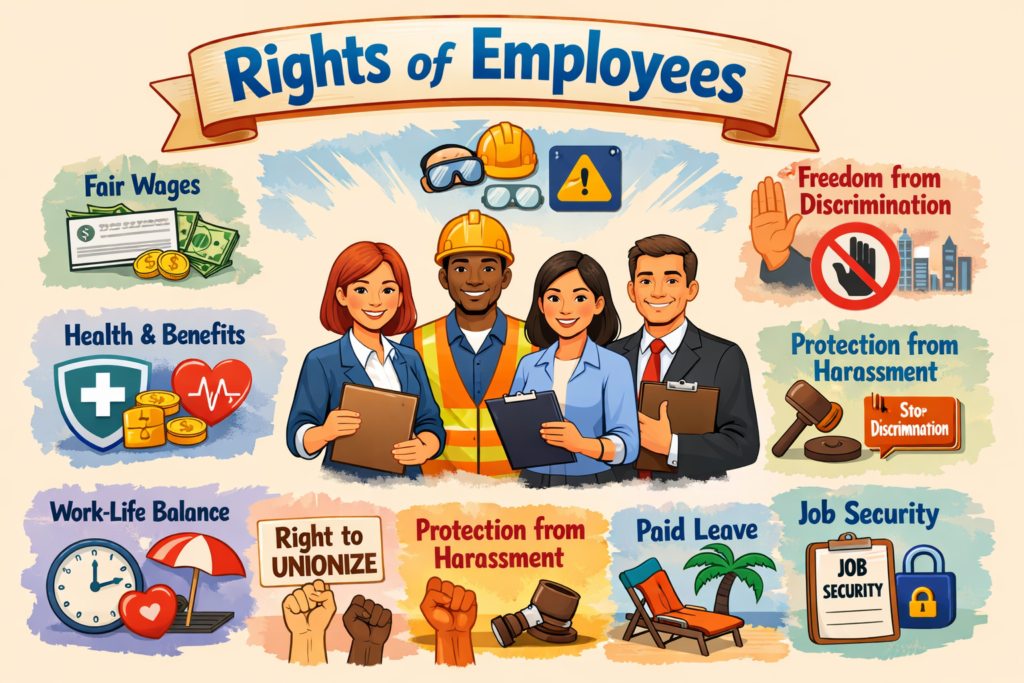
INTRODUCTION TO RIGHTS OF EMPLOYEES
Chukwuemeka had worked at a Lagos trading company for eight months before he first asked his employer, Mr. Babatunde Adeyemi, for a written contract. He had started work on a handshake and a verbal promise of a monthly salary but payday came and went with irregular payments, sometimes short, sometimes late.
When his colleague Ngozi Okonkwo fell pregnant and requested her legally entitled maternity leave, she was told there was “no such policy” in the company. Emeka and Ngozi did not know it yet, but Nigerian law was firmly on their side. Had they known their rights from the right to a written contract, to wage protection, to trade union membership their story might have been very different. This article exists so that no Nigerian worker has to discover their rights the hard way.
The Nigerian workplace is governed by a robust legal framework designed to protect the dignity, safety, and welfare of employees across all sectors. Despite this, many workers remain unaware of the rights they are entitled to under the law. From the moment a worker is engaged by an employer, a series of legal obligations and entitlements are activated enforceable under statutes such as the Labour Act (Cap L1, LFN 2004), the Constitution of the Federal Republic of Nigeria 1999 (as amended), and the National Minimum Wage (Amendment) Act 2024.
This article outlines the major rights every Nigerian employee should know, complete with the specific legal provisions that back them.
RIGHTS OF EMPLOYEES: THE CORE RIGHTS
1. Rights of employees to a Written Contract of Employment
One of the most foundational rights under Nigerian labour law is the right to receive a written statement of the terms and conditions of employment. Section 7(1) of the Labour Act mandates that no later than three months after the beginning of a worker’s employment, the employer must provide a written statement specifying: the name of the employer; the name, address, and date of engagement of the worker; the nature of the employment; where the contract is for a fixed term, the date of expiry; and the rates of wages, the method of calculation, and the manner and frequency of payment.
This written contract is critical because it eliminates ambiguity about the terms of service and gives both parties a clear record to rely on in the event of a dispute. Employees who begin work without this document are advised to formally request it in writing. Employers who fail to comply are in breach of the Labour Act.
Relevant Law: Section 7(1), Labour Act (Cap L1, LFN 2004)
2. Rights of employees to Payment of Wages
Every Nigerian worker has an unqualified right to be paid in legal tender meaning in the official currency of Nigeria (the Naira) and at regular, agreed intervals. Section 1(1) of the Labour Act makes any contract that provides for payment in a form other than legal tender illegal, null, and void. Furthermore, Section 15 of the same Act requires that wages become due and payable at the end of each agreed period, and where that period exceeds one month, wages must be paid at intervals not exceeding one month.
The National Minimum Wage (Amendment) Act 2024 has further strengthened this right by setting the national minimum monthly wage at ₦70,000. No employer is permitted to pay a worker below this threshold. Wage theft whether through outright non-payment, deliberate underpayment, or unconventional payment methods is a violation of Nigerian law and actionable in court.
Relevant Laws: Section 1(1) and Section 15, Labour Act; National Minimum Wage (Amendment) Act 2024
3. Rights of employees to Annual Leave and Rest
Rest is not a luxury it is a legal right. Under Section 18(1) of the Labour Act, every worker is entitled to a paid holiday after completing twelve months of continuous service. The minimum leave period is at least six working days for adult employees, and at least twelve working days for workers under the age of sixteen, including apprentices. These leave days must be paid in full, meaning the employer cannot deduct wages for the period during which the employee is on authorised leave.
Many employers in Nigeria offer leave entitlements that exceed this statutory minimum particularly in the formal sector. However, the Labour Act provisions remain the legally guaranteed floor. Employees whose leave requests are denied or whose leave pay is withheld have a legal basis for redress.
Relevant Law: Section 18(1), Labour Act (Cap L1, LFN 2004)
4. Rights of employees to Maternity
Female employees in Nigeria are entitled to maternity leave under Section 54(1) of the Labour Act. The law provides that a female worker has the right to leave her work upon presenting a medical certificate from a registered medical practitioner indicating that her confinement is expected within six weeks. She shall not be permitted to work during the six weeks immediately following her confinement. In addition, where a female employee has been employed for at least six months, she is entitled to receive at least 50% of her wages during the maternity period.
It is worth noting that while the Labour Act provides for twelve weeks of maternity leave in total typically split as six weeks before and six weeks after delivery many organisations and states have adopted more generous policies. Any dismissal, demotion, or penalisation of a female employee on account of pregnancy or maternity leave would be unlawful under Nigerian law.
Relevant Law: Section 54(1), Labour Act (Cap L1, LFN 2004)
5. Rights to Notice of Termination
No employer in Nigeria is legally permitted to terminate a worker’s employment without giving the required notice or making payment in lieu of such notice. Section 11(1) of the Labour Act provides that either party to a contract of employment may terminate the contract upon giving proper notice. Section 11(2) specifies the minimum notice periods as follows: one day where the contract has lasted three months or less; one week where it has lasted more than three months but less than two years; two weeks where it has lasted between two and five years; and one month where it has continued for five years or more.
This right protects workers from sudden, destabilising job loss without warning. If an employer wishes to terminate employment immediately without notice, they must pay the equivalent wages for the full notice period. Sudden dismissal without notice or payment in lieu is a breach of contract and may be challenged in the National Industrial Court of Nigeria.
Relevant Laws: Section 11(1) and Section 11(2), Labour Act (Cap L1, LFN 2004)
6. Freedom of Association and Trade Union Rights
The right to join a trade union is a constitutionally guaranteed fundamental freedom in Nigeria. Section 40 of the Constitution of the Federal Republic of Nigeria 1999 (as amended) provides that every person shall be entitled to assemble freely and associate with other persons, and in particular may form or belong to any political party, trade union, or any other association for the protection of their interests. This right applies in the workplace as much as in any other sphere of life.
Trade unions play a vital role in collective bargaining negotiating wages, working conditions, and benefits on behalf of their members. Any employer who intimidates, victimises, or dismisses an employee on the grounds of trade union membership or activity is in violation of both constitutional rights and the Trade Unions Act. Workers are encouraged to exercise this right freely and without fear.
Relevant Law: Section 40, Constitution of the Federal Republic of Nigeria 1999 (as amended)
Final Thoughts on Rights of Employees
The rights outlined in this article are not privileges they are legally enshrined protections that every Nigerian employee is entitled to enjoy from the very first day of employment. From the right to a written contract and fair wages, to maternity leave, annual rest, adequate notice of termination, and freedom to join a trade union, the Nigerian legal framework is clear: workers must be treated with dignity and in accordance with the law.
Yet awareness remains one of the biggest barriers to enforcement. Like Chukwuemeka and Ngozi at the beginning of this article, too many Nigerian workers suffer preventable workplace injustices simply because they do not know what the law guarantees them. Employers, on their part, must understand that ignorance of these provisions is no defence compliance is mandatory, not optional.
If you believe your rights have been violated, you may seek redress through your organisation’s HR department, the Ministry of Labour and Employment, or the National Industrial Court of Nigeria. Knowledge is the first step to justice.
Contributors

Lead Partner, EKO SOLICITORS AND ADVOCATES

Idowu-Agida Nifemi
Counsel, EKO SOLICITORS AND ADVOCATES
RIGHTS OF EMPLOYEES, RIGHTS OF EMPLOYEES, RIGHTS OF EMPLOYEES, RIGHTS OF EMPLOYEES