

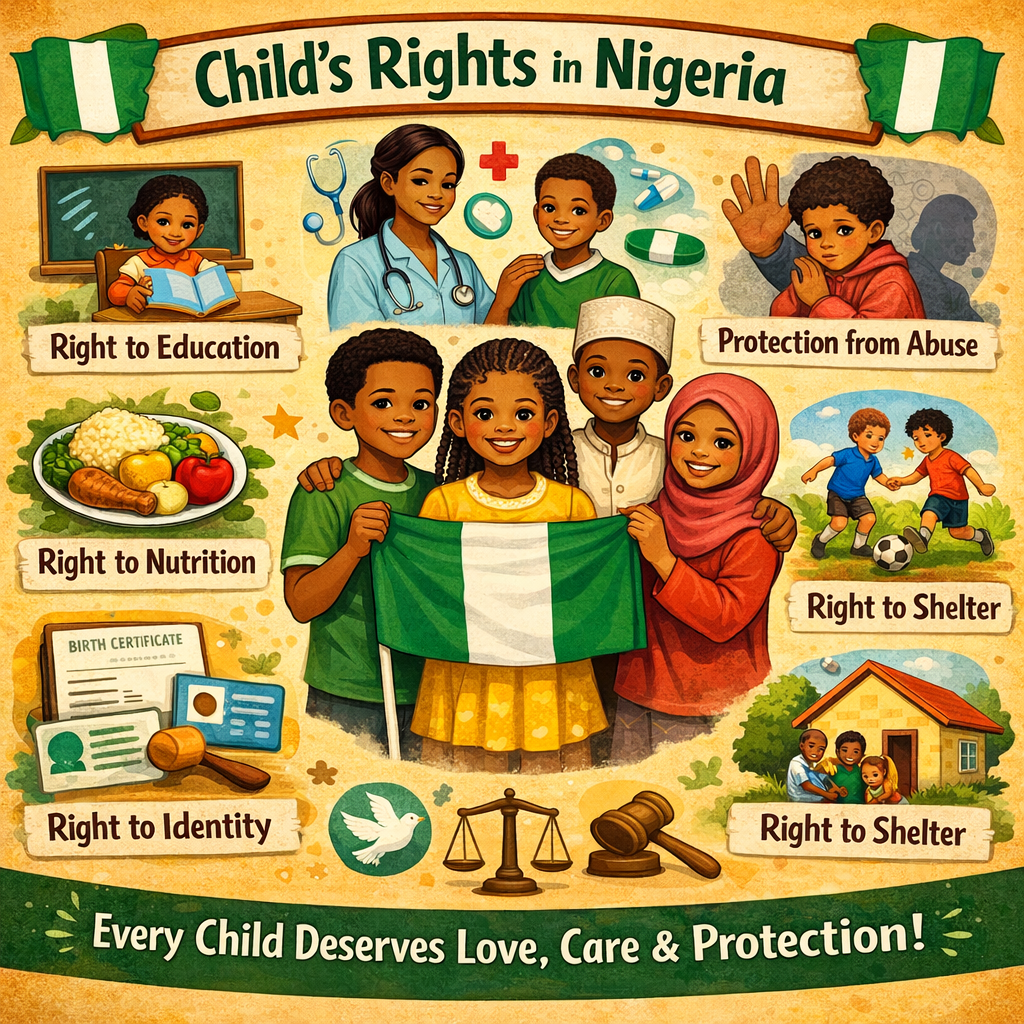
Introduction to Child’s Rights in Nigeria
Twelve-year-old Amara sat beneath the mango tree in their dusty compound in Kano, her younger brother Emeka at her side. Their neighbour’s daughter, nine-year-old Chidinma, had just been withdrawn from school to help with domestic chores, and whispers of an arranged betrothal had begun to circulate. Amara’s mother, Mrs. Ngozi Okafor, had overheard and was deeply troubled.
“Mama, can they do that to Chidinma?” Amara asked, her eyes wide with concern. Mrs. Okafor sighed and pulled her children close. “Not under the law,” she said firmly. “Every child in this country has rights, rights that protect her from exactly this.” She spoke of a law called the Child’s Rights Act that had been passed years before Amara was born, a law that stood between every Nigerian child and a lifetime of missed opportunities. The next morning, Mrs. Okafor visited Chidinma’s parents, booklet in hand, ready to speak about a better future. Because knowing one’s rights, she believed, was the first step to claiming them.
IMPORTANT THINGS TO NOTE
Children represent the most vulnerable members of any society, and their protection is both a moral imperative and a legal obligation. In Nigeria, the primary legislation governing children’s rights is the Child’s Rights Act (CRA) of 2003. While this is a federal law, it is important to note that it applies directly to the Federal Capital Territory (Abuja) and to states that have formally domesticated it. As of recent reports, 35 out of 36 states have adopted the Act, with Bauchi being the last notable holdout.
The CRA draws heavily from the United Nations Convention on the Rights of the Child (UNCRC) and the African Charter on the Rights and Welfare of the Child, which Nigeria has ratified. Its provisions touch on every dimension of a child’s existence from birth and identity, to education, health, and protection from exploitation and abuse. Understanding these rights is the foundation of building a society where every child, whether born in Lagos, Enugu, or Maiduguri, can thrive.
Child’s Rights in Nigeria: The Child’s Rights Act 2003
1. Child’s Rights in Nigeria: Foundational and Identity Rights
At the heart of the CRA lies the paramount principle: the best interest of the child must guide every decision made concerning a child. Section 1 of the Act states: “In every action concerning a child, whether undertaken by an individual, public or private body, institutions or service, court of law, or administrative or legislative authority, the best interest of the child shall be the paramount consideration.” This overarching principle serves as the lens through which all other provisions must be interpreted.
Closely tied to this is the right to survival and development. Section 4 declares plainly: “Every child has the right to survival and development.” This provision obligates the state and parents alike to ensure a child’s physical, cognitive, and social growth is not stunted. Equally, every Nigerian child is guaranteed a legal identity. Section 5 provides that “every child has the right to a name and, accordingly, shall be given a name on his birth.” A name and a birth certificate are a child’s first passport into the world of rights and recognition.
The Act also provides protection against discrimination. Section 10(1) states: “No child shall be subjected to any form of discrimination on the ground of his belonging to a particular community or ethnic group or by reason of his place of origin, sex, religion or political opinion.” Furthermore, Section 10(2) adds: “No child shall be subjected to any disability or deprivation merely by reason of the circumstances of his birth.” This is particularly significant in a diverse country like Nigeria, where ethnic, religious, and socioeconomic divisions can easily translate into disadvantage for children.
2. Rights to Protection from Abuse, Marriage, and Labour
The dignity and physical safety of children is safeguarded under Section 11, which provides: “Every child is entitled to respect for the dignity of his person, and accordingly, no child shall be subjected to physical, mental or emotional injury, abuse, neglect or maltreatment, including sexual abuse; or subjected to torture, inhuman or degrading treatment or punishment.” This section is central to Nigeria’s ongoing efforts to address child abuse and provides the primary legal basis for prosecuting perpetrators of such harm.
Health is also constitutionally guaranteed. Section 13(1) provides: “Every child is entitled to enjoy the best attainable state of physical, mental and spiritual health.” On education, Section 15(1) of the Act aligns with the Universal Basic Education (UBE) Act: “Every child has the right to free, compulsory and universal basic education and it shall be the duty of the Government in Nigeria to provide such education.” This provision directly addresses one of the most persistent barriers to child development in Nigeria which is lack of access to schooling.
Among the most contested yet critical provisions are those relating to child marriage and child labour. Section 21 unambiguously declares: “No person shall: (a) marry a child; or (b) betroth a child.” The Act defines a child under Section 277 as any person under the age of 18 years, effectively setting 18 as the minimum age of marriage. On labour, Section 28(1) states: “No child shall be subjected to any forced or exploitative labour; or employed to work in any capacity except where he is employed by a member of his family on light work of an agricultural, horticultural or domestic character.” These provisions, where enforced, have significant potential to transform millions of young lives across Nigeria.
Final thoughts on Child’s Right in Nigeria
The Child’s Rights Act of 2003 is a landmark piece of legislation that places Nigeria firmly within the global framework for child protection. Its provisions cover the full spectrum of a child’s needs: the right to an identity, to survival and health, to education, to dignity, and to freedom from exploitation and abuse. However, the existence of a law is only the beginning. Enforcement remains a significant challenge, particularly in states where the Act has not yet been domesticated, where poverty is rampant, or where cultural practices run contrary to the Act’s provisions.
For Nigeria to fulfil its promise to its children, there must be sustained investment in public awareness, community education, judicial enforcement, and social welfare systems. Every stakeholder from parents like Mrs. Ngozi Okafor in our opening story, to lawmakers, judges, teachers, and civil society organisations has a role to play in ensuring that the rights enshrined in the CRA are not merely words on paper, but living realities in the lives of every Nigerian child.
Contributors

Ojienoh Segun Justice, ESQ
Lead Partner, EKO SOLICITORS AND ADVOCATES

Counsel EKO SOLICITORS AND ADVOCATES

Idowu-Agida Nifemi
Counsel EKO SOLICITORS AND ADVOCATES
Child’s Rights in Nigeria, Child’s Rights in Nigeria, Child’s Rights in Nigeria, Child’s Rights in Nigeria