

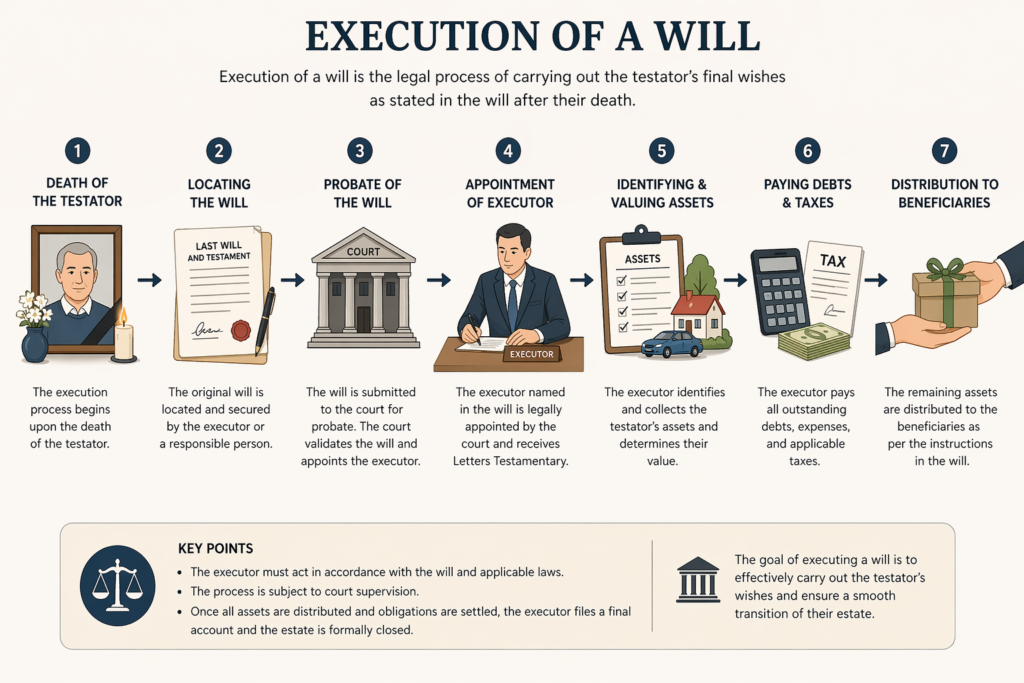
Introduction to the execution of a will
The execution of a Will does not end with the mere signing and attestation of the document. Beyond these formalities lie several legal considerations that determine whether a Will can be upheld, proved, or revoked upon the death of the testator. Issues such as proof of due execution, the effect of codicils, revocation of Wills, custody of testamentary documents, and the appointment of personal representatives are central to the effective operation of a Will.
This second part of the discourse examines these post-execution matters, highlighting the presumptions applied by the courts, the circumstances under which a Will may be displaced or revoked, and the practical information necessary for proper testamentary planning and administration of estates.
PROOF OF DUE EXECUTION OF A WILL
It is important to strictly comply with the formalities for executing a Will. The requirement for execution is that the Will must be signed by the testator in the presence of witnesses. Where a will appears on its face to be ex facie regular, the courts will presume that it is duly executed based on the maxim “Omnia Praesumuntur Rite Esse Acta” meaning “all things are presumed to have been done rightly” what is regular was explained by the trial court in Ize-Iyamu v. Alonge when it noted that once a Will-
- Has the name of the testator
- Is properly witnessed by two witnesses
- Is signed by the testator and dated
The presumption of regularity would be ascribed to the document, more so if the Will was deposited in the probate registry and is admitted as the only Will of the testator.
However, the presumption may be displaced by clear and reliable evidence which shows that the Will has not duly executed where there is dispute on the validity of a Will.
CODICILS (execution of a will)
A codicil is a mini and supplementary Will by which a testator adds to, alters, or revokes which is contained a Will. All the principles on capacity and validity of Wills applies to codicils.
REVOCATION OF WILLS
A Will is revokable during the lifetime of the testator, and it does not matter of the Will declares itself to be irrevocable. Revocation of a Will has the effect of annulling the contents of the Will so that it never takes effect after the death of the maker. Here are the following ways in which a Will may be revoked:
- Marriage: Section 18 Wills Act by operation of law revokes a Will[1]. The rationale for this is that marriage is such a fundamental change in a person’s life and such a person may wish his spouse or children to inherit him. This doesn’t apply to customary and Islamic law marriages.
- A later Will or codicil can expressly revoke the provisions of an earlier Will. The intention to revoke must be clear. The words of revocation in the codicil should also be clear. Where the words of revocation are not clear, the earlier Will remains.
- Writing with a declaration of intention can also revoke a Will
- Destruction by means of burning, tearing or otherwise destroying the Will with the intention of revoking. Two conditions are required for destruction of a Will to be valid – acts of sufficient destruction and the intention to destroy.
RELEVANT INFORMATION NEEDED TO DRAFT A WILL(Execution of a Will)
- Full name and addresses of the testator.
- Names and addresses of all the executors to the Will.
- Names and addresses of beneficiaries in the Will.
- List and particulars of property owned by the testator and how he wants them to be shared.
- What should happen in the event if the death of a beneficiary or in the event that the gift fails or ceases to exist? Provisions for substitute gifts should be made there.
- The place of origin of the testator or ethnic nationality in order to determine whether there is any native law and custom that restricts the disposition of any particular property.
- The religion of the testator in order to determine whether he is subject to Islamic law which restricts disposition of his property.
- Any relatives or dependents of the testator, in order to make reasonable financial provisions for them if they were maintained by him.
- How the testator desires that the residue of his estate should be shared.
- The names and addresses of witnesses to ensure that they are available to attest the will.
- Any previous Will or codicil of the testator and compare it with the instructions given. Did he also wish to revoke earlier Wills?
- Details of persons who may be appointed as guardians of any infants of the testator.
- Any directives the testator may wish to give with respect to his funeral.
- Custody of the Will
- Remuneration for executor.
CUSTODY OF WILLS
After executing the Will, the original and any counterpart may be safely kept in any of the following places-
- With the probate registry within the jurisdiction.
- By the Solicitor who prepared it.
- With the bankers of the testator if he has.
- In the posession the testator.
The problem with keeping the Will with the testator is that it may be subject to being tampered. It could be tampered with by relatives and other beneficiaries who may have access to the home or office of the testator. So, it is advisable to keep it with any of the first three persons, although it might cost some consideration.
APPOINTMENT OF PERSONAL REPRESENTATIVES
Personal representatives are persons who carry out the wishes of deceased persons. They are deemed in law, the heirs of the deceased properties. Personal representatives could be appointed
- Expressly
- Impliedly
- Through a nominee in a Will
- By court
- By representation.
CONCLUSION
The effectiveness of a Will extends beyond its execution to the manner in which it can be proved, preserved, altered, or revoked during the lifetime of the testator. The law, while presuming regularity in a duly executed Will, permits such presumption to be rebutted where credible evidence of non-compliance is established.
Codicils, revocation, proper custody, and the appointment of personal representatives all play vital roles in ensuring that a testator’s intentions are ultimately carried into effect.
Proper attention to these aspects not only safeguards the validity of a Will but also minimizes disputes, promotes certainty. It ensures the smooth administration of the estate. Ultimately, a well-executed and well-managed Will remains one of the most effective tools for preserving a testator’s legacy. While protecting the interests of beneficiaries.
[1] Section 18 Wills Act;Section 11 Will Law Lagos State.
Contributors

Lead Partner, EKO SOLICITORS & ADVOCATES

OGUNLEYE AYOMIDE FAITH
Graduate Trainee, EKO SOLICITORS & ADVOCATES
Execution of a will, Execution of a will, Execution of a will,Execution of a will, Execution of a will, Execution of a will, Execution of a will