

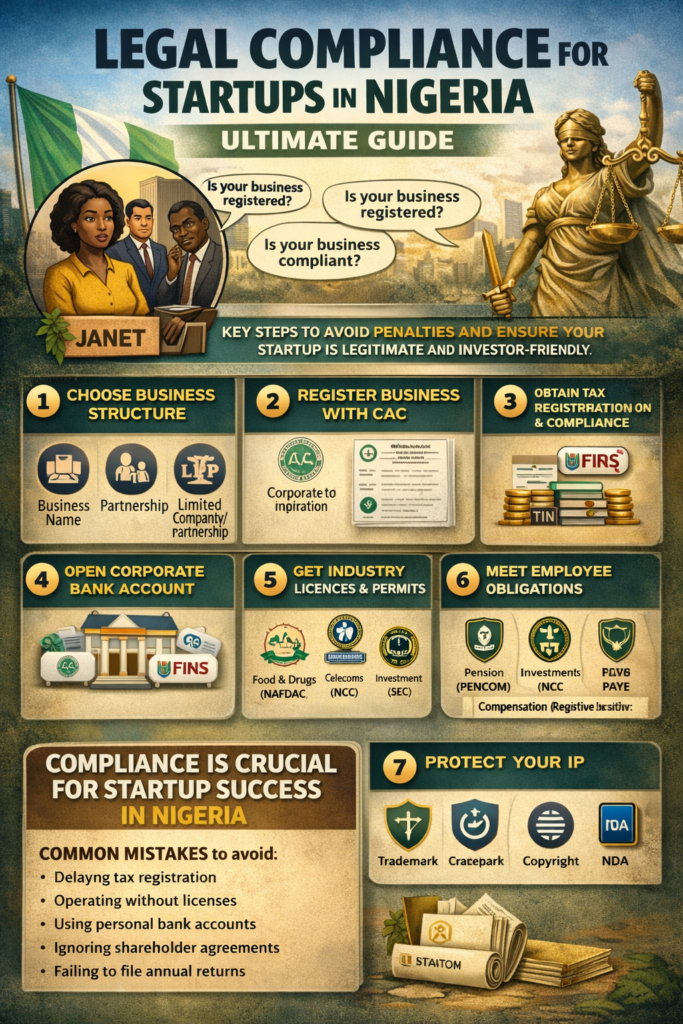
Introduction to legal compliance for startups
Two weeks after launching her dream fashion brand in Lagos, Janet was very excited about starting her dream. She had her first paying customer, started posting her collections, and speaking to an investor. The meeting with the investor went well until the investor asked one question ‘has your business been registered?’ Janet froze and left the meeting, wondering what that meant. Three days later, while pondering that question, Janet received an unexpected visit. Not from customers. Not investors. But from regulators.
Her mistake? She was so excited about profits and starting her business that she ignored compliance.
Starting a business in Nigeria is opening up a plethora of opportunities. Nigeria’s growing economy offers a massive consumer base, tech growth, and expanding SME opportunities. But without proper legal compliance, your business can face fines, account restrictions, or even closure. This article is an exploration of the legal requirements for starting a business in Nigeria to ensure your venture is protected from day one.
Why Legal Compliance for Startups Matters in Nigeria
When starting a business in Nigeria, compliance is not optional. Compliance builds legitimacy and sustainability. It determines:
- Whether investors can legally invest in your company
- If you can open a corporate bank account
- Whether you can bid for contracts
Legal Compliance for Startups: Step 1- Choose the Right Business Structure
The first decision you should make when starting a business in Nigeria is choosing your structure. The Companies and Allied Matters Act (CAMA 2020) provides the recognised business structures. Which are :
- Business Name (Sole Proprietorship): It is owned by a single person, has a simple registration and has no separate legal personality.
- Partnership: It is owned by two or more persons with a shared liability structure.
- Limited Liability Company/Partnership(LLP): This structure has a separate legal personality, liability is limited by shares and is suitable for growth and investors.
The regulatory authority responsible for registration is the Corporate Affairs Commission (CAC). For most entrepreneurs seeking credibility and scalability, a Limited Liability Company is advisable.
Legal Compliance for Startups: Step 2- Register Your Business with CAC
A Sole Proprietorship does not require registration with CAC except where the name of the business is different from the initials and surname of the sole proprietor.
Starting a business in Nigeria requires official registration through the CAC portal.
The process of registration include:
- Conduct name search
- Reserve business name
- Prepare incorporation documents
- File online
- Obtain Certificate of Incorporation
The registration must contain required details such as
- Registered address
- Share structure
- Director details
- Statement of compliance
Without CAC registration, your business legally does not exist.
Legal Compliance for Startups: Step 3- Obtain Tax Registration and Compliance
After incorporation, tax compliance is mandatory especially with the new tax act that was signed into law.
You must register with the Federal Inland Revenue Service (FIRS) to obtain:
- Tax Identification Number (TIN)
- VAT registration
- Company Income Tax compliance
You may also need to register with your State Internal Revenue Service for PAYE (if you have employees).
Failure to comply may result in penalties or frozen accounts.
Step 4: Open a Corporate Bank Account
To fully operationalise your business:
- Present CAC incorporation documents
- Provide TIN
- Submit director identification
Operating a business through a personal account raises regulatory and tax red flags.
Step 5: Obtain Industry-Specific Licences and Permits
Depending on your sector, additional approvals may be required.
Examples include:
- Food and drugs — National Agency for Food and Drug Administration and Control (NAFDAC)
- Telecommunications — Nigerian Communications Commission (NCC)
- Investment and capital market — Securities and Exchange Commission (SEC)
- Hotels and restaurants — Local government permits
Starting a business in Nigeria without sector licensing can result in closure or prosecution.
Step 6: Employee Compliance Obligations
If you employ staff, compliance expands to include:
- Pension registration with PENCOM
- Employee Compensation Scheme
- NSITF registration
- PAYE remittance
Labour non-compliance exposes businesses to lawsuits and sanctions.
Step 7: Protect Your Intellectual Property
Brand protection is often overlooked when starting a business in Nigeria.
You must consider:
- Trademark registration
- Copyright protection
- Non-disclosure agreements
Without trademark protection, competitors may legally claim your brand identity, leaving you with nothing.
Common Legal Mistakes Entrepreneurs Make
- Delaying tax registration
- Operating without licences
- Using personal bank accounts
- Ignoring shareholder agreements
- Failing to file annual returns
Compliance is not a one-time event, it is an ongoing process.
Conclusion
Starting a business is a very exciting idea, but beyond the passion and the profits lies the law, structure and regulations. A business that complies with all the regulations attracts investors, gains consumer trust, avoids costly penalties and grows sustainably. Treat legal compliance as your first investment.
Contributors

OJIENOH SEGUN JUSTICE, ESQ.
Lead Partner, EKO SOLICITORS AND ADVOCATES

Counsel, EKO SOLICITORS AND ADVOCATES

Faith Ogunleye
Graduate Trainee, EKO SOLICITORS AND ADVOCATES