

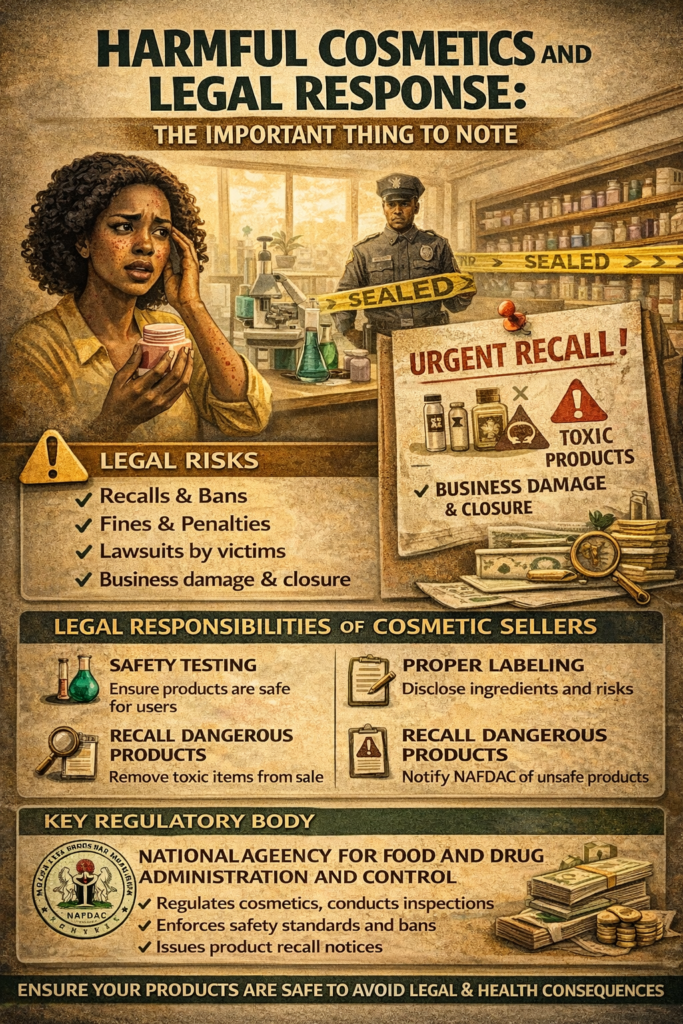
Introduction Harmful Cosmetics And Legal Response:
On a sunny afternoon in Lagos, a 24-year-old female graduate searching for employment, uneasily examined her reflection. Like many of her peers, she believed that a lighter skin tone would improve her chances in a competitive job market. To achieve that ideal, she regularly applied potent skin-bleaching products purchased from unregulated vendors, products promising dramatic lightening within weeks.
Within months, she developed severe dermatitis and hyperpigmentation, and eventually had to see a dermatologist who informed her that the products contained mercury, lead, corticosteroids and hydroquinone in concentrations far above safety limits. Her experience is neither unique nor trivial. Across Nigeria and much of West Africa, the use of skin bleaching agents and other harmful cosmetics has sparked public health alarm, consumer protection debates, and regulatory scrutiny.
This article examines the legal and regulatory landscape governing harmful cosmetics and skin-lightening products in Nigeria, assesses the Federal Government’s response, and explores relevant statutory provisions and case law principles.
It also highlights how Nigerian law intersects with public health policy, consumer protection norms, and international regulatory standards.
1. Skin Bleaching and Harmful Cosmetics: Public Health Concerns
1.1 What Are Harmful Cosmetics?
“Harmful cosmetics” refers to cosmetic products that contain toxic or banned substances like high levels of mercury, potent corticosteroids, hydroquinone, or other ingredients exceeding permitted concentrations posing serious dermatological, neurological and systemic health risks to users. Skin bleaching products often promise rapid depigmentation, but they frequently contain undisclosed quantities of such harmful agents, particularly when traded through informal markets, unregulated online platforms, or street vendors.
1.2 Health Impacts and Public Awareness
Mercury-based creams may cause inflammation, scarring and kidney or brain damage; high-strength corticosteroids cause thinning of skin and endogenous hormonal disruption; and prolonged use of high concentrations of hydroquinone can lead to ochronosis paradoxical skin darkening. Nigerian dermatologists have documented increasing presentations of such conditions linking them to unregulated bleaching products.
In response, the Federal Ministry of Health, Standards Organisation of Nigeria (SON), National Agency for Food and Drug Administration and Control (NAFDAC), and consumer advocacy groups have raised alarm about unsafe cosmetics and urged regulatory enforcement.
2. Regulatory Framework in Nigeria (Harmful Cosmetics)
2.1 The National Agency for Food and Drug Administration and Control (NAFDAC) Act
Section 1 of the NAFDAC Act establishes NAFDAC as the agency responsible for regulating, controlling and supervising the manufacture, importation, exportation, distribution, advertisement and use of food, drugs, cosmetics, medical devices, chemicals, and packaged water. NAFDAC has exclusive authority to regulate cosmetics including their registration, quality standards, and labelling. The Act empowers NAFDAC to issue standards, conduct inspections and seize unregistered or unsafe products.
2.2 Standards and Prohibitions on Harmful Substances
The NAFDAC (Prohibition of Harmful Cosmetic Products) Regulations promulgated under the Act identify banned substances, set allowable limits for certain chemicals like 2% of Hydroquinone and prohibit cosmetics containing substances that adversely affect health. These regulations explicitly bar distribution and sale of cosmetics with excessive corticosteroids, hydroquinone above permitted concentrations, or unapproved skin-lightening agents.
The Standards Organisation of Nigeria (SON) also establishes Nigeria Industrial Standards (NIS) for cosmetics under the Standards Organisation of Nigeria Act, specifying acceptable composition and labelling requirements.
3. Enforcement Actions and Government Responses( Harmful Cosmetics)
3.1 Raids, Seizures, and Public Notices
NAFDAC, sometimes in collaboration with SON and the Nigeria Customs Service, has repeatedly raided markets, seized consignments of illegal cosmetics and issued public warnings. These enforcement actions reflect efforts to curb the widespread distribution of harmful skin-lightening products, particularly those imported through informal channels.
For example, in 2024, NAFDAC announced the seizure of thousands of units of unapproved cosmetics in Mushin and Yaba markets (Lagos), particularly targeting products containing prohibited levels of steroids and mercury.
3.2 Public Education Campaigns
The Federal Ministry of Health and NAFDAC have also engaged in awareness campaigns alerting the public to the dangers of harmful bleaching products, urging consumers to verify NAFDAC registration numbers and avoid unlabelled or repackaged products. Despite these interventions, enforcement remains challenged by porous borders, the informal nature of trade, and widespread belief in skin-lightening aesthetics.
4. Consumer Protection and Legal Liability(Harmful Cosmetics)
4.1 Consumer Protection Regime
In addition to NAFDAC’s regulatory powers, the Federal Competition and Consumer Protection Act (FCCPA) 2018 provides broad protections for consumers against unsafe goods and unfair trade practices. The FCCPA defines a “consumer product” to include cosmetic products and bars suppliers from engaging in practices that are hazardous to life, health or safety of consumers.
The Act allows the Federal Competition and Consumer Protection Commission (FCCPC) to take enforcement action against suppliers of unsafe products, including seeking injunctions, recalls and penalties. This Act complements NAFDAC enforcement by providing a separate avenue for addressing consumer harms from unsafe cosmetics.
4.2 Legal Remedies and Civil Liability
Victims of injuries caused by harmful cosmetic products may seek compensation under tort law (negligence) where a manufacturer or seller breaches a duty of care, causing foreseeable harm as recognised by Nigerian courts.
5. Challenges in Enforcement and Regulatory Gaps(Harmful Cosmetics)
5.1 Challenges with Informal Markets and Internet Trade
A persistent difficulty is the proliferation of harmful cosmetics through informal and online marketplaces including unregistered imports and repackaged products without NAFDAC numbers. Many Nigerians continue to source bleaching products from street vendors or online platforms, making regulatory tracking and seizure difficult.
5.2 Prosecution and Judicial Enforcement
While regulatory agencies can seize products and issue administrative sanctions, criminal prosecution of distributors of harmful cosmetics remains limited. NAFDAC and FCCPC prosecutions under the relevant Acts have had mixed success, partly due to evidentiary challenges and resource constraints.
5.3 Absence of Specific Judicial Precedent on Skin Bleaching Harms
Although there is limited direct case law in Nigeria expressly addressing personal harm from skin-lightening products, the broader tort and consumer protection jurisprudence particularly on defective products and duty of care provides a framework for potential litigation. Judicial acknowledgment that manufacturers and suppliers must ensure product safety supports the argument that injured consumers have legal remedies.
6. Comparative Perspectives and International Standards
6.1 International Health Advice
Global health authorities, including the World Health Organisation (WHO), advise against mercury-containing cosmetics due to neurotoxic effects and environmental concerns. The Minamata Convention on Mercury to which Nigeria is a party restricts mercury use in cosmetics, aligning Nigerian domestic prohibitions with international commitments.
6.2 Regional Regulations
Other jurisdictions, such as the European Union (EU) and United States Food and Drug Administration (FDA), have comprehensive bans or limits on hydroquinone, mercury and corticosteroids in cosmetics, representing best regulatory practice to protect consumer health. Nigerian standards conform broadly to these international benchmarks, though enforcement remains the core challenge.
7. Policy Recommendations
To enhance protection against harmful cosmetics and skin-bleaching products, the Federal Government should consider:
- Strengthening Customs and Border Controls to prevent importation of unregistered harmful cosmetics.
- Empowering NAFDAC and FCCPC with fast-track prosecution units dedicated to consumer safety litigation.
- Expanding public health campaigns targeting youth and communities where bleaching practices are prevalent.
- Encouraging local product testing and certification to make safe alternatives more accessible.
- Leveraging online marketplace regulations requiring e-commerce platforms to delist unregistered cosmetics.
These policy measures, grounded in existing legal frameworks, could reduce harmful cosmetic use and enhance consumer safety.
Conclusion (Harmful Cosmetics)
Skin bleaching and the use of harmful cosmetics present a complex nexus of public health, consumer protection, and regulatory enforcement in Nigeria. While the legal framework spearheaded by the NAFDAC Act, FCCPA 2018, and complementary international obligations provides robust authority to regulate and prohibit unsafe products, enforcement remains uneven in the face of informal markets and pervasive cultural demand.
Victims of harmful products have potential civil remedies under tort law and consumer protection statutes. Strengthening enforcement, public education, and legal clarity around liability for cosmetic-related harm can help protect Nigerian consumers from the well-documented health risks of hazardous bleaching products.
READ ALSO: CONTRACTS WITH ILLITERATE PERSONS IN NIGERIA
CONTRIBUTORS

Ojienoh Segun Justice Esq.
Lead Partner, EKO SOLICITORS & ADVOCATES

Counsel EKO SOLICITORS AND ADVOCATES

CHINWENDU MBANU
Graduate Trainee, EKO SOLICITORS & ADVOCATES