

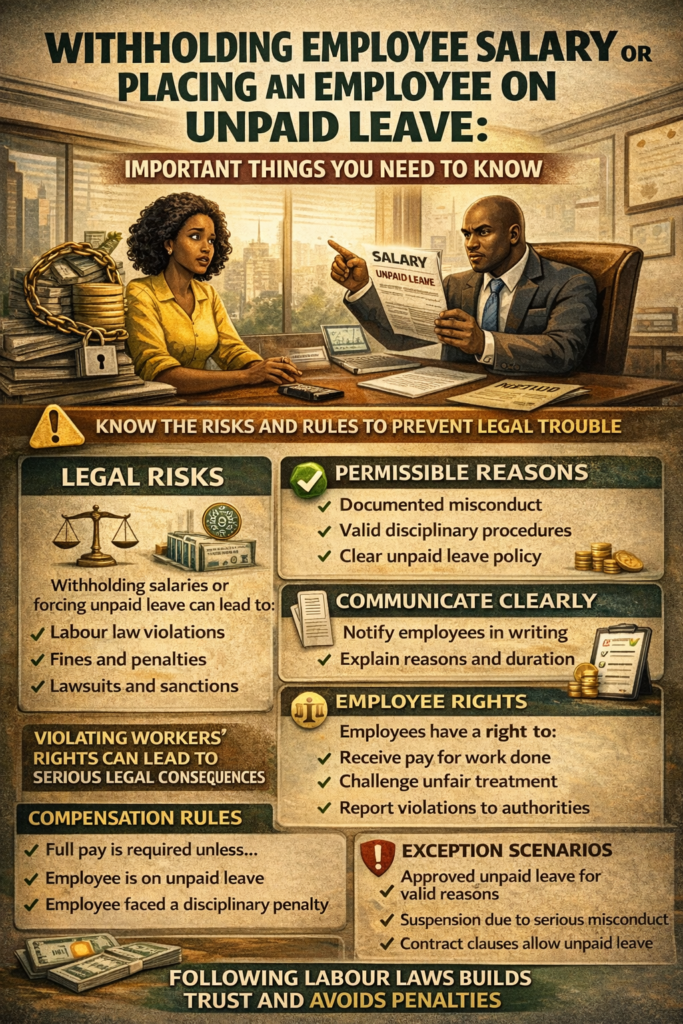
Withholding employee salary is not an uncommon phenomenon. Imagine resuming work one morning only to be told to “stay at home until further notice” and then discovering at the end of the month that your salary has been withheld. This situation is becoming increasingly common in Nigeria, especially in the private sector. Many employees are left confused and asking the same question: can an employer lawfully withhold salary or place an employee on unpaid leave in Nigeria?
The General Rule under Nigerian Labour Law
Under Nigerian labour law, salary is not a gift. It is payment for work done or deemed to have been done. Once an employment relationship exists, an employer cannot withhold salary arbitrarily.
The courts have consistently held that an employer must justify any action that deprives an employee of earned wages. This principle applies to both public and private sector employment, although the rules may differ slightly.
Can an Employer Place an Employee on Unpaid Leave in Nigeria?
The short answer is NO, unless there is a legal or contractual basis. There is no provision in the Labour Act that gives employers a general power to place employees on unpaid leave. Therefore, unpaid leave is only lawful where it is:
- Expressly stated in the contract of employment, or
- Provided for in the staff handbook or conditions of service, or
- Mutually agreed by both employer and employee.
Where none of these exists, placing an employee on unpaid leave may amount to an unfair labour practice.
In the National Industrial Court case of Udemah v. Nigerian Coal Corporation, the Supreme Court held that:
“Where an employee is willing and able to work but is prevented by the employer, the employee is entitled to be paid.”
The court made it clear that an employer cannot deny salary while keeping the employment alive. This principle applies strongly to situations where employees are asked to “stay at home” without formal termination.
Similarly, in the case of Aloysius v. Diamond Bank Plc, the employee was placed on suspension without pay. The court held that an employer has no inherent right to suspend an employee without pay unless the contract of employment clearly provides for it.
The court emphasised that suspension without pay, where not contractually allowed, is punitive and unlawful. See also the case of Longe v. First Bank of Nigeria Plc
Is Salary Withholding an Unfair Labour Practice?
Yes, Nigerian courts increasingly regard arbitrary salary withholding as an unfair labour practice, especially where it causes hardship and violates the employee’s legitimate expectations. The NICN, empowered by section 254C of the Constitution, actively intervenes to protect employees from oppressive workplace practices.
What Can an Employee Do If Salary Is Withheld?
An affected employee may:
- Write a formal complaint to the employer
- Demand payment citing contract terms
- Approach the National Industrial Court of Nigeria
The NICN has exclusive jurisdiction over labour matters in Nigeria and can order payment of withheld salaries, damages, and even interest.
Contributors

Lead Partner, EKO SOLICITORS & ADVOCATES

COLE ANJOLA-JESU
Graduate Trainee, EKO SOLICITORS & ADVOCATES
WITHHOLDING EMPLOYEE SALARY WITHHOLDING EMPLOYEE SALARY WITHHOLDING EMPLOYEE SALARY