

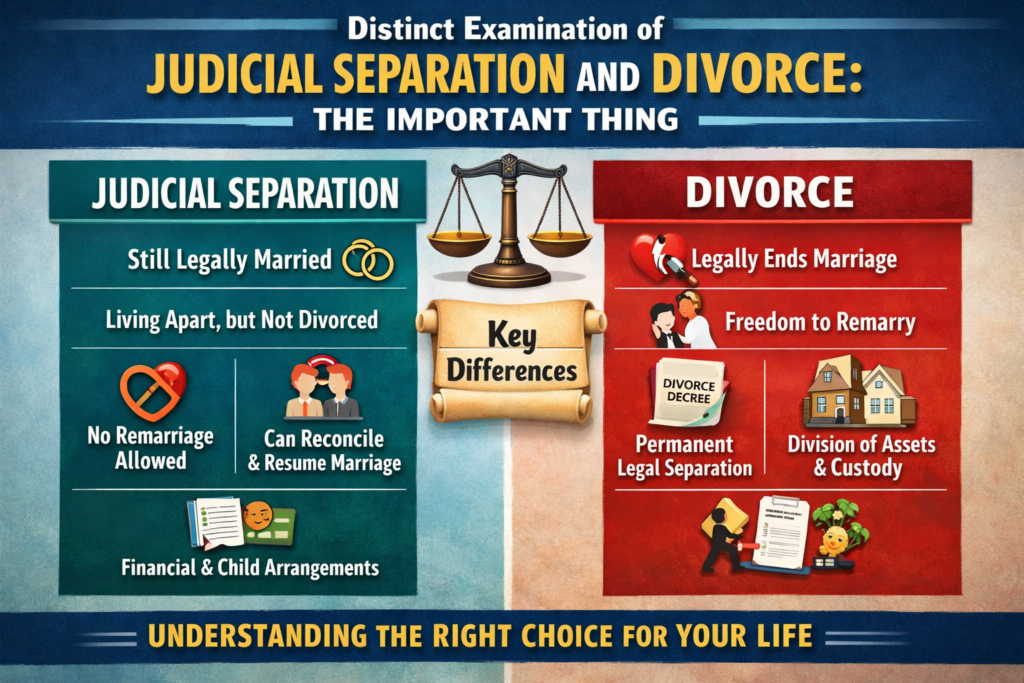
Introduction to the Differences Between Judicial Separation and Divorce
Imagine a married couple, Emeka and Funke, who once shared laughter over dinner, dreams of children, and retirement plans. But as years passed, their conversations and laughter became heated arguments, and their shared hopes began to unravel. Funke wants out, but her conscience and her community lean heavily on the sanctity of “for better or for worse.” She eventually leaves the matrimonial home, unsure whether she and Emeka will ever rebuild their marriage and thinking she is “free”, only to realise months later that she cannot legally move on with her life.
Like many, she is caught in the confusing web of whether packing out of the matrimonial home is a Judicial separation or a divorce. At this moment, two critical legal questions arise: Is this a Judicial separation or a divorce? And what are the legal consequences of each? Are there any differences between Judicial separation and divorce?
In Nigeria, Judicial separation and divorce are distinct legal concepts. Each carries unique rights, responsibilities, and outcomes. Many couples assume they are the same, but understanding the differences between Judicial separation and divorce in Nigeria can affect everything from property rights to child custody.
What Is Judicial Separation in Nigeria?
Judicial separation in Nigeria refers to a situation where a married couple lives apart, either by mutual agreement or due to conflict, but remains legally married. Separation may be:
- De facto (actual) separation – one spouse leaves the matrimonial home without court orders.
- Judicial separation – a court order grants formal recognition to the separation.
Separation does not end the marriage; the couple remains legally husband and wife.
Separation may arise from domestic disputes, financial disagreements, infidelity, emotional breakdown etc. But unlike divorce that performs a final “surgical removal”, separation does not dissolve the marital bond but keeps the marriage alive on “life support.”
Judicial Separation in Nigeria
Under section 39 of the Matrimonial Causes Act, a decree of judicial separation means you’re still legally married but no longer obligated to live with your spouse. Because, the marriage still exist, if Funke were to “marry” another man while under a decree of jucial separation, she could be prosecuted for bigamy.
In Oladimeji v. Oladimeji (where the court recognised the importance of judicial separation orders), the court held that judicial separation does not terminate the marriage but relieves parties from the obligation to cohabit.
What is Divorce in Nigeria?
When a marriage has hit a dead end, divorce in Nigeria is the legal mechanism to end it permanently. Unlike Judicial separation, divorce changes your legal status from “married” to “single.”
There is only one ground for divorce in Nigeria under Section 15(1) of the Matrimonial Causes Act: that the marriage has broken down irretrievably. To get a divorce, you must prove specific facts, such as:
- The respondent willfully and persistently refuses to consummate the marriage
- He/she has committed adultery and the petitioner finds it intolerable to live with him or her
- The respondent has deserted the petitioner for at least one year
- Both respondent and petitioner have lived apart for two years and no objection from the respondent
- Both respondent and Petitioner have lived apart for three years
- Failure to comply with decree of restitution of conjugal rights
- The other party has been absent for a period (usually seven years or more) implying they are dead.
Once the court issues a Decree Absolute, the marriage is dead. You’re free to remarry.
Key differences between Judicial Separation and Divorce in Nigeria
The Differences Between Judicial Separation and Divorce Are as Follows:
- Meaning: Judicial separation vs Divorce in Nigeria
The differences between separation and divorce in Nigeria starts from their meanings. Separation occurs when spouses stop living together but remain legally married. It may be voluntary or ordered by a court (judicial separation). Divorce, on the other hand, is the legal termination of marriage by a competent court.
2. Status of the Marriage
In separation, the marriage continues to exist in law while in divorce, the marriage ceases to exist once the decree absolute is granted. This means separated couples are still legally husband and wife, while divorced couples are not.
3. Right to Remarry
A separated spouse cannot lawfully remarry, as the marriage still subsists while a divorced spouse may remarry legally, but only after the decree absolute.
4. Court Involvement
Judicial Separation can be informal and formal (mere physical separation) while divorce must be granted by a court of competent jurisdiction.
5. Legal Grounds Required
Judicial separation may be granted where continued cohabitation is unsafe or unreasonable while Divorce requires proof that the marriage has broken down irretrievably under Section 15 of the Matrimonial Causes Act.
6.Effect on Property Rights
During separation, property rights remain largely intact because the marriage subsists. Upon divorce, the court may redistribute matrimonial property based on equity and contribution.
7.Effect on Children and Custody
Separation does not automatically trigger custody proceedings while divorce requires the court to determine custody, access, and maintenance.
8.Finality of the Decision
Separation is often temporary and may lead to reconciliation while divorce is final and legally irreversible once completed.
Final Thoughts on Judicial Separation and Divorce
Understanding the differences between separation and divorce in Nigeria is crucial for married couples. While separation allows couples to live apart without ending the marriage, divorce legally dissolves the marital union.
Contributors

Lead Partner, EKO SOLICITORS AND ADVOCATES

Counsel, EKO SOLICITORS AND ADVOCATES
