

Redress Under The FCCPA
Imagine a marketplace where the buyer has no real recourse as where faulty goods, exploitative services, and corporate impunity are the norm, not the exception. For much of Nigeria’s history, this was the reality for consumers, with redress mechanisms being largely inaccessible, slow, and ineffective. This long-standing deficit not only harmed individuals but also stifled economic confidence and growth.
The passage of the Federal Competition and Consumer Protection Act (FCCPA) in 2018 was heralded as a transformative milestone, promising to empower the Nigerian consumer with a powerful shield and a accessible sword. But has this promise been fulfilled? This article aims to dissect the effectiveness of the redress mechanism under the FCCPA 2018, investigating its operational strengths, identifying its persistent challenges, and determining its ultimate impact on the landscape of consumer protection in Nigeria.
Understanding Consumer Redress: The Cornerstone of Consumer Confidence
At its core, consumer redress refers to the means available to a consumer to obtain a remedy for a wrong or a loss suffered in a marketplace transaction. It is the system that allows an individual who has purchased a defective product, been subjected to a fraudulent service, or been treated unfairly by a business to seek and obtain justice. Think of it not merely as a complaint mechanism, but as the essential enforcement arm of consumer rights the process that transforms theoretical rights into tangible, real-world outcomes.
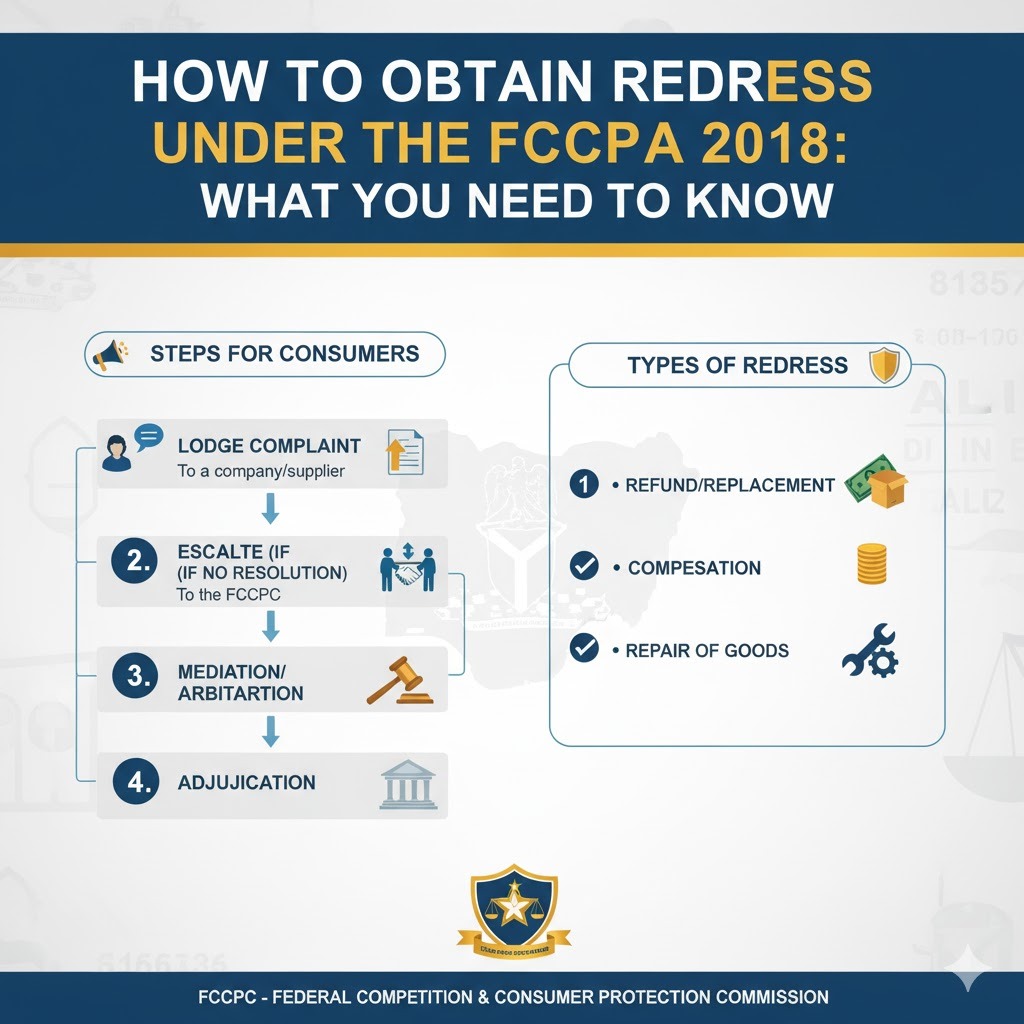
Consumer redress goes beyond simply voicing a grievance. It is a structured process that culminates in a remedy. This remedy can take various forms, including:
· A refund of the purchase price.
· Repair or replacement of a faulty product.
· Compensation for damages or losses incurred.
· A formal apology or correction of misleading information.
In essence, redress is what closes the loop. A consumer’s right to safety, information, and choice means little without the right to redress. the guaranteed ability to seek a fair settlement when those other rights are violated.
An effective consumer redress system is founded on the core principles of accessibility, affordability, speed, and fairness, ensuring that justice is not a theoretical right but a practical reality. International models provide a clear blueprint for this: the United Kingdom’s sector-specific Ombudsman services exemplify a streamlined and binding process, while South Africa’s National Consumer Commission demonstrates the power of a centralized state agency. These systems highlight that a successful mechanism must be both easy for consumers to navigate and empowered to deliver enforceable outcomes, setting a critical benchmark for the effectiveness of frameworks like Nigeria’s FCCPA.
What the law says about Consumer Redress under the FCCPA
The Federal Competition and Consumer Protection Act (FCCPA) 2018 establishes a comprehensive legal foundation for consumer redress in Nigeria, ensuring that consumers are not left without remedies when their rights are violated. The Act consolidates and modernizes consumer protection law, creating an enforceable framework for addressing complaints, disputes, and unfair trade practices.Under Sections 115 to 129, the FCCPA recognizes the statutory rights of consumers, including the right to fair value, good quality, and safe goods and services; the right to disclosure and information; and the right to seek redress against unfair practices. These provisions affirm that every consumer in Nigeria is entitled to protection from exploitation, defective goods, and misleading representations.
The FCCPA 2018 is the principal legislation that governs consumer protection and redress in Nigeria. Part XV of the Act particularly Sections 115 to 129 sets out consumer rights, complaints, and redress mechanisms.These sections guarantee every consumer the right to seek redress when goods or services fail to meet legal or contractual standards.The FCCPA explicitly recognizes several enforceable consumer rights, including, Right to fair value, good quality, and safety according to Section 120, Right to information and disclosure Where consumers must be given accurate, clear, and timely details about goods and services according to Section 115.
Right to choose and to cancel agreements under specific conditions as seen in Sections 118 to 119. And Most Pertinent, the Right to redress, where goods are defective, services inadequate, or representations false, consumers can demand repair, replacement, refund, or compensation from Sections 122 to 124 of the FCCPA. These rights form the foundation for any claim or complaint under the Act.
Challenges of Consumer Redress in Nigeria
Despite the establishment of the Federal Competition and Consumer Protection Act (FCCPA) 2018, several obstacles still hinder effective consumer redress in Nigeria. A major issue is low public awareness where many consumers are unaware of their rights or the procedures for lodging complaints, leaving violations unreported. Additionally, bureaucratic delays and high litigation costs discourage consumers from pursuing redress, especially for minor claims.
Another challenge is the weak enforcement of tribunal and FCCPC decisions, as some businesses fail to comply promptly with orders for refunds or compensation. Moreover, overlapping mandates with sector regulators such as the NCC, CBN, and NERC often result in jurisdictional conflicts, fragmented enforcement, and inconsistent outcomes.
These challenges collectively weaken the impact of Nigeria’s consumer protection system, limiting the FCCPA’s ability to deliver timely and effective justice to consumers.
Recommendations and Conclusion
To make consumer redress more effective in Nigeria, there is a pressing need to improve public awareness. Many consumers remain unaware of their rights under the FCCPA, so sustained education campaigns through media and community platforms are essential. Bureaucratic delays should also be minimized by empowering the FCCPC to handle more disputes through mediation and digital complaint systems that deliver faster, cheaper resolutions.
Enforcement of tribunal and Commission decisions must be strengthened through stricter penalties for non-compliance and regular monitoring of businesses. Likewise, closer collaboration between the FCCPC and sector regulators such as the NCC, CBN, and NERC will help harmonize their roles and prevent overlapping mandates that often slow redress processes.
In conclusion, the FCCPA 2018 provides a strong legal foundation for consumer protection in Nigeria. However, its true impact depends on effective enforcement, institutional cooperation, and public participation. Strengthening these areas will ensure that consumer redress becomes timely, accessible, and meaningful for all Nigerians.
CONTRIBUTORS

Managing Partner, EKO SOLICITORS AND ADVOCATES

Counsel, EKO SOLICITORS AND ADVOCATES

Counsel, EKO SOLICITORS AND ADVOCATES
(Redress Under The FCCPA, Redress Under The FCCPA, Redress Under The FCCPA, Redress Under The FCCPA)