

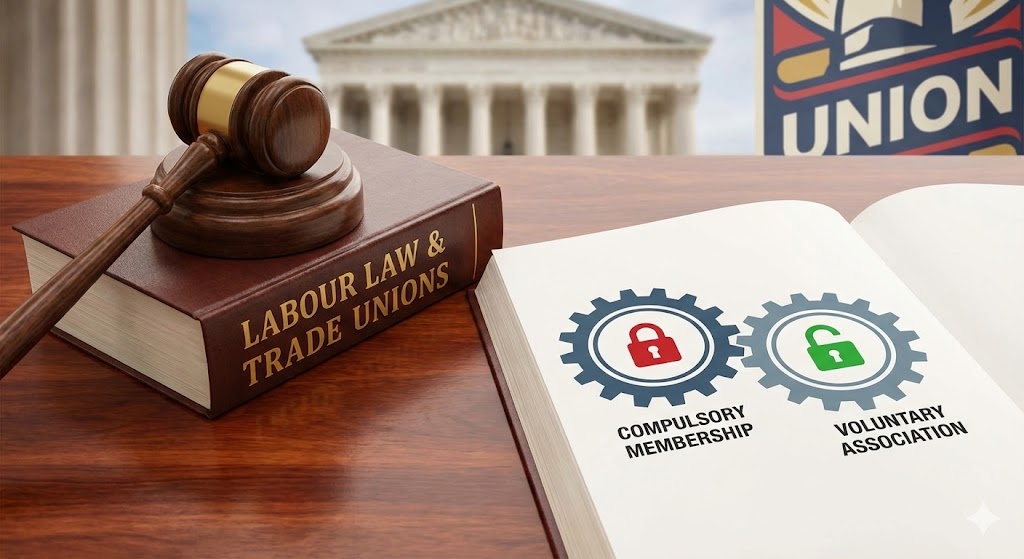
Introduction To Trade Unions and Compulsory Membership
At dawn, Musa opened his stall at the popular Oja-Oba market, unaware that his refusal to join the traders’ association would soon cost him his livelihood. By noon, association officials arrived with sticks and padlocks, accusing him of “disrespecting the union.” His wooden stall was pulled apart, goods scattered, and customers chased away. Musa was told bluntly: “Join us, or you cannot trade here.” No court order was shown. No lawful authority cited. Just force.
Scenes like this are not uncommon across Nigerian markets and informal commercial spaces. Traders, artisans, and small business owners are often compelled to join unions or associations under threat of harassment, economic exclusion, or outright destruction of property. This raises critical legal questions: Can trade unions or associations lawfully compel membership? Does freedom of association permit coercion? And are violent or destructive enforcement measures legally justifiable? This article examines these questions within Nigeria’s constitutional, statutory, and judicial framework. This article seeks to analyse the legality or otherwise of compulsory union or association membership, particularly where enforced through intimidation or destruction of property, with reference to relevant Nigerian statutes and decided cases.
Freedom of Association Under Nigerian Law(Trade Unions)
Constitutional Foundation
The right to freedom of association is constitutionally guaranteed under section 40 of the Constitution of the Federal Republic of Nigeria 1999 (as amended), which provides that:
“Every person shall be entitled to assemble freely and associate with other persons, and in particular he may form or belong to any political party, trade union or any other association for the protection of his interests.”
Nigerian courts have consistently interpreted this provision to include both the right to associate and the right not to associate. Compulsory association negates the voluntary nature inherent in constitutional freedom.
In Independent National Electoral Commission v. Musa, the Supreme Court affirmed that constitutional freedoms must be interpreted liberally to promote liberty rather than restrict it. This interpretative approach applies equally to freedom of association.
Trade Unions and Voluntary Membership
Trade Unions Act
The Trade Unions Act explicitly prohibits compulsory membership. Section 12(4) provides:
“Notwithstanding anything to the contrary in this Act, membership of a trade union by employees shall be voluntary, and no employee shall be forced to join any trade union or be victimised for refusing to join or remain a member.”
This provision makes it unequivocally clear that forced unionism is illegal. Any union action aimed at compelling membership whether through threats, intimidation, or economic sanctions is unlawful.
In Osawe v. Registrar of Trade Unions, the Supreme Court held that individuals cannot be forced into union membership against their will and emphasised the voluntary nature of trade unionism under Nigerian law.
Market Associations and the Limits of Authority
Associations Distinguished from Trade Unions
While trade unions are statutorily regulated, many market associations operate as voluntary social or commercial groups. However, they derive no coercive authority from law to compel membership or regulate trade by force.
In Mojekwu v. Iwuchukwu, the Supreme Court reaffirmed that customary or associative practices cannot override constitutional rights. Thus, even long-standing market customs cannot justify compulsory membership where constitutional freedoms are infringed.
Illegality of Coercive Enforcement Measures (Trade Unions)
Destruction of Property and Intimidation
Acts such as sealing shops, destroying stalls, or preventing access to markets amount to criminal and civil wrongs, irrespective of the actor’s status as a union or association.
Under the Criminal Code, wilful destruction of property constitutes an offence. Such acts also ground civil liability for trespass and nuisance.
In A.G. Oyo State v. Nigeria Labour Congress, the Court of Appeal held that even lawful strikes or union actions must be conducted peacefully and within the confines of the law; violence or destruction invalidates any claim of legitimacy.
Similarly, in National Union of Road Transport Workers v. Ogbodo, the court restrained union officials from harassing non-members and interfering with their lawful means of livelihood.
Victimisation and Unlawful Interference with Livelihood
Labour Act Protections
The Labour Act further reinforces freedom of association. Section 9(6) renders void any employment condition that compels union membership or penalises non-membership. Though primarily applicable to employment relationships, the principle applies broadly to protect economic freedom.
In Petroleum and Natural Gas Senior Staff Association of Nigeria v. Schlumberger Anadrill Nig. Ltd, the court held that workers could not be coerced into union activities or punished for opting out.
Fundamental Rights Enforcement
Victims of coercive association practices may seek redress under section 46 of the Constitution, which empowers High Courts to enforce fundamental rights.
In Uzoukwu v. Ezeonu II, the Court of Appeal affirmed that any conduct which interferes with personal liberty or freedom of association may be challenged through fundamental rights proceedings.
Civil Remedies and Injunctive Relief
Courts have consistently granted injunctions restraining unions or associations from unlawful interference.
In SSANU v. Federal Government of Nigeria, the court restrained union excesses that went beyond lawful advocacy into coercion. This principle applies equally to market associations engaging in unlawful enforcement.
Conclusion
While trade unions and market associations serve important collective functions, Nigerian law draws a firm line between voluntary association and unlawful coercion. The Constitution guarantees freedom of association, the Trade Unions Act mandates voluntary membership, and Nigerian courts have repeatedly condemned victimisation, intimidation, and destruction of property as unlawful. Any union or association that compels membership or enforces compliance through violence acts outside the law and exposes itself to criminal prosecution, civil liability, and constitutional sanctions. In a constitutional democracy, no group however powerful, may substitute force for law.
CONTRIBUTORS

Lead Partner, Eko Solicitors & Advocates

Counsel EKO SOLICITORS AND ADVOCATES

Graduate Trainee, EKO SOLICITORS & ADVOCATES