

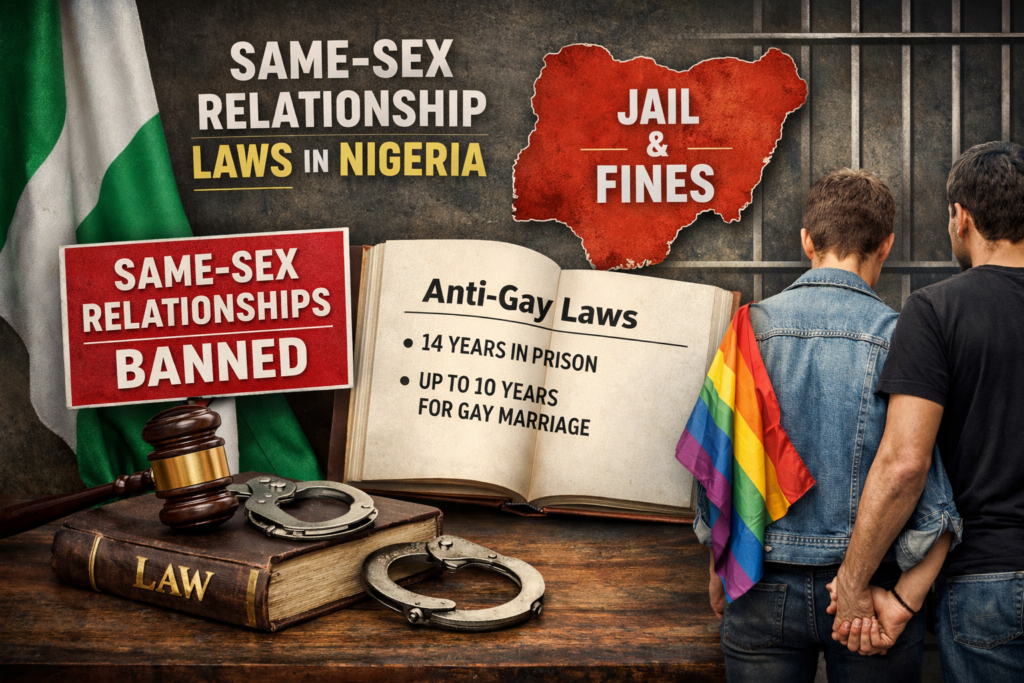
Introduction to same-sex relationship Laws
Victor(an alias) participated in a controversial and confidential talk show where confided in the host of the program. He stated that he felt unsafe simply because of who he was. He wasn’t asking for special treatment. Victor wasn’t demanding a parade. He just wanted to live quietly without fear. It felt like the whole society was against him because of his sexual orientation.
In Nigeria, conversations about sexuality are often whispered, avoided, or fiercely debated. The topic of Same-Sex Relationship Laws in Nigeria is not just legal. It has deep social, cultural, religious, and political implications.
This article explains the legal framework governing same-sex relationships in Nigeria, explores constitutional and human rights arguments, and examines the ongoing public debate.
Historical Background of Same-Sex Relationship Laws in Nigeria
Nigeria’s firm stance on same-sex relationships didn’t just start in 2014 with the Same-Sex Marriage Prohibition Act (SSMPA). It can be traced back to colonial era criminal laws.
Under the Criminal Code, which is applicable in southern Nigeria, “carnal knowledge against the order of nature” is criminalised. Similarly, the Penal Code Act, which is applicable in the northern states of Nigeria provides similar provisions.
These laws were introduced during British colonial rule and reflect Victorian-era moral standards rather than indigenous Nigerian customary law. Before 2014, same-sex conduct was already punishable under these statutes. However, the law became significantly stricter with new legislation that was passed.
Same-sex relationship law: The Same-Sex Marriage (Prohibition) Act 2014
The same-sex marriage prohibition act brought a bigger crackdown on such relationships. The Act expanded the scope beyond just the act to marriage and subsequently association and public expression. The Act contains key provisions such as:
- Prohibits marriage or civil union between persons of the same sex.
- Criminalises the registration, operation, or participation in gay clubs, societies, and organisations.
- Penalises public displays of same-sex amorous relationships.
- Provides penalties of up to 14 years imprisonment for entering into a same-sex marriage.
- Provides up to 10 years imprisonment for participation in or support of LGBTQ+ organisations
Constitutional Framework and Fundamental Rights
Nigeria operates under the Constitution of the Federal Republic of Nigeria, which guarantees fundamental rights under Chapter IV.
These rights include:
- Right to life (Section 33)
- The Right to dignity of the human person (Section 34)
- Right to personal liberty (Section 35)
- The Right to private and family life (Section 37)
- Freedom of thought, conscience and religion (Section 38)
- The Freedom of expression (Section 39)
- Freedom of association (Section 40)
Critics have argued that the SSMPA conflicts with rights to privacy and association. While supporters argue that section 45 of the Constitution permits law reasonably justifiable in a democratic society for reasons of morality, public order and health.
International Human Rights Obligations
Nigeria is a signatory to several international human rights treaties, including:
- The African Charter on Human and Peoples’ Rights
- The International Covenant on Civil and Political Rights
The African Charter, domesticated in Nigeria, guarantees rights to dignity, equality, and freedom from discrimination.
It is argued by human right advocates that criminalisation of same-sex relationships contradicts these obligations.
However, Nigeria maintains that its domestic law reflects its cultural and moral values.
This creates tension between international expectations and national sovereignty.
Final thoughts on same-sex relationship laws
The bone of contention behind Same-Sex Relationship Laws in Nigeria is not just about statutes. It is about identity, belief, culture, and law intersecting in complex ways. For some Nigerians, the law reflects moral conviction.
For others, it represents exclusion and fear. As society evolves, so too may legal interpretation hence the conversation is far from over.
Contributors

OJIENOH SEGUN JUSTICE, ESQ.,
Lead Partner, EKO SOLICITORS AND ADVOCATES

Faith Ogunleye
Graduate Trainee, EKO SOLICITORS AND ADVOCATES