

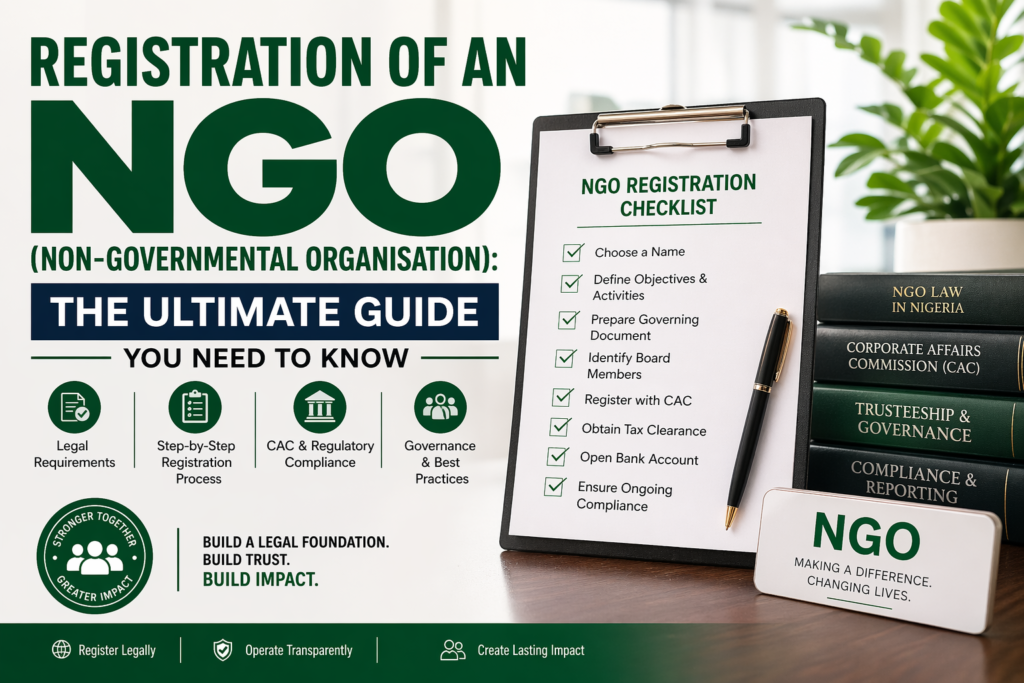
Introduction to registration of an NGO
Non-Governmental Organisations (NGOs) play a vital role in addressing social, environmental, and humanitarian challenges in Nigeria. From supporting education and healthcare to advocating for human rights, NGOs contribute significantly to national development. However, many individuals and groups begin charitable activities without formally registering their organisation. While the intention may be noble, failure to comply with legal requirements can lead to serious consequences.
This article provides a step-by-step guide to registering an NGO in Nigeria, as well as the implications of operating without formal registration.
WHAT IS THE REGISTRATION OF AN NGO UNDER NIGERIAN LAW?
In Nigeria, what is commonly referred to as a Non-Governmental Orangisations(NGO) is legally recognised as an Incorporated Trustee under the Companies and Allied Matters Act (CAMA). An organisation is classified as an Incorporated Trustee when it follows under the following;
I. Charitable organisations
II. Religious bodies
III. Foundations
IV. Associations and clubs
Registration is handled by the Corporate Affairs Commission (CAC), which regulates corporate entities in Nigeria.
THE DOCTRINE OF CORPORATE PERSONALITY
The legal foundation of NGO registration lies in the doctrine of separate legal personality, firmly established in the landmark decision of Salomon v A Salomon & Co Ltd(1897). In this case, the House of Lords held that a duly incorporated entity is distinct from its members, even where one individual effectively controls the organisation.
Legal Implications
The doctrine establishes that:
• The organisation has an independent legal identity
• It can own property in its own name
• It can sue and be sued
• Members and trustees enjoy limited liability
The above legal implications are also enjoyed by a Non- Governmental Organisation(NGO) which is an incorporated trustee.
STEP-BY-STEP GUIDE TO THE REGISTRATION OF AN NGO IN NIGERIA
1: Choose a Unique Name
The first step is selecting a suitable name for your NGO.
• The name must not be identical or similar to an existing organisation
• It should reflect the mission or objective of the NGO
• Avoid restricted words unless special approval is obtained
You will then conduct a name availability search on the CAC portal.
2: Reserve the Name (REGISTRATION OF AN NGO)
Once a suitable name is found:
• Apply for name reservation through the CAC online portal
• Pay the prescribed fee
• Wait for approval (usually within a few days)
Approval confirms that the name is available for registration.
3: Prepare the Constitution
Every NGO must have a constitution, which serves as its governing document.
It should include:
• Name and objectives of the organisation
• Membership rules
• Appointment and removal of trustees
• Meeting procedures
• Financial management and auditing provisions
This document is crucial, as it defines how the NGO will operate.
4: Appoint Trustees (REGISTRATION OF AN NGO)
You must appoint at least two trustees.
Requirements to be a trustee;
• Trustees must be adults (18 years and above)
• They should be persons of integrity
• They must not have been convicted of fraud or dishonesty
• They must be of sound mind
The trustees are responsible for managing the NGO’s affairs.
5: Prepare Trustee Documentation
Each trustee must provide:
• Valid means of identification( e.g Voter’s card, NIN, Passport e.t.c)
• Passport photograph
• Signature
You will also need a formal declaration (sworn affidavit) confirming their willingness to act as trustees.
6: Publish a Public Notice
A mandatory requirement is to publish a notice of your intention to register the NGO.
• The notice must be placed in two newspapers
• One must be a national daily
• The other should be a local newspaper
This allows the public to raise objections, if any.
7: Complete CAC Application (REGISTRATION OF AN NGO)
Submit your application through the CAC portal.
Required documents include:
• Approved name
• NGO constitution
• Trustee details
• Newspaper publications
• Means of identification
You will also pay the official filing fees.
8: Await CAC Approval
The CAC reviews the application to ensure compliance with the law.
If satisfied:
• A Certificate of Incorporation is issued
• The NGO becomes a legal entity
9: Post-Registration Compliance
After registration, the NGO must:
• Keep proper financial records
• File annual returns with CAC
• Operate strictly within its stated objectives
Failure to comply may result in penalties or deregistration.
IMPLICATIONS OF OPERATING AN NGO WITHOUT REGISTRATION
Operating without registration may seem easier initially, but it carries significant legal and practical risks which include;
1. Lack of Legal Recognition
An unregistered NGO:
• Has no legal identity
• Cannot sue or be sued in its own name
• Cannot own property legally
This limits its ability to function effectively.
2. Inability to Open a Corporate Bank Account
Banks typically require CAC registration documents.
Without registration:
• Funds may have to be held in personal accounts
• This creates accountability and trust issues
3. Risk of Government Sanctions
Authorities may:
• Shut down the organisation
• Investigate its activities
• Impose fines or legal action
This is especially likely where funds are involved.
4. Loss of Public Trust (REGISTRATION OF AN NGO)
Donors, partners, and international organisations prefer registered entities.
An unregistered NGO may:
• Struggle to attract funding
• Be perceived as fraudulent or informal
5. Personal Liability of Members
Without incorporation:
• Members and founders may be personally liable for debts and obligations
• There is no legal separation between the organisation and individuals
6. Limited Access to Grants and Partnerships
Most grant-making bodies require:
• Proof of legal registration
• Compliance documentation
Operating informally shuts the door to these opportunities.
LEGAL FRAMEWORK GOVERNING THE REGISTRATION OF AN NGO IN NIGERIA
The registration and regulation of NGOs are governed by the Companies and Allied Matters Act (CAMA) 2020.
Key Statutory Provisions
• Section 823 – Registration of Incorporated Trustees
• S. 824 – Permitted objectives (charitable, educational, religious, etc.)
• Section 826 – Application requirements
• S. 830 – Mandatory publication of notice
• Section 831 – Consideration of objections
• S. 845 – Filing of annual returns
The regulatory authority is the Corporate Affairs Commission (CAC).
CONCLUSION
Registering an NGO in Nigeria is not merely a procedural formality it is a legal necessity that ensures credibility, accountability, and sustainability. While the process may appear detailed, it is straightforward when approached step by step. More importantly, the benefits of registration far outweigh the risks of operating informally. For anyone seeking to make a lasting social impact, formal registration with the Corporate Affairs Commission under the Companies and Allied Matters Act (CAMA) is the most secure and professional path forward.
Note: Readers are advised to seek professional legal advice for detailed guidance tailored to their specific circumstances.
Reference
Companies and Allied Matters Act 2020
Salomon v A Salomon & Co Ltd [1897] AC 22 (HL)
Contributors

OJIENOH SEGUN JUSTICE, ESQ.,
Lead Partner, EKO SOLICITORS AND ADVOCATES

Counsel EKO SOLICITORS AND ADVOCATES

Itsede Emoshioke Victory
Graduate Trainee, EKO SOLICITORS AND ADVOCATES