

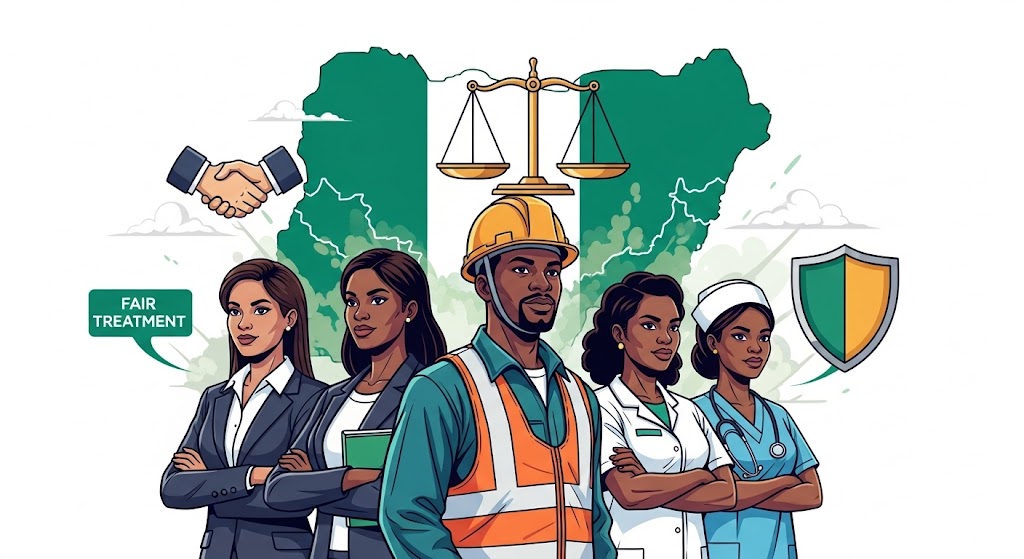
Understanding employee rights in Nigeria is essential for every worker, regardless of industry or position. Many workplace abuses happen simply because employees do not know their rights. Nigerian Labour Law and courts, especially the National Industrial Court (NICN) have increasingly strengthened employee protections on issues like fair wages, safe conditions, discrimination, and termination. This article explains employee rights under Nigerian Labour Law so that every worker knows what the law says and how to enforce their rights.
Specific Employee Rights In Nigeria Every Worker Should Know
Employees in Nigeria are entitled to a range of rights designed to protect their welfare, dignity, and economic security in the workplace. These rights are enshrined in the Labour Act, the Constitution, and other relevant labour regulations. Some of these rights are explained in the following paragraphs:
Employee Rights In Nigeria to a Written Employment Contract
One of the most important employee rights under Nigerian Labour Law is the right to a written employment contract. Section 7 of the Labour Act requires employers to issue a written statement of employment terms within three months of work engagement. This document must contain details such as job description, salary, working hours, and notice period.
A written contract protects employees from exploitation and confusion. Without it, disputes about employee rights under Nigerian Labour Law become harder to prove. In the case of Mr. Godwin Uemgba v. FCMB1, it was the decision of the NICN that employers who fail to issue written terms create uncertainty that must be interpreted in favour of the employee. This decision of the court supports employee rights under Nigerian Labour Law because workers should not suffer for the employer’s failure.
This equally presupposes that if an employer fails to issue a written employment contract, the employee should request for one and keep a copy of their employment contract for their own protection.
Employee Rights In Nigeria to Fair Wages and Timely Payment
Another key employee right under Nigerian Labour Law is the right to fair and timely payment of wages. The law requires employers to pay workers their salaries as agreed and prohibits unlawful or illegal deductions.
Pursuant to Section 15 of the Labour Act, an employee should be paid in time. The section provides,
Wages shall become due and payable at the end of each period for which the contract
is expressed to subsist, that is to say, daily, weekly or at such other period as may be
agreed upon:
Provided that, where the period is more than one month, the wages shall become
due and payable at intervals not exceeding one month.
Accordingly, Section 9 of the National Minimum Wage Act providesthat an employer should not pay lower than the nationa minimum wage.
Nigerian courts have consistently held that withholding salaries violates employee rights under Nigerian Labour Law, except where the law allows deductions or disciplinary measures. For instance, in the case of Francis Adetayo v Zenith Bank Plc (NICN/LA/164/2016), the NICN ruled that employers cannot withhold salaries without a valid reason. The court in this suit, ordered the employer to pay all outstanding wages.
Hence, it’s the law in Nigeria that workers must be paid for the work they have legally performed and not be deprived of same.
Right to Safe and Healthy Working Conditions
A safe workplace is part of employee rights under Nigerian Labour Law. This is traceable to the common law duty of care of the employer. These duties are personal and non-delegable, as confirmed in Wilson & Clyde Coal v English.2 It includes the right to proper safety equipment, safe work tools, and a hazard-free environment. Employers must take steps to fulfil these duties to protect the rights of employees and protect workers from accidents and occupational diseases.
Where an employer fails to provide safety measures, employees can enforce their employee rights under Nigerian Labour Law by reporting to the appropriate regulatory bodies or seeking compensation for workplace injuries.
Employers are legally obligated to ensure workers’ welfare and safety. The NICN in Ibrahim v Ecobank (NICN/LA/406/2013), the court held that employers must take reasonable steps to protect their workers from harm. The employee in this suit received compensation for the injury suffered due to the inability of the employer to provide a safe working environment for the employee.
Right to Annual Leave, Sick Leave, and Maternity Protection
Annual Leave
Leave entitlement is part of employee rights under Nigerian Labour Law. Workers are entitled to annual leave. The Labour Act provides at least six days annual leave for workers, with additional benefits for longer service.
Maternity/Paternity Leave
For female workers, employee rights under Nigerian Labour Law include maternity leave of at least 12 weeks, with no discrimination or dismissal because of pregnancy. Section 54 of the Labour Act makes provision for maternity protection. Female employees expect to be entitled to at least 12 weeks maternity leave with full pay.
Male employees may also expect paternity leave. Unfortunately, the Nigerian Labour Act does not recognise paternity leave and makes no such provisions. However, in Lagos State, civil servants are entitled to 10 days paternity leave within the first 2 months of the birth of the baby.
A new development arose in 2022, the Nigerian Government announced via a circular dated 25th November 2022,3 the approval of paternity leave, which is 14 days for civil servants.
Workers are equally entitled to sick leave, though with the provision of a doctor’s report.
In Mrs. Bridget Onyebuchi vs. Stanqueen Nigeria Limited4, the NICN condemned the dismissal of a pregnant employee and awarded damages for discrimination. Pregnancy is not a valid reason for termination. Employers who violate these leave rights may be sanctioned under Nigerian Labour legislation.
Right to Notice Before Termination
Another employee right under Nigerian Labour Law is the right to notice before termination. Section 11 of the Labour Act sets out minimum notice periods depending on length of employment. If an employer terminates without notice, the worker must receive payment in lieu of notice.
Nigerian courts, as in Chukwumah v. Shell Petroleum5, have emphasised that failure to provide appropriate notice violates employees’ rights under Nigerian Labour Law and constitutes wrongful termination. Every worker must know their contract’s notice period to protect themselves. Equally, in Ebare Aloysius v. Diamond Bank Plc6, the court held that termination must follow due process and the provisions of the employment contract. Failure to give notice or pay in lieu constitutes wrongful termination.
While some older Supreme Court cases allowed employers wide discretion in termination, the case of Aloysius represents the NICN’s more progressive view that fairness and reasonableness must guide termination decisions.
Right to Freedom from Discrimination and Workplace Harassment
Employees have the right to work without discrimination based on gender, tribe, religion, or disability. Employee rights under Nigerian Labour Law protect workers from harassment, bullying, and unfair treatment. Employers must maintain a non-discriminatory workplace, and employees who face harassment can report to human rights bodies or file claims at the National Industrial Court. This is protected under Section 42 of the 1999 Constitution.
In Mrs Janet Udoh v Civil Service Commission7, the NICN held that discriminatory practices violate employee dignity and will attract judicial intervention. The court emphasises in this case that harassment and discrimination have no place in modern workplaces.
Protecting dignity at work is a central part of employee rights under Nigerian Labour Law, and organisations are legally required to address complaints promptly.
Right to Join Trade Unions
Workers have the right to join or form trade unions. This is a vital employee right under Nigerian Labour Law that gives employees collective bargaining power. Trade unions help workers negotiate better conditions, wages, and benefits. Employers cannot intimidate or punish employees for joining unions. Doing so violates employee rights under Nigerian Labour Law and may attract penalties under labour and industrial relations regulations.
The National Industrial Court, in the case of Petroleum and Natural Gas Senior Staff Association vs. Schlumberger8, held that unionisation is a fundamental right, and that any attempt by employers to frustrate it is unlawful.
Right to Rest Periods and Reasonable Working Hours
Rest Periods and reasonable working hours underpin healthy labour relations and are part of employee rights under Nigerian Labour Law. Section 13 of the Labour Act mandates reasonable working hours, rest periods, and overtime compensation. This is a core part of employee rights under Nigerian Labour Law, ensuring that employees are not overworked or subjected to unhealthy schedules.
In Rufus Olanrewaju v WAPCO Plc9, the National Industrial Court held that employees cannot be subjected to excessive hours without adequate compensation. The court stressed that fatigue increases the risk of accidents.
Right to Pension and Social Security Contributions
Workers are entitled to pension contributions under the Pension Reform Act 2014. This law reinforces employee rights under Nigerian Labour Law by ensuring long-term financial security. Employers must remit both employer and employee pension contributions monthly.
The right to pension for public servants is constitutional as it is provided for under Section 173 of the Constitution.
Failure to remit pensions is a serious violation of employee rights under Nigerian Labour Law and may lead to sanctions by the National Pension Commission (PENCOM). Employees should monitor their pension accounts regularly to ensure compliance.
Where to Seek Redress?
The ability to seek justice is the backbone of employee rights under Nigerian Labour Law. The National Industrial Court is the primary court for employment disputes. Cases like Aloysius v. Diamond Bank, Onyebuchi v. Stanqueen, and Udemgba v. FCMB all demonstrate that workers can successfully enforce their rights.
The Court has a reputation for being more employee-friendly and human rights–focused in interpreting employee rights under Nigerian Labour Law.
Conclusion On Employee Rights In Nigeria
Understanding employee rights under Nigerian Labour Law is the first step toward building a fair, safe, and productive workplace. Workers must know their rights to avoid exploitation, and employers must comply with the law to maintain healthy employment relationships. Whether it is the right to fair wages, safe working conditions, leave entitlements, or notice before termination, these protections strengthen the Nigerian workforce.
- NICN/LA/329/2013 ↩︎
- [1938] AC 57 ↩︎
- ref no: HCSF/SPSO/ODD/NCE/RR/650309/3 ↩︎
- NICN/LA/181/2016 ↩︎
- [1993] 4 NWLR (Pt.289) 512 SC ↩︎
- [2015] 59 NLLR (Pt. 119) 92 at 105 ↩︎
- (2013) LPELR-21849(CA) ↩︎
- [2008] 11 NLLR (Pt 29) 164 ↩︎
- NICN/JOS/11/2016 ↩︎

OJIENOH SEGUN JUSTICE, ESQ.,
Lead Partner, EKO SOLICITORS AND ADVOCATES

Bessie Obort Ofuka
Graduate Intern, EKO SOLICITORS AND ADVOCATES

Salawa Abike Sule-Azeez
Counsel, EKO SOLICITORS AND ADVOCATES
Employee rights in Nigeria, Employee rights in Nigeria, Employee rights in Nigeria , Employee rights in Nigeria, Employee rights in Nigeria.
#toplawfirminlagos #toplawfirminnigeria #labourlaw