

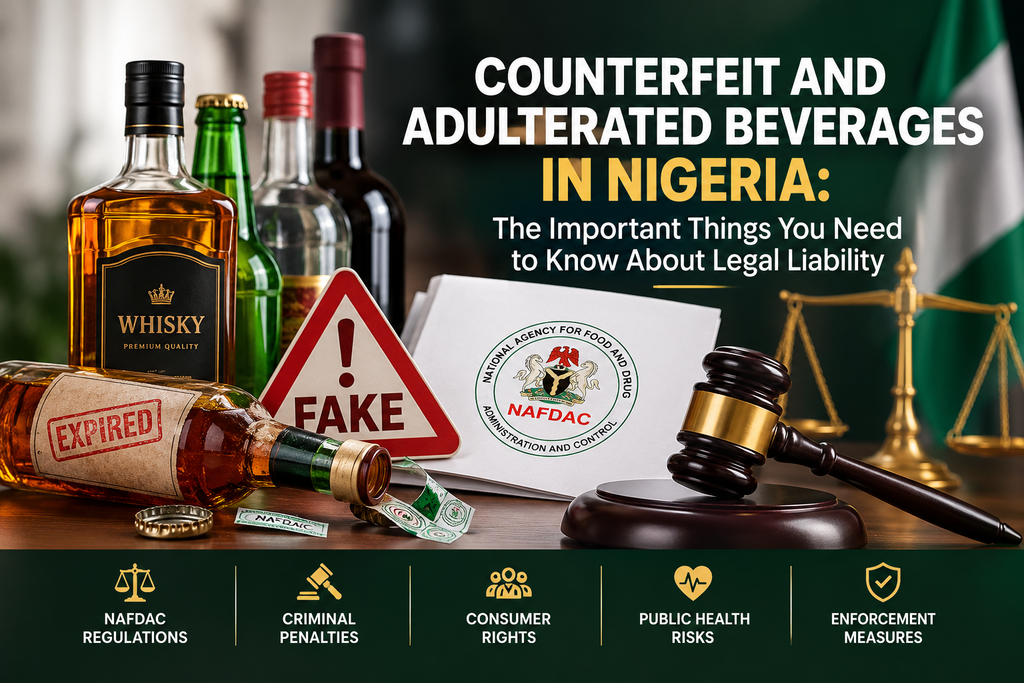
INTRODUCTION to counterfeit and adulterated beverages
What happens when the very products consumers trust to be safe become potential threats to their lives? What happens when expiry dates are deliberately altered and products that should have been withdrawn from circulation are prepared for resale? These questions are no longer hypothetical, as the circulation of counterfeit and adulterated alcoholic beverages poses a serious threat to public health in Nigeria.
The recent seizure of expired alcohol and other illegal products reportedly valued at ₦2 billion by the National Agency for Food and Drug Administration and Control (NAFDAC) has raised concerns about consumer protection and regulatory enforcement.
According to NAFDAC, the operators allegedly purchased expired drinks from bars and clubs, sometimes with the assistance of bartenders, and resold the products through arrangements with bar and nightclub managers.
The incident raises important legal questions concerning the responsibility of those who manufacture, distribute and sell unsafe products. It also exposes the vulnerability of consumers who rely on manufacturers and regulatory authorities to ensure that products available in the market are genuine and safe.
The Legal Framework Governing Counterfeit and Adulterated Beverages in Nigeria
Nigeria has enacted several laws to regulate consumable products and protect consumers against unsafe goods.
Section 5 of the National Agency for Food and Drug Administration and Control Act (NAFDAC Act) establishes the statutory foundation for the Agency’s regulatory functions concerning products within its mandate. The alleged recycling and deceptive relabelling of expired alcoholic beverages raise concerns about compliance with this regulatory framework.
Section 25 of the NAFDAC Act addresses offences and penalties, including specified contraventions of applicable regulatory requirements. The Act also provides for circumstances in which officers of corporate bodies may incur liability.
Section 1 of the Counterfeit and Fake Drugs and Unwholesome Processed Foods (Miscellaneous Provisions) Act prohibits specified activities involving counterfeit, adulterated, banned, fake, substandard or expired drugs and unwholesome processed foods. Its application to particular alcoholic beverages depends on the statutory scope and definitions.
The Federal Competition and Consumer Protection Act 2018 also protects consumers against unsafe goods and unfair commercial practices. Section 123 prohibits misleading and deceptive representations concerning goods and services. Section 131 addresses consumers’ entitlement to goods reasonably suitable for their intended purposes, while Section 134 requires manufacturers, importers and distributors to label goods in a manner that facilitates traceability.
Furthermore, Section 243 of the Criminal Code Act addresses the sale or possession for sale of noxious or unfit food or drink where the relevant knowledge or intention exists. In jurisdictions where the Penal Code applies, Sections 180 and 181 address specified forms of food or drink adulteration.
These provisions demonstrate that Nigerian law provides mechanisms for addressing the circulation of unsafe products. However, their effectiveness depends on proper investigation, enforcement and prosecution.
Criminal Liability of Producers, Blenders and Refillers
The first category of potential offenders comprises individuals who allegedly collect used bottles, refill them with different substances, alter expiry dates or apply labels that falsely represent their contents as genuine products.
Where the evidence establishes the relevant statutory elements, these activities may attract liability under applicable provisions of the NAFDAC Act and the Counterfeit and Fake Drugs and Unwholesome Processed Foods (Miscellaneous Provisions) Act.
The deliberate presentation of adulterated or expired beverages as genuine products may also raise issues under Section 243 of the Criminal Code Act where the requirements for an offence involving noxious or unfit drink are satisfied.
The seriousness of such conduct lies in its potential to expose consumers to substances whose composition, quality and safety cannot be verified. A person who knowingly introduces harmful beverages into the market may face criminal consequences under applicable legislation.
However, liability must be determined based on evidence establishing the accused person’s conduct and the elements of the relevant offence. The discovery of counterfeit products at a facility does not automatically establish the guilt of every person associated with its operations.
Liability of Suppliers, Distributors, Retailers and Corporate Officers COUNTERFEIT AND ADULTERATED BEVERAGES
Criminal responsibility may extend beyond those who manufacture or refill counterfeit beverages.
Suppliers of bottles, caps, labels and regulatory marks: Individuals who knowingly provide materials specifically for an established counterfeiting operation may face liability where their conduct falls within applicable statutory prohibitions. However, supplying packaging materials is not automatically a criminal offence; the circumstances and the supplier’s involvement must be established.
Distributors, wholesalers and retailers: Individuals who knowingly sell or distribute prohibited counterfeit, adulterated or expired products may incur liability under applicable legislation. Bars, nightclubs and retailers should obtain beverages from reliable suppliers and exercise appropriate care when purchasing products.
Companies and their directors or managers: Corporate involvement does not necessarily exclude personal responsibility. Section 25(4) of the NAFDAC Act addresses circumstances in which an offence committed by a body corporate is attributable to the consent, connivance or neglect of a director, manager, secretary or another relevant officer.
Similarly, Section 3(2) of the Counterfeit and Fake Drugs and Unwholesome Processed Foods (Miscellaneous Provisions) Act contains provisions concerning specified officers, servants and agents of corporate bodies.
Accordingly, individuals who knowingly facilitate or participate in unlawful activities may face consequences where the applicable legal requirements are satisfied.
Counterfeit NAFDAC Stamps, Consumer Rights and Public Health Implications counterfeit and adulterated beverages
The alleged manufacture or use of counterfeit NAFDAC stamps raises additional concerns about forgery, fraud and the deliberate misrepresentation of product approval.
Where operators use false registration details or counterfeit regulatory marks to make beverages appear genuine or approved, their conduct may attract further criminal consequences. Section 467 of the Criminal Code Act contains provisions relating to forgery, although its application depends on the nature of the mark or document and the circumstances of the alleged offence.
The public health implications are equally serious. Contaminated beverages may cause acute poisoning, organ damage, blindness and death, depending on the substances involved and the level of exposure.
Nigeria has experienced outbreaks associated with contaminated alcoholic beverages. In 2015, an outbreak in Rivers State was linked to contaminated local gin, with severe methanol poisoning reported. The Ode-Irele outbreak in Ondo State in 2015 also highlighted the dangers of consuming contaminated locally brewed gin.
Reports of methanol poisoning in Ondo State in 2026 further emphasise the potential consequences of consuming contaminated alcoholic and herbal beverages.
Alcohol consumption itself is associated with increased risks of several cancers, including cancers of the oral cavity, pharynx, larynx, oesophagus, liver and female breast. Research published in Frontiers in Oncology in 2017, titled Cancers Attributable to Alcohol Consumption in Nigeria (2012–2014), estimated that 186 of 4,336 recorded cancer cases examined in the study were attributable to alcohol consumption.
These incidents demonstrate that beverage adulteration is not merely commercial dishonesty. It is a public-safety concern that can cause irreversible injury and loss of life.
Regulatory Enforcement, Legal Consequences and the Protection of Consumers in Nigeria
Although Nigerian law provides a framework for regulating beverages and addressing specified forms of counterfeiting and adulteration, effective protection requires consistent enforcement.
The seizure of illegal products is an important first step, but it does not, by itself, establish criminal responsibility or guarantee that offenders will be punished. Regulatory authorities must investigate the alleged offences, preserve evidence, identify those responsible and pursue appropriate legal proceedings.
Where the evidence supports criminal charges, prosecution should proceed in accordance with the applicable law. Convictions and sentences must be based on admissible evidence and proof of the relevant offences.
Enforcement should also include regular inspections, monitoring of products in circulation, investigation of suspicious supply chains and appropriate sanctions for proven violations.
Consumers have a legitimate interest in purchasing goods that are safe, properly labelled and reasonably suitable for their intended purposes. The Federal Competition and Consumer Protection Act 2018 provides protections against unsafe goods and misleading commercial practices.
However, consumers should not bear the entire burden of identifying sophisticated counterfeiting operations. Regulatory authorities, manufacturers, distributors and retailers must work together to improve product traceability and prevent expired or adulterated beverages from returning to circulation.
Conclusion
The reported ₦2 billion seizure at Zamfara Plaza, Lagos Trade fair Complex goes beyond a single raid. It raises serious questions about consumer safety, criminal responsibility and the effectiveness of Nigeria’s regulatory system.
A consumer may be unable to distinguish a genuine bottle from one that has been refilled with an unknown substance. Counterfeiters exploit this vulnerability, placing unsuspecting members of the public at risk.
Although Nigerian law provides mechanisms for regulating beverages and punishing specified forms of counterfeiting and adulteration, the practical value of these laws depends on effective investigation, prosecution and enforcement.
The seizure may remove today’s danger, but it will not necessarily deter tomorrow’s offender. Protecting consumers requires more than raids that attract public attention. It requires sustained regulatory oversight, transparent enforcement and accountability for those whose proven conduct endangers human life.
CONTRIBUTORS

OJIENOH SEGUN JUSTICE, ESQ.,
LEAD PARTNER, EKO SOLICITORS AND ADVOCATES

SALAMI HABEEBAH OLASHILE
GRADUATE TRAINEE, EKO SOLICITORS AND ADVOCATES
COUNTERFEIT AND ADULTERATED BEVERAGES ,COUNTERFEIT AND ADULTERATED BEVERAGES ,COUNTERFEIT AND ADULTERATED BEVERAGES ,COUNTERFEIT AND ADULTERATED BEVERAGES ,COUNTERFEIT AND ADULTERATED BEVERAGES ,COUNTERFEIT AND ADULTERATED BEVERAGES