

Introduction
Copyright is a legal right granted to creators of original works. Including literary, musical, artistic, and audiovisual works, giving them exclusive rights to use and distribute their creations.In Nigeria, your creative work is automatically protected by copyright as soon as you bring it into existence and put it into a tangible form However, voluntary registration with the Nigerian Copyright Commission (NCC) provides evidentiary value in case of any infringement. This article outlines the procedure for registering your copyright in Nigeria.
In Nigeria’s vibrant creative landscape which is brimming with authors, musicians, filmmakers, software developers, and artists, always protecting your intellectual property is paramount. While copyright protection arises automatically the moment an original work is fixed in a tangible medium (written down, recorded, saved digitally, etc.), However, a formal registration with the Nigerian Copyright Commission (NCC) provides crucial legal advantage for the beneficiary.
It serves as prima facie evidence of ownership, simplifies enforcement against infringement, and is often essential for commercial transactions. Copyright in Nigeria is governed by the Copyright Act, Cap C28, and Laws of the Federation of Nigeria 2004 (as amended). The Nigerian Copyright Commission (NCC) is the regulatory body responsible for the administration and enforcement of copyright laws in the country.
Why Register Your Copyright?
Although not mandatory, registering your copyright offers several advantages such as Public record of your ownership, Prima facie evidence in court of the validity of the work, Proof of date of creation, Ease in enforcement of rights and licensing. Here’s how to navigate the registration process.
Step 1
Understand What Can Be Registered
According to Section 1(1) & (2) of the Copyright Amendment Act 2022, explicitly lists the categories of works eligible for copyright protection in Nigeria. These include literary works, Musical works, Artistic works, Cinematograph films, Sound recordings, Broadcasts. Also Section 26(1) extends protection to performances by performers. Section 28 provides sui generis protection for expressions of folklore. The Act implicitly covers computer programs under “literary works”. Furthermore Section 51 defines “literary work” to include “computer programs”.
Step 2
Determine Your Eligibility
In Section 2 of the Copyright Amendment Act 2022, stipulates that copyright is vested initially in the author. Section 10 addresses works created in the course of employment (“work-for-hire”), where the employer is the first owner, subject to any agreement. Section 1(2) (a) requires that a work must be sufficiently original to qualify for copyright protection.
This is interpreted as requiring independent creation involving a minimal degree of creativity, not novelty. Furthermore Section 1(2)(b) requires that the work must be “fixed in any definite medium of expression now known or later to be developed, from which it can be perceived, reproduced or otherwise communicated either directly or with the aid of any machine or device.” Copyright does not protect mere ideas.
READ ALSO: COPYRIGHT OWNERSHIP IN NIGERIA’S MUSIC INDUSTRY: ARTIST Vs RECORD LABEL RIGHTS.
Step 3:
Prepare the Required Documents
Gather the following documents, which is the official NCC Copyright Registration Form (Form CO1). You can download it from the NCC website https://copyright.gov.ng](https://copyright.gov.ng or get a physical copy from any NCC State Office, alongside it is Two (2) Copies of the Work, These are your deposit copies, they could include Literary, Musical, Artistic Works which are Printed copies or digital copies on CD/DVD/USB clearly labeled.
Also Sound Recordings/Films could be in form of CD, DVD, or USB containing the audio/video file. Also Computer Programs, Source code and object code on CD/DVD/USB, plus significant portions of the program listing. It is pertinent to ensure copies are clear and complete. Also Section 38(2) explicitly states that “An application under subsection (1) of this section shall be accompanied by two copies of the work in respect of which registration is applied for and such other particulars as may be prescribed by regulations.
Step 4
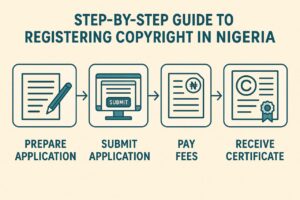
Submit Your Application
Section 38(1) states an application for registration of a work under this Act shall be made to the Commission in such manner as may be prescribed by regulations. This can be done by two main options, which is Online Submission which is highly recommended, and Efficient and Physical Submission.
- Online Submission: visit the NCC Digital Copyright Administration (DCA) portal https://dcopyright.gov.ng](https://dcopyright.gov.ng and create an account fill out the online application form carefully, follow it up, by Uploading scanned copies of all required documents such as your ID, notarized declaration, assignment if applicable, etc. also Upload digital copies of the work and ensure they meet specifications, afterwards you may proceed to pay the application fee online securely via the provided payment gateway.
- Physical Submission: if you would love to go by submitting the application physically, you will need Visit the Nigerian Copyright Commission Headquarters situate in Abuja, and if your location is not proximal to Abuja, you can visit Nigerian Copyright Commission State Office in Nigeria for submission. While there, you are expected to submit two (2) complete hard copies of the application form and all supporting documents and submit the two (2) physical copies of the work, this is then usually followed by paying the application fee at the designated bank and includes the teller with your submission, or pay directly at the NCC office if possible.
Step 5
Pay the Application Fee
Section 38(3) of the Copyright Amendment Act 2022 explicitly states a prescribed fee shall be paid in respect of an application for registration of copyright under this section; the current non-refundable application fee is Ten Thousand Naira (₦10,000) per work, however it is pertinent to always confirm the latest fee on the NCC website or by contacting them directly before submission, as fees can change. Payment methods are typically specified for online, card or bank transfer via portal and physical payments can be done at the bank for deposit or cash at the office submissions. Keep proof of payment.
Step 6
Nigerian Copyright Commission Processing & Examination
The processing starts when upon receiving your complete application and fee, the Nigerian copyright commission will issue an acknowledgement slip where submission was made physically or by the author or owner would receive a notification where the application was made online. After this the Nigerian copyright commission examiners will review your application for completeness and check the work against their records for potential conflicts or prior registrations. They assess if the work meets the originality and fixation requirements. The NCC may contact you if they require clarification or additional documents, it usually advisable to respond promptly. If approved, your work proceeds to registration. Likewise If rejected, you will be notified of the reasons.
Step 7
Issuance of Certificate
Upon successful completion of the examination and approval, your work is entered into the official Copyright Register. A Copyright Certificate as in (Form CO4) is generated. You will be notified to collect the physical certificate. For online applications, you may be able to download a digital copy, but the physical certificate is usually still issued and may need collection or delivery arrangement. The certificate contains vital details like the registration number, title of work, author’s name, owner’s name, and date of registration.
Timeline and Important Considerations while registering your copyright
- Processing Time: While the Nigerian copyright commission aims for efficiency, processing can take several weeks to a few months, depending on workload, completeness of the application, and complexity of the work. Online submissions are generally faster.
- Validity: Registration provides evidence of ownership. The copyright itself lasts for the duration specified by law (typically the life of the author + 70 years for most works), not the registration certificate.
- Copyrighting your work is Not Mandatory, But Highly Advisable: Remember, copyright exists automatically. Registration strengthens your legal position immensely when proving ownership in disputes or licensing.
- Beware of Scams: Only deal directly with the NCC or its authorized offices/agents. Be wary of individuals or companies offering “fast-track” registration for exorbitant fees.
- Keep Records: Maintain copies of your application, deposit materials, payment receipt, and your certificate in a safe place.
- Updates: Inform the NCC of any significant changes in ownership (via an application for recordal of assignment).
Conclusion
Registering your copyright in Nigeria is a vital step in securing your creative investment and empowering you to leverage your work commercially and legally. By following these steps meticulously, preparing the correct documents, utilizing the online portal for efficiency, and paying the requisite fee, you can navigate the NCC process successfully. Protect your intellectual property– it’s the foundation of your creative legacy and economic potential.
CONTRIBUTORS

Managing Partner EKO SOLICITORS & ADVOCATES

Counsel EKO SOLICITORS & ADVOCATES
